
Animal-assisted Therapy
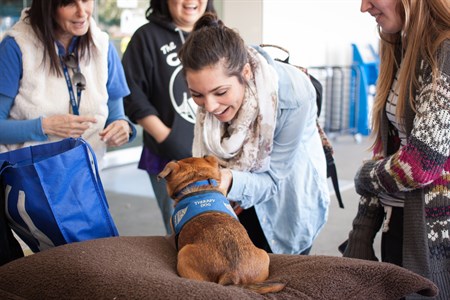
Depression, loneliness, stress and anxiety threaten the health of our society. Oftentimes, old age and rehabilitation foster the negative emotional, psychological and physical ailments that can take a damaging toll on our well-being. Prescription medications and psychiatrists work hard to provide the suffering with help, but sometimes a sloppy, wet kiss from a furry friend makes for good medicine as well.
While not considered to be a conventional healing method, animal-assisted therapy has proven to increase the health of those in agony and bring comfort to those in need.
“The Delta Society defines animal-assisted therapy as a goal-directed intervention in which an animal meets specific criteria as an integral part of the treatment process,” says Kit Darling, the Infection Control Coordinator for the Texas A&M College of Veterinary Medicine & Biomedical Sciences and owner of a certified therapy dog. “Animal-assisted therapy provides multiple benefits including fine and gross motor skills; verbal, tactile, and auditory stimulation; ambulation and equilibrium; decision making and instruction following; memory recall; and extended and concentrated attention span.”
With all of their abilities, it is clear that animals can provide an excellent service to humans. But how are these services positively affecting our health?
“People can benefit from human-animal interaction socially, psychologically and physically,” elaborates Darling. “Animals encourage social interaction with others, increase activity levels, strengthen motivation, and restore a sense of well-being. They also have the ability to decrease stress, anxiety and blood pressure levels.”
Animals are used in many settings and with many different people to better the health of hurting individuals. Kit Darling describes exactly how pets provide encouragement.
“Animal-assisted activities and animal-assisted therapy may be used in physical, occupational, recreational, and speech therapy settings,” explains Darling. “Animals do not judge people by their looks or disabilities. They simply want our attention. The pets that perform animal-assisted activities and therapy are anxious to meet people and bring a smile to someone’s face. Their attempts to please help create a sense of well-being in humans.”
Pets in these programs often relieve loneliness for the elderly who have lost a spouse or whose children have moved away.
“Pets can help the elderly by being companions,” comments Darling. “Caring for a pet may help one feel a sense of purpose and increase activity, oftentimes helping with loneliness. Receiving a visit from a pet can support social contact, not only with the animal, but also with the person bringing the pet for a visit.”
But these furry companions are helping more than just the elderly. Animals can encourage the terminally ill and those recovering from extensive surgeries and rehabilitation programs.
“Pets can be comforting and calming, decreasing loneliness that may be felt throughout these difficult situations,” notes Darling. “Animal-assisted therapy is useful in increasing fine and gross motor skills, verbal and tactile stimulation and ambulation, aiding the rehabilitation process. Sometimes, patients will respond to animals, even when they are not responding to humans.”
The miracles of pet therapy on human health are evident and real. Perhaps this is why Darling and her own pet actively participate in her local animal-assistance non-profit organization, Aggieland Pets with a Purpose.
“I have been a volunteer since the organization’s formation and my dog, Dexter, was in the first group of animals evaluated,” boasts Darling. “Dexter is a long-haired dachshund that has touched many lives through animal-assisted therapy. He has helped school children, autistic children, the elderly and those recovering from strokes and trauma. I have seen several children talk to him about their problems and both adults and children talk to him when they were not talking very much to other humans. I thank Dexter that he allows me to go along and watch him work.”
Animal-assisted therapy and activity programs are providing support and increasing the health of those in need. Pets like Dexter provide unconditional love that can better our lives when it seems like nothing else can.
Pet Talk is a service of the College of Veterinary Medicine & Biomedical Sciences, Texas A&M University. Stories can be viewed on the Web at vetmed.tamu.edu/news/pet-talk. Suggestions for future topics may be directed to editor@cvm.tamu.edu.
Angela G. Clendenin
Director, Communications & Public Relations
Ofc – (979) 862-2675
Cell – (979) 739-5718

