
Beware the Skunks
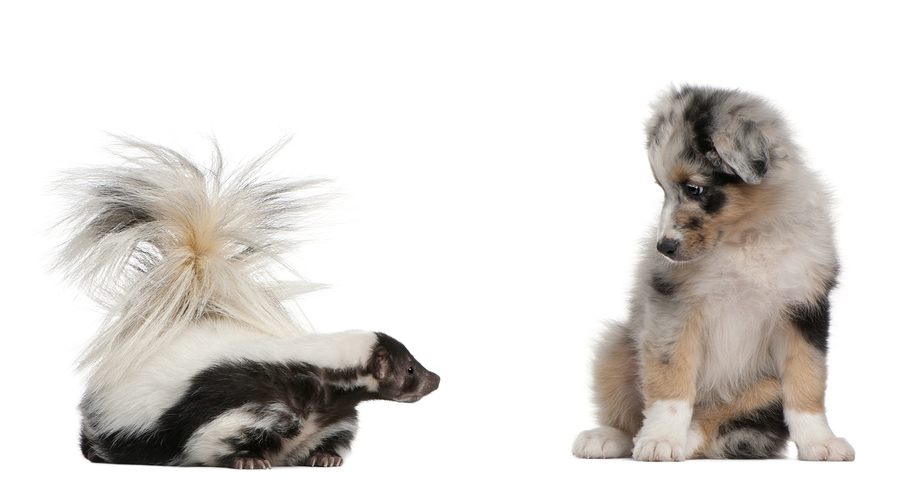
With the fall season in sight, many of us will venture to the great outdoors and go camping. All kinds of fascinating creatures can be found in the great outdoors, but when your pet is roaming around, beware the skunks! Puppies especially can become curious when they come across these foreign creatures, but skunks are startled easily and have no mercy. The skunk odor, which is actually a poison, can sometimes take years to remove from a dog’s fur.
Skunks have an incredible talent for spraying with accuracy. They also have the ability to spray multiple times in a row, reaching up to ten feet away. The spray that a skunk emits is a type of oil, accompanied by a horrific odor that will seep deeply into a dog’s fur. Thankfully, there are multiple options for getting rid of the odor
Most people believe that tomato juice is the best remedy for getting rid of a skunk’s odor, but this is in fact, false. Tomato juice is not very effective on animals and will sometimes stain a light-haired animal’s fur. Tomato juice is also very acidic and is thought to be harmful to cats, but it is not known for certain just how harmful. Better options include hydrogen peroxide, lemon juice, dishwasher detergent, or a variety of commercial products that are available at local pet stores or from your veterinarian. While commercial products are more costly than home remedies, they are often more successful at removing the odor on the first try.
Dr. Alice Blue-McLendon, a veterinarian at the College of Veterinary Medicine & Biomedical Sciences at Texas A&M University cautions pet owners to always wash their pet outside if it has been sprayed by a skunk. She also warned pet owners to be sure pets do not get loose on the way to the bath tub, because the odor-causing oil will stick to anything it touches.
There are no toxins in skunk spray, so it will not harm your pet. However, it could become uncomfortable for them.
“If your pet was sprayed in the face, make sure to clean it properly,” said Dr. Blue-McLendon. ” Wash the eyes out with a saline solution and clean out the nostrils with a damp paper towel or cotton balls.”
The smelly skunk spray should not be the only concern to pet owners. Skunks carry rabies without showing signs of the symptoms. One bite from a skunk and your pet could become infected with the rabies disease; his life in danger. If there is a chance your pet has been bitten by a skunk, Dr. Blue-McLendon stressed that you should take your pet to see a veterinarian immediately, if there is even a chance it has been bitten by a skunk.
Skunks like to hide in dark places, so it is a good idea to train your pet not to go under houses or decks, and always have them updated on their rabies vaccinations.
“If you own fruit bearing plants, remove the fallen fruit quickly to reduce food sources that may keep skunks coming back to your property” said Blue-McLendon.
“There is no way to train your pet to stay away from skunks,” noted Blue-McLendon. Most pets will keep their distance after being sprayed once, but some pets never learn their lesson, and continue to be sprayed by the paranoid skunks.
Pet Talk is a service of the College of Veterinary Medicine & Biomedical Sciences, Texas A&M University. Stories can be viewed on the Web at vetmed.tamu.edu/news/pet-talk. Suggestions for future topics may be directed to editor@cvm.tamu.edu.
Angela G. Clendenin
Director, Communications & Public Relations
Ofc – (979) 862-2675
Cell – (979) 739-5718

