
Don’t be Lame – Causes and Cures for Equine Lameness
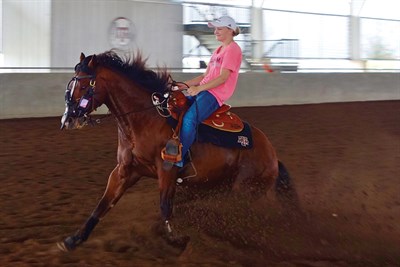
An athlete’s body is trained to handle an amazing amount of work and stress. From runners to swimmers, all athletes train to handle the specific stress their sport requires. Unfortunately, it is still not uncommon for these athletes to injure themselves performing the very actions they trained for. This is also true of a horse’s body.
Many horses are trained athletes that are bred and conditioned for a specific sport such as racing, jumping, western performance or dressage. While these sports are relatively safe, just like a human athlete, there is always a possibility of injury and in most cases with horses the injury tends to be lameness. Equine lameness is an abnormality of gait that is caused by pain or restriction of movement.
“Most of the injuries we see are muscular/skeletal lamenesses,” states Dr. Kent Carter, professor of equine lameness and chief of medicine at the Texas A&M University College of Veterinary Medicine & Biomedical Sciences Large Animal Hospital. “The lameness can be a result of things such as chipped bones, bowed tendons and other soft tissue injuries.”
The type of equine lameness is generally dependent on the horse’s use. For example, race horses tend to present injuries such as bowed tendons or bone chips in joints. Jumpers on the other hand tend to have more soft tissue injuries.
“Probably the greatest number of cases we see are soft tissue injuries in the foot and lower limb,” notes Carter. “Foot lamenesses can be caused by traumatic injuries or as a result of a degenerative process.”
Of course, your horse doesn’t have to be an elite athlete to suffer an injury. Some can happen as the result of accidents, such as stepping in a hole or on a rock during a trail ride and twisting an ankle. Horses can even injure themselves while bucking and playing in a pasture.
“You should be as aware as possible of the terrain on which you are riding and make sure that your horse has the proper conditioning for the activity you are having it perform,” urges Carter. “With that said, even with the best care an animal can always injure itself.”
As a horse owner, it is fairly easy to recognize if your horse is lame as most likely there will be some limping. If the injury is further up in the leg it is also possible to see swelling of the leg.
“If you notice that your horse is limping or its leg is swollen the first thing you want to do is stop exercising them. If you are knowledgeable you can also apply a pressure wrap around the leg,” advises Carter. “If it is not getting better or if the limp is severe you should take them to their veterinarian as soon as possible.”
Depending on the type, severity and location of the injury there are many types of treatment that a veterinarian can perform.
“We prefer to start with rest and support wraps, but when the injury is more severe we can do anything from pain killers and injections of anti-inflammatory drugs to surgery,” states Carter. Of course you can’t treat a problem until you can diagnose what the problem is and some lamenesses don’t present at all or not fully until a rider is on the horse.
“The Texas A&M University College of Veterinary Medicine recently added a state of the art lameness arena to our facility,” notes Carter. “The surface of this arena helps us to better diagnose specific lamenesses by putting a rider on a horse and having them ride.”
Once the problem is identified and the veterinarian performs the treatment regimen there is always a chance that the horse will either not heal completely or will require additional rehabilitation.
“While I would say that for the most part we can at least benefit most horses with lameness, we can’t heal everyone,” says Carter. “We can, however, improve the outcome in the majority of cases.”
Most horses with lameness problems will probably have to have some form of rehabilitation. While most rehab is done at home by owners, in more severe cases the horses can be sent to rehabilitation centers.
“Rehab centers will have specialized equipment to deal with more difficult cases,” explains Carter. “This can be anything from 24/7 monitoring to water treadmills.”
With all the options for the treatment of equine lameness, the cost of these procedures can range from relatively inexpensive to thousands of dollars.
“It’s highly dependent on what we do. We can give a simple injection of anti-inflammatory for less than $100 while some surgeries can cost over $4,000,” states Carter.
In order to avoid expensive procedures and painful injuries the best prevention is to be aware of your horse’s surroundings and try your best to keep them in good physical condition for their activities. Of course when injuries do occur, it’s important know how to spot them and what to do in order to keep your four legged athlete in tip top shape.
Pet Talk is a service of the College of Veterinary Medicine & Biomedical Sciences, Texas A&M University. Stories can be viewed on the Web at vetmed.tamu.edu/news/pet-talk. Suggestions for future topics may be directed to editor@cvm.tamu.edu.
Angela G. Clendenin
Director, Communications & Public Relations
Ofc – (979) 862-2675
Cell – (979) 739-5718

