
Emergency Preparedness with Pets
If an area is not safe for you, it is not safe for your pet. As hurricane season is upon us, remember those words when preparing for any emergency evacuation with your pet.
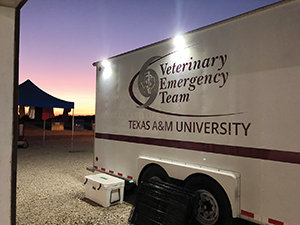
“I never advise that you or your companion animal stay at home if an evacuation is ordered,” explains Dr. Wesley Bissett, assistant professor at Texas A&M University College of Veterinary Medicine (CVM) and lead faculty member for the newly formed Veterinary Emergency Team (V.E.T.). “If you are disabled or can-not afford to leave, there is always help provided during these situations so you can get out of harm’s way. If you stay, you put your life and the life of your pet at risk.”
Before leaving, preparations have to be made to insure the safest recovery of pets. Bissett recommends bringing several days worth of food and water, bringing several weeks worth of medication, bringing health records so they can get the best care if they are placed in a shelter or away from the owner, and making sure the pet is always identified by bringing current photos and proof of ownership.
If a pet is not able to go with the owner, there are several options in place during emergency situations. Bissett recommends shelters as there are co-shelters where people and animals can stay together as well as animal only shelters. There is also an emergency response effort that is federally mandated that requires the government to come up with a plan to provide for companion animals during an emergency situation. Check with the local county emergency team prior to leaving to ask for assistance and guidance.
The main thing to remember is to always be prepared. Natural disasters happen when one least expects them. It is also good to be familiar with all of the natural disasters that affect each area and the best way to react to them. If one is prepared with an emergency kit that has containers for food and water, medical records, identification information, medications and comfort items than one should be ready when an emergency strikes.
It is also important to assemble a first aid kit for pets in case of an emergency. The first aid kit should contain diarrhea medication, hydrogen peroxide, eye dropper, towel, blanket, ice cream sticks that can be used as splints, scissors, tweezers, liquid dish detergent to clean mild wounds and non-adherent bandage pads.
“The key is to get everyone reunited after an emergency,” said Bissett. “The best way to avoid problems is to plan, prepare and stay informed.”
For a more comprehensive list on developing an emergency plan and evacuation kit, visit these websites:
http://www.dshs.state.tx.us/idcu/health/zoonosis/animal/disaster/
http://www.fema.gov/medialibrary/media_records/2484
Pet Talk is a service of the College of Veterinary Medicine & Biomedical Sciences, Texas A&M University. Stories can be viewed on the Web at vetmed.tamu.edu/news/pet-talk. Suggestions for future topics may be directed to editor@cvm.tamu.edu.

