
Horse Dental Care (February is National Dental Month)
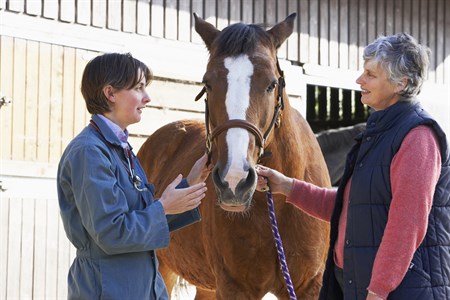
February is National Pet Dental Health Month. As with humans, horses benefit from having good oral hygiene and dental care. Dental disease can lead to pain, tooth loss and infection in other organs when bacteria from infected teeth and gums enter the blood stream and circulate throughout the body.
“Regular dental care is important to the well being of today’s horse,” notes Dr. Cleet Griffin, clinical assistant professor at the Texas A&M College of Veterinary Medicine & Biomedical Sciences. “Foals and weanlings are examined to check for proper skull and dental development as well as alignment of upper and lower jaws. This is followed by routine checkups every six months until about five years old. Once the adult teeth are in place, annual teeth exams should be performed.”
“Horses have teeth with long crowns that are contained within a deep dental socket. The teeth continually erupt into the mouth as the grinding surface is worn away,” notes Griffin.
Horses chew many times per minute when grazing and eating tough, fibrous feed material. The horse’s teeth slowly wear down when the upper and lower teeth grind one another while chewing the forage and feed, explains Griffin. After a few minutes of chewing, the food softens and is able to be swallowed. Not only does eating and chewing gradually wear the teeth down, but sharp points also develop.
“The horse’s anatomy (the horse’s lower jaw is narrower than its upper jaw) in combination with the horse’s continual tooth eruption and chewing motion contribute to the formation of sharp points along the edges of the teeth. Sharp dental points can cause irritation when the horse is eating or when being ridden because these areas cut and ulcerate the cheeks and the tongue,” notes Griffin.
Your equine veterinarian will examine your horse’s mouth for odor, inflammation, ulcers, cuts, tooth decay and abnormalities of wear. Juvenile age performance horses may require more frequent dental attention to monitor eruption of the permanent cheek teeth and incisor teeth, explains Griffin.
“To give an equine dental exam, sedation is commonly used. It makes the procedure safer and easier by providing relaxation and analgesia which helps to keep the horse more quiet and still, says Griffin. Only a licensed veterinarian should administer a sedative to your horse. It is also best if he/she can provide the comprehensive dental care, too.”
A speculum, which is a type of brace, is used to keep the horse’s mouth open during an equine dental exam. The speculum is not painful to the horse when used properly. It facilitates a better view inside the horse’s mouth and provides a safer working environment for the veterinarian since motorized floats and specialized dental equipment are now used in conjunction with manual files, notes Griffin.
Both medication and medical tools are used by your veterinarian to safely remove ‘points’ and ‘hooks’ that could eventually cause discomfort when your horse eats or takes the bit, explains Griffin. We float (file) the points off the teeth to prevent them from cutting the cheek tissue or tongue. Also, floating often involves reducing the length of overlong teeth in order to allow free chewing motion and prevent trauma to opposing dental tissues. Horse teeth contain sensitive pulp and nerves. When performed properly by the veterinarian, the floating procedure does not cause harm or pain because great care is taken not to expose the sensitive tissues of the teeth.
“The horse’s mouth is an efficient food-processing machine. What your horse eats and where he eats it will affect how your horse’s teeth wear. For example, research has shown that horses fed a grass or hay diet utilize a greater side-to-side chewing motion, chew more times per minute and spend more time per day chewing compared to horse that are fed grain concentrate. With grain concentrate, horses tend to utilize a more ‘up-and-down’ chewing motion which contributes to formation of sharp dental points,” notes Griffin.
A thorough equine dental exam by a veterinarian can provide important information about the overall well being of your horse. It is best to detect dental problems early because it is usually more difficult and costly to correct a later dental crisis. A healthy mouth that is free from sharp points or painful areas should help your horse chew and perform more comfortably.
ABOUT PET TALK
Pet Talk is a service of the College of Veterinary Medicine & Biomedical Sciences, Texas A&M University. Stories can be viewed on the Web at vetmed.tamu.edu/news/pet-talk. Suggestions for future topics may be directed to editor@cvm.tamu.edu.

