
Potty Training for Pets
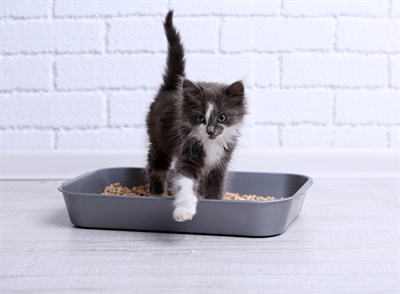
Bringing home a new pet is an exciting time for a family. Playing with a sweet little puppy or kitten and watching them explore their new home can be rewarding and fun. Unfortunately, cleaning up messes your pet makes in your home is a part of pet ownership that can quickly become tiresome. For this reason, it is important to have a potty training plan for your new pets and start them on it as soon as you bring them home.
“It’s important to start young with potty training, because what we don’t want to do is establish bad habits in our pets,” explains Dr. Mark Stickney, Director of General Surgery Services at the Texas A&M University College of Veterinary Medicine & Biomedical Sciences. “Once they learn one way to do something it’s hard for them to unlearn it, and any change can confuse them.”
Potty training is a significantly different process for cats than for dogs. While dogs require a good deal of attention and time to train, cats are quite a bit easier.
“Litter training is instinctive for cats,” notes Stickney. “All you really need to do is put your kitten in the room with the litter pan and keep it in there when you are not playing with it or paying attention to it.”
While there are a variety of litter boxes available, Stickney suggests that you make sure you get one, at least initially, that your kitten can easily get in and out of.
“You have to remember that when you bring home a kitten it is just a little baby and if you get a really high box it may have trouble getting into the box and therefore will not use it,” says Stickney. “It’s also good to remove anything in the room that may resemble litter such as potted plants or they may become your pet’s bathroom.”
When choosing your litter it is good to know that while there are many different kinds and varieties, they are mostly marketed for human preference. Find one that your cat will use and that works for you.
“Although all cat litter brands are ok to use, it may helpful if you know what kind of litter your kitten was using before it came to live with you and start with that if possible,” notes Stickney. “Cats can be texture and odor specific with their litter so if you can at least start with that you can gradually transition them to another litter later if you prefer.”
As previously mentioned, potty training puppies is a completely different process and quite a bit trickier than training kittens. The process is slow and can take up to a year for some dogs to get the hang of it.
“Begin training your dog as soon as you bring it home,” urges Stickney. “Take it straight outside and give it plenty of time to go potty. Stay out there with it, but ignore it until it goes. Then, as soon as it goes, give it a treat and ‘ooh and ahh’ all over it.”
While this process may be time consuming, it will be worthwhile in the end when you don’t have to pick up messes in your house.
When your pet is inside the house, Stickney advises that most effective way to train it is by crate training.
“When you are not at home you should keep your pet in a crate inside your house,” says Stickney. “This becomes their safe place (or their den) and thus crate training takes advantage of their natural instinct not to make a mess in their own den.”
As soon as you get home immediately take your pet out of its kennel and take it outside to go to the bathroom.
“It’s not realistic to leave a puppy in a carrier for eight hours straight and not have an accident,” explains Stickney. “If at all possible you should try to come home or arrange for someone to come by and give it a potty break in the middle of the day if you work full-time.”
Because the cage is your animal’s safe place it is important to never use it as a punishment. If you put them in it for punishment it will have a negative view of it and will no longer see it as their den.
“This also goes for punishment of accidents. Never negatively reinforce their behavior,” warns Stickney. “If you hit them when they have an accident they not only don’t connect their accident to the punishment, but it can cause anxiety and lead to slower potty training.”
If you have followed all these training guidelines and you are still unsuccessful there are professional dog trainers who can help with the process. You may also want to consult your veterinarian to make sure the animal doesn’t have an underlying problem.
“If your dog or cat is already housebroken and suddenly starts having accidents this is also a sign that it may have a health problem,” states Stickney. “In this case you should definitely take the pet to its veterinarian for a check-up.”
While our pets are a great addition to our families and a wonderful source of enjoyment, nobody wants to deal with pet messes in the home. If you have a potty-training plan in place and are diligent about sticking to it, you can have a healthy, happy and potty trained pet.
Pet Talk is a service of the College of Veterinary Medicine & Biomedical Sciences, Texas A&M University. Stories can be viewed on the Web at vetmed.tamu.edu/news/pet-talk. Suggestions for future topics may be directed to editor@cvm.tamu.edu.
Angela G. Clendenin
Director, Communications & Public Relations
Ofc – (979) 862-2675
Cell – (979) 739-5718

