
Prosthetic Limbs for Dogs
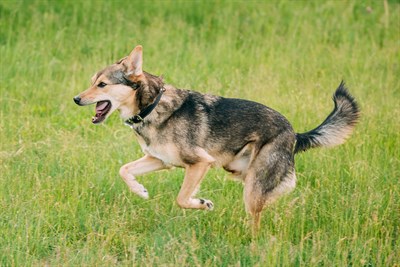
Prosthetic intervention has been used for many years in human rehabilitation to achieve mechanical and rehabilitative goals, that is, to stand up and walk again. The use of these prosthetic limbs for dogs and other pets has been limited in veterinary medicine although published case reports have existed for over 40 years.
“The use of prosthetic devices in veterinary medicine is in its infancy,” says Dr. Jacqueline Davidson, clinical professor at the Texas A&M University College of Veterinary Medicine & Biomedical Sciences. “Usually, most dogs and cats do really well with three legs and so, in the past, veterinarians just amputated the affected leg.”
For most of these injuries, even those that require the amputation of more than one leg, there are other devices, such as wheeled carts that can do the job. “In the last ten years people started to do more prosthetics,” Davidson says. “Lately we are seeing more small animals with prosthetics.”
This surgery is not a cheap one, and normally it is the owner who requests it.
“There are different types of surgeries that involve prosthetic limbs. One surgery involves fitting a prosthesis over the skin on the stump of the leg and the other one is more involved as the prosthesis is implanted into the bone,” Davidson says.
According to Davidson, this kind of surgery, though promising, will still need some time to be more cost-effective. “Right now, you have to work with a prosthetist and you have to order the materials specifically for each animal. It can be very expensive.”
Just like humans do, pets that undergo this kind of surgery and get a prosthetic limb implanted need to go through a rehabilitation process. “Sometimes, getting the pet to adapt depends on the personality of the animal, on the circumstances, or their age. But after some time they start to adjust and live a fairly normal life,” Davidson says.
It’s important to remember that, after a successful prosthetic limb implant, dogs are not the only ones who recover several degrees of freedom. Their owners feel a sense of freedom because they are able to sit on the porch or sofa again and watch their cats and dogs run around the house.
ABOUT PET TALK
Pet Talk is a service of the College of Veterinary Medicine & Biomedical Sciences, Texas A&M University. Stories can be viewed on the Web at vetmed.tamu.edu/news/pet-talk. Suggestions for future topics may be directed to editor@cvm.tamu.edu.

