
Trick or Treat, Give Me Something Good to Eat!
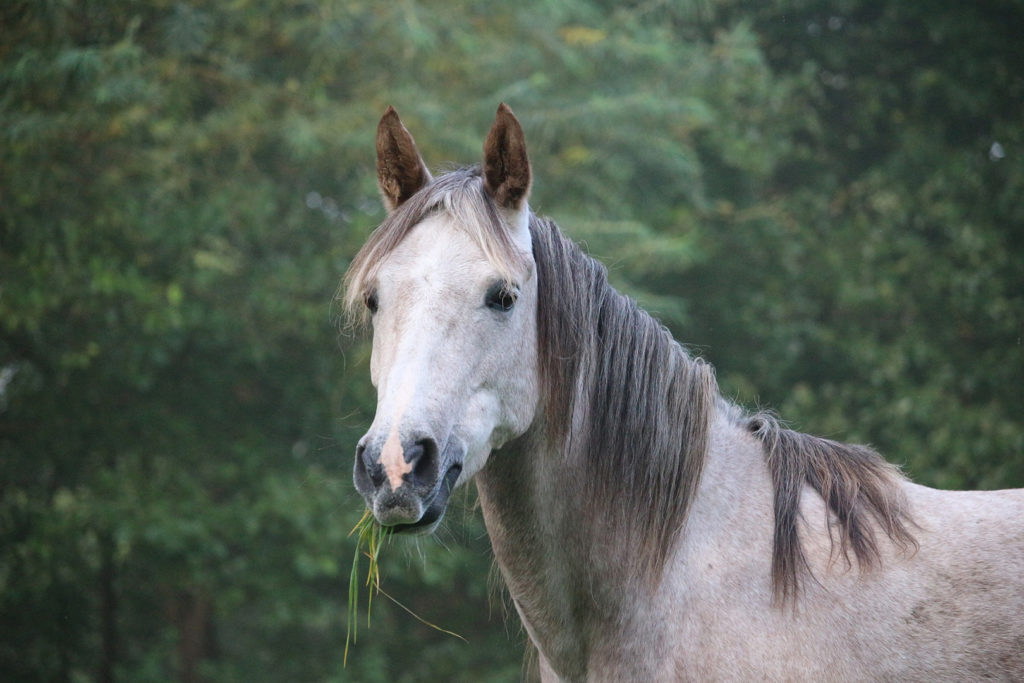
Trick or Treat, give me something good to eat! There are a number of healthy treats that your horse can enjoy. These treats can provide pleasure and add beneficial nutrients to your horse’s diet. However, they can also precipitate into behavioral problems.
“Some fruits and vegetables make healthy horse treats,” notes Dr. Glennon Mays, clinical associate professor at the Texas A&M College of Veterinary Medicine & Biomedical Sciences. “However, feeding your horse foods other than their usual grain and forage can result in some unwanted results.”
“Many horses enjoy apples and an apple cut into pieces makes a wonderful treat,” states Mays. “Apples should be cut into pieces since a whole apple may cause your horse to choke. Whole apples are the perfect size to become lodged in the horse’s esophagus.”
“Nutritionally, apples provide your horse with potassium which is important for proper muscle contraction and nerve function. Also, potassium is an electrolyte which is important for cellular metabolism,” explains Mays. “Additionally, apples provide calcium and phosphorus. Calcium is important for bone growth, muscle and heart function, and milk production. Phosphorus is required for bone structure and energy metabolism. Apples also provide all important fiber to the equine diet,” notes Mays.
From healthy fruit to nutritional vegetable, the carrot makes a welcomed treat for your horse. Mays notes to also be careful to avoid choking when feeding carrots. Cutting the carrots into thin slices will prevent a large chunk from becoming lodged in your horse’s esophagus.
“Carrots contain vitamin A which is needed for healthy eyes, mucus membranes, skin and hair,” states Mays. “Fortunately, fresh pastures and quality hay provide horses with most of their needed vitamin A. However, lack of green grass in the winter may be reason to provide your horse with additional amounts of vitamin A during those months.”
As in all treats, moderation is the key. Over indulgence can mean future trouble, warns Mays. Digestive problems are one aspect of too many apples or carrots, but behavioral problems can be much more difficult to contend with.
“When a horse anticipates and expects a treat as routine, and does not get the treat, unacceptable behavior may occur. Your horse is a large animal and may become abusive when not given more treats,” states Mays.
As long as the treat remains an infrequent, unexpected reward, apple or carrot pieces can be a true treat for your horse, notes Mays. However, it should be noted that giving your horse treats too frequently may result in your horse acquiring obnoxious behaviors.
“Giving your horse treats can become problematic because horses can become spoiled to the idea and therefore demand the treat so it is no longer a treat but becomes part of a routine,” explains Mays.
When considering whether to give treats to your horse or not, you should determine their intended purpose and role in your horse’s overall health and well being, notes Mays. If your horse seems to be satisfied with the treat of a gentle pat on the neck, or vocal praise, then a food treat may not be necessary.
Give your horse something good to eat. For a horse, something good to eat is a well balanced diet of grain and forage with some mineral supplements and maybe … just an occasional treat of chopped apple or carrot.
Pet Talk is a service of the College of Veterinary Medicine & Biomedical Sciences, Texas A&M University. Stories can be viewed on the Web at vetmed.tamu.edu/news/pet-talk. Suggestions for future topics may be directed to editor@cvm.tamu.edu.

