
College of Veterinary Medicine & Biomedical Sciences Celebrates 90 Years
COLLEGE STATION, February 27, 2006 – From its humble beginnings in animal stalls and few professors to today’s state-of-the-art facilities that produce research that affects the world, Texas A&M University’s College of Veterinary Medicine & Biomedical Sciences turns 90 this year amid a world that is far different than its founders envisioned in 1916.
Today, Texas A&M remains the only veterinary college in Texas and one of the world’s largest veterinary medicine schools – 1 of every 10 practicing veterinarians in the United States has an Aggie diploma. The College of Veterinary Medicine (it added Biomedical Sciences to its title in 2004) produces world class researchers and its animal care programs continually draw praise from the international scientific community.
In recent years, the institution has become the cloning capital of the world – it is the only organization that has successfully cloned six different species (cattle, swine, a goat, a horse, deer, and a cat) but it is also recognized for its leading research in animal diseases and most recently, work in bioterrorism issues.
It was not always so.
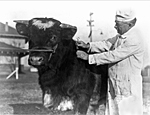
Dr. Mark Francis inoculates a bull
In 1888, Dr. Mark Francis was appointed as the first veterinarian to join the Texas A&M faculty, and in 1916 he became the first dean of the new school of veterinary medicine. Francis later wrote of those early days, “There were no laboratories or equipment for our work. We had no hospital. We had a room about 14 feet by 16 feet that served as office, classroom and laboratory. The adjoining room became vacant and was assigned to us as a classroom, and in this unsuitable place we toiled for 15 years.”
Francis overcame the difficulties, cramped space and tight budgets to become one of the world’s most famous veterinarians – he is often called the “father of Texas veterinary medicine” and it was he who discovered that ticks were causing Texas cattle fever that was wiping out herds all over the state. He would go on to develop effective inoculations to stem the disease.
The first veterinary graduation class was in 1920 and it didn’t take long to hand out diplomas – a whopping four students earned DVM degrees. The college now graduates an average of 125 students each year.
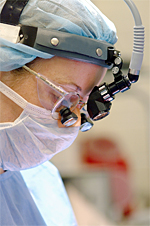
Dr. Theresa Fossum, veterinary cardiac surgeon
Other key dates:
- 1953 – the first Veterinary Medical Teaching Hospital was built;
- 1963 – the first woman was admitted; also the name was changed from the School of Veterinary Medicine to the College of Veterinary Medicine;
- 1966 – the first woman graduates from Texas A&M College of Veterinary Medicine;
- 1981 – a new Small Animal Hospital was built;
- 1993 – the Veterinary Medical Research Building and new Large Animal Hospital were constructed;
- 1999 – researchers clone cattle, the first of six different species to be cloned at Texas A&M, the most by any institution in the world
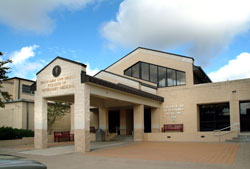
Mark Francis would hardly recognize the college today. It has an enrollment of about 500 students selected from a highly competitive admissions process, and about 2,250 students are enrolled in the undergraduate biomedical sciences program and 160 in the graduate program. The Veterinary Medical Teaching Hospital is composed of a Large and Small Animal Hospital and a Wildlife and Exotic Animal Center that treats about 20,000 in-hospital cases each year. The teaching hospital is a state-of-the-art facility that rivals most human hospitals with its equipment, clinical services, and medical specialists. The VMTH employs more than 100 faculty members in disciplines ranging from behavioral medicine to diagnostic imaging, large and small animal dentistry to neurology and neurosurgery, and internal medicine to dermatology.
Surgical heart treatment, nephrology research, small animal rehabilitation and comprehensive testing available at the gastrointestinal laboratory are just a few of the services available for animals through the VMTH, generating approximately $10 million annually.
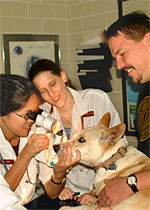
Veterinary students on ophthalmology rotation
As testimony to the high caliber of students admitted to the college, the current President of the Student American Veterinary Medical Association (AVMA) is 4th year student Travis McDermott who represents 10,000 veterinary students across the United States as a delegate at AVMA functions. The veterinary college also hosted a highly successful 2005 Student AVMA Symposium which was completely student managed and attracted more than 2,000 veterinary students from across the U.S. to College Station.
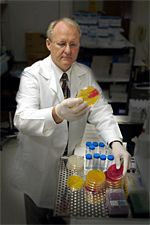
Dr. Garry Adams conducts cutting edge research
In addition to awarding DVM degrees, the college has a DVM and Masters of Business Administration dual degree program oriented toward business and leadership development in veterinary medicine. The DVM/MBA program was developed through the college’s new Center for Executive Leadership in Veterinary Medicine. The college also has a dual DVM/PhD program which is integral to the on-going success of the college’s teaching and research programs.
And while Francis and his fellow professors spent almost all of their time on animal care and diseases, today’s veterinary professionals are internationally minded and may work in a myriad of animal health fields related to bioterrorism such as anthrax, food safety and zoonotic diseases (those passed from animals to humans), public service, research, the corporate sector and other areas that were inconceivable in 1916.
The College of Veterinary Medicine & Biomedical Sciences is one of the premier institutions in the world for education, research and patient care in veterinary medicine. Through innovative educational programs and strong research capabilities, the college continues to affirm its commitment to provide the best in health care for animal patients.
The advances made through the college’s research, from basic animal anesthesia to cloning, continue to prove indispensable not only in the improved health and production of food, companion, sporting and service animals, but toward new medicines and procedures for the health of humans as well.
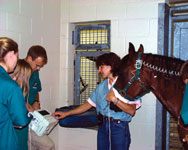
Dr. Joanne Hardy answers questions for students during their large animal emergency clinical rotation
“The challenges facing veterinarians today are changing faster than at any time in history with more global implications than ever before,” says The Carl B. King Dean of Veterinary Medicine H. Richard Adams, dean of the college since 1998 and a 1966 DVM graduate of Texas A&M University.
“Since that first graduating class, we have granted more than 6,200 veterinary medicine degrees. Today, Texas Aggie veterinarians work all over the world, and they serve the 19 million residents of Texas and their animals in roles dealing with private practice, but also in areas dealing with the military, industry, government and universities,” says Adams.
“We’ve had a distinguished 90 years, but I can honestly say that our best and most exciting days are ahead of us. The veterinary medicine student of the 21st century will be the most highly trained in history.”

