Digital Imaging
The Department of Veterinary Pathobiology has acquired and
assembled a fully functional core facility for computer-based
acquisition of images, their editing and analysis, and production
of high quality hardcopy and film-based output. Three principal
components are available:
- Image Acquisition and Analysis Lab
- BioTek "TechMate 500" Robotic Immuno-/In Situ Hybridization
Staining System
- Gel Documentation and Digital Imaging Lab
These core assets are supervised by John B.
Roths (jroths@cvm.tamu.edu);
1-979-862-1871. He will provide interested Department faculty and
staff with instruction on using the hardware and software and
assist in experimental design, as needed.
Image Acquisition and Morphometric Analysis Lab
Located in Room 322B, Veterinary Research Building, the primary
purpose of this facility is to enable the acquisition of
microscopic (and conventional) images for editing, archiving,
densitometric and morphometric analysis, and production of
appropriate "hardcopy" documentation. Key components include:
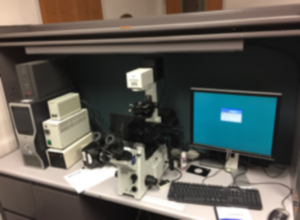
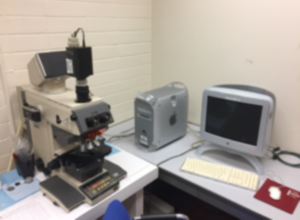
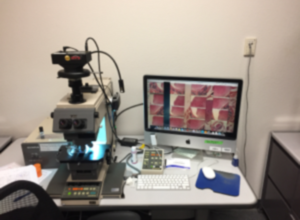
- Olympus Vanox (AHBS3) Photomicrographic Research Microscope
fitted with the following accessories: Xenon-based epi-fluorescence
illuminator, Nomarski Differential Interference Contrast, and
polarization filters. The Vanox has two 35mm camera backs, for
conventional photomicroscopy.
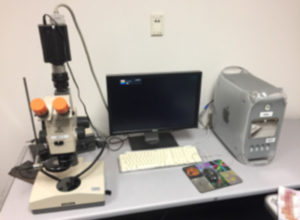
- Olympus SZH Zoom Stereo Microscope.
- Sony DXC-960MD 3-chip CCD Color Video Camera. This camera can
be "migrated" between the Vanox and SZH Stereomicroscopes. Thus,
high quality color images ranging from micrometer to centimeter
ranges in size can be "acquired".
- Video display and printing. Video images can be directed from
the Sony 3-CCD camera to a 19" Sony 1943MD color monitor and single
or multi-image (2-16) "plates" can be printed on a Sony UP-7100MD
Color Video Printer, an 8.5" x 11" printer with 163 dpi resolution
and 24-bit color capability.
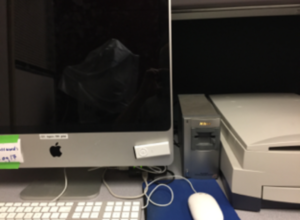
- Power Macintosh 8100/80AV Computer. This high-end Power
Macintosh is equipped with 32 MB of RAM, a 500 MB Hard
Drive and an internal CD-ROM Drive. 4 MB of Video RAM supports
16-bit color images on a 20" color monitor. On board hardware
includes: An S-video and audio capture board (for generation of
"Quicktime movies", for example; a Scion LG-3 Frame Grabber; and a
Scion TV-3 output board. The LG-3 board permits the digitization of
the R,G,B, and Luminance signals sent from the Sony 3-CCD camera.
The TV-3 board permits output of grayscale images to the video
components described above.
- A 650 MB Magneto-Optical Cartridge Drive is used for image file
"backups". The key licensed image-oriented software installed
includes: "NIH-Image, Adobe Photoshop, Adobe Illustrator, Aldus
Fetch, Aldus Digital Darkroom, Kodak PhotoEnhancer, and the NCSA
Image software suite. Graphic, statistics, and optical character
recognition (OCR) software includes Kaleidagraph, Statview and
Omnipage Pro, respectively. Word Processing, spreadsheet and
presentation applications uses the Microsoft Office suite of
programs.
- Flatbed Scanner. An Epson 800C 24-bit color scanner capable of
both incident and transmitted image acquisition is available.
- Output Devices. In addition to a high quality laser printer
(600 dpi Apple Laserwriter Select 360), the facility includes a
Fargo Primera Pro (24-bit color, 600 dpi, postscript-capable)
combination thermal wax and photorealistic dye-sublimation printer.
Additionally, images can be "printed" to standard 35mm color slide
or print film using a Polaroid Digital Palette 5000 color film
recorder.
- Additional input and editing devices include: A VideoLabs
"FlexCam Pro" S-video camera with audio capabilities, used for
acquisition of "real time, motion-based images"; a Kodak DC-40,
24-bit color Digital Camera, and a Wacom UD-1212 graphics tablet
with both "puck" and pressure-sensitive stylus for image
manipulation and measurement.
BioTek TechMate 500 robotic Immuno- and In Situ Hybridization
Staining System
Located in Lab 322 of the Veterinary Research Building. This
computer-controlled robotic stainer permits within-run, and
different-run consistency in the staining of sectioned tissue. This
is a critical prerequisite for later densitometric analysis of
digitized images (see above) stained with immunospecific, DNA/RNA
probe specific, or specialized histochemical reagents. The key
features and components of this system include:
- A 32-place immunostainer with robotic slide carrier.
- Based on "capillary-gap" staining protocols using special
"ChemMate" slides.
- A "DNA oven" for in-situ hybridization. Capable of denaturing
and annealing 30 pairs of capillary-gap slides.
- A microwave oven for pretreatment (antigen-retrieval protocols,
for example) of slide-mounted tissue sections.
- A dedicated 486-based Pc computer capable of controlling up to
5 independent protocols. New protocols can be written and saved on
disk for subsequent experiments.
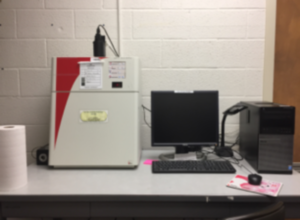
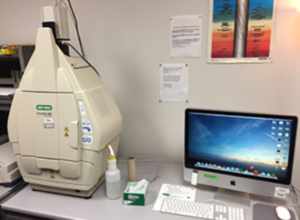
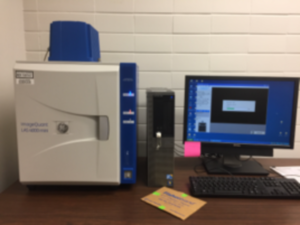
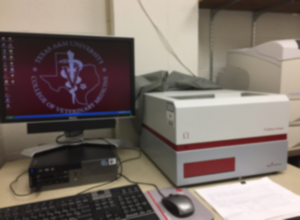
Gel Documentation and Digital Imaging Labs
This component primarily supports those VTPB investigators
needing to document one-dimensional electrophoretic gels/blots such
as DNA gels, protein gels, and autoradiographs. Two identical
systems are available: One is located in Room 318A of the
Veterinary Research (VMR) Building; the other is located in Room
220 of the VMA building. The on-site supervisors for these systems
are: John Roths (VMR), 862-1871 and Dr. Pat Holman (VMA), 845-4275.
An orientation session is required before issuance of a "user
account" and password. Briefly, these Alpha-Innotech (IS-500)
systems include:
- A 486DX2 computer
- A SVGA 800 x 600 color monitor
- A Hyper HAD CCD camera (designed for low-light level
imaging)
- A dual-light transilluminator (visible and UV)
- Dual epi-illumination (fluorescence side lights)
- An 8-bit grayscale thermal printer
- Software for image acquisition and enhancement.
These systems were purchased in part to replace the use of
polaroid-based gel documentation. The high quality thermal paper
prints produced with this system are estimated to cost only 6-10
cents per print (as opposed to nearly $1.00 per Polaroid print).
Moreover, the IS-500 system is capable of saving both Pc- and
Mac-compatible TIFF images for follow-up editing, analysis, and
printing. A Polaroid MP-4 gel photography system is also available
in VMR, Room 318A.