
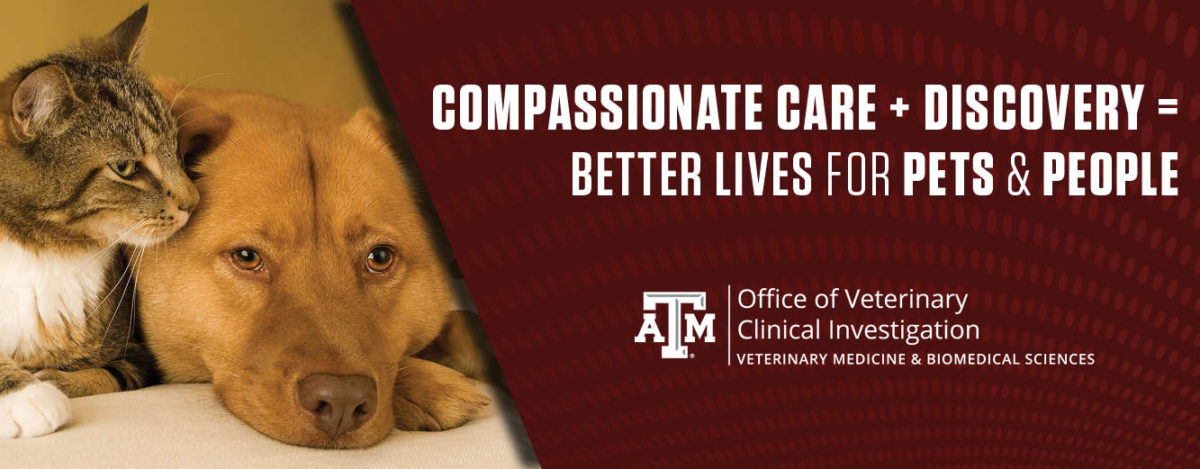
By enrolling your pet in a clinical trial, you play an important role in helping to advance veterinary medicine,
and each pet’s participation can ultimately lead to improvements in both animal and human health.
The Texas A&M Office of Veterinary Clinical Investigation (OVCI) is the administrative home for clinical trials in the Small Animal Teaching Hospital (SATH).
Clinical trials are studies that evaluate how effective a new treatment is by comparing it to standard practice in animals with disease. These trials are often designed from preliminary data showing that the new treatment may be effective.
The goal of the OVCI is to provide our patients with the highest quality of care throughout their clinical trial journey. All of our clinical trials are approved by our Clinical Research Review Committee (CRRC), an internal committee comprising veterinarians and community members who ensure that all patients are treated with your pet’s best interest in mind.
We sincerely thank you for your interest in our trials!
Frequently Asked Questions
What is a veterinary clinical trial?
The final stage of many laboratory research projects is to test the treatment (medication, device, etc.) in a clinical setting with real patients to see if it works as well as it does in the artificial laboratory setting.
By the very nature of a clinical trial, there is no way for a clinician to predict if the new treatment is going to be better than the old one. Although it may seem that the treatment is likely to be better, it must be tested under controlled conditions with objective ways of measuring data and responses.
Your clinician should give you detailed information before you enroll your pet in a clinical trial. For most animals, the trial consists of routine blood tests, routine imaging (x-rays, ultrasounds, etc), and a new treatment. Based on previous results, expected adverse effects may be explained to you before you agree to enroll your pet. In many cases, clinical trials are done to find a better treatment when the current therapies are ineffective.
As veterinarians, your clinician has your pet’s best interest in mind. An animal may be removed from a clinical trial at any time by you, the owner, or the veterinarian if it is in the animal’s best interest.
Clinical trials often require frequent visits to the Texas A&M Veterinary Medical Teaching Hospital (VMTH). It is often required that tests and procedures be done at the VMTH to receive the financial incentives associated with these trials and to maintain consistency in how the trial is run.
These studies offer the benefits of cutting-edge research. Conclusions drawn from a clinical trial may go on to benefit humans with similar diseases as well as other animals.
Are clinical trials voluntary?
Absolutely. Your pet will never be placed in a clinical trial without your knowledge or permission. Owners of all qualified patients involved in veterinary clinical trials must sign a consent form before the study begins.
Informed consent is your right as a veterinary clinical trial participant. The consent document outlines the purpose of the study, the exact treatments you will receive, possible side effects, and your right to withdraw at any time. Make sure you understand what costs are covered by the trial (e.g., treatment, medical care, travel, etc.). If you do not understand something, please ask your veterinarian to clarify.
Signing the informed consent form acknowledges that the trial was explained to you and that you understand the information presented in the document. You can, however, withdraw from a clinical trial at any time, even after signing the form.
What are the benefits of participating in a clinical trial?
Potential benefits to enrolling your pet into a clinical trial include:
- Access to a treatment that isn’t available yet. This treatment may be more effective or have fewer side effects than the treatments that are currently prescribed.
- Regular and careful attention from some of the best veterinary clinicians. The clinical trial team includes top veterinarians and scientists, all of whom will work with you.
- Treatment that may be lower cost. Some, but not all clinical trials may pay for part or all of your pets’ treatment, medical care, travel, and other expenses during the study. Make sure you know exactly what you’ll have to pay for before you agree to enroll your pet in a clinical trial.
- Contributing to new medical knowledge that may save lives in the future. Many of the excellent diagnostic tests and therapies we routinely use today came about through past veterinary clinical trials [see Animal Roles in Medical Discoveries (PDF) for contribution examples]. NOTE: The PDF is large, so it may take a couple of minutes to download.
- The feeling that you’re taking a more active role in your pets’ veterinary care.
Are there risks involved with participating in a clinical trial?
Our clinicians take every precaution to minimize risk to your pet. All clinical trial protocols are reviewed by two separate review boards to ensure that the studies are well-designed, risks are mitigated, and there is a reasonable likelihood of a similar or better outcome compared to current standards of veterinary care. Although every effort is made to control the risks, some may be unavoidable. Potential risks include:
- The new treatment may not work for your pet, even if it benefits other patients in the clinical trial. It also may turn out that the new treatment isn’t as effective as what’s currently available.
- More severe side effects than current treatments.
- More frequent testing and veterinary visits. Because your pet will be closely monitored, additional visits and tests may be required more often than would occur if you were not participating in the trial.
Are there any financial costs to participating?
Cost varies depending on the specific clinical trial. Although some trials cover most or all of the cost, others can only partially cover the finances associated with the study’s diagnostic tests and/or treatments. In other words, they are not likely to pay for all tests or treatments your pet receives just because you’re in the study.
Many not-for-profit organizations can provide financial aid if you want to participate in a trial but cannot commit to the financial obligations.
How can I find out if my pet qualifies for a study?
Each veterinary clinical trial has specific criteria that patients must meet to be included. For example, the study might only concentrate on a certain type or stage of the disease. Enrollment might also be dependent upon patient age, treatments already received, or present health condition. Information about these requirements can be found in the details of each study website.
If you are interested in learning more about one of our clinical trials, please have your veterinarian contact us or use the contact information listed on the study website. We cannot provide any treatment or diagnostic recommendations over the phone; you must present your pet in person for a consultation.
What questions should I ask before participating in a clinical trial?
Choosing to be in a clinical trial is an important personal decision. Discuss the following questions with your veterinarian or technicians involved in the study to make an informed choice:
- What is the purpose of this clinical trial?
- How will my pet benefit?
- What are the potential risks involved?
- What are my responsibilities?
- What kinds of tests and procedures are involved?
- Do I have to change veterinarians to be in the trial, or can I stay with my own veterinarian?
- Can I learn the final result of the study? If so, how?
- Is there any cost to participating in the study, or are all costs covered?
- What follow-up is involved once my pet’s treatment ends?
If I want my pet to participate, what are my responsibilities?
- Read, understand the information presented, and sign the Owner Informed Consent document. Please ask your veterinarian or staff for clarification if you have any questions about the study.
- Make sure you know exactly what you’ll have to pay for before you agree to enroll your pet in a clinical trial.
- Complete the study procedures as outlined by your veterinarian.
- Maintain scheduled appointments, as visits are often scheduled to gather data at specific time points. Please reschedule any missed appointments at the next available opportunity.
- Notify the study investigator or your veterinarian regarding any changes in your animal’s health or your willingness to participate in the study.
Contact Us
Lisa Even, MS, RLATg | Laboratory Manager
Office of Veterinary Clinical Investigation (OVCI)
Department of Small Animal Clinical Sciences (VSCS)
Texas A&M School of Veterinary Medicine & Biomedical Sciences (VMBS)
4474 TAMU | College Station, TX 77843-4474
Tel: 979.458.2270 | Email: vetclinicaltrials@tamu.edu
About Lisa
Lisa Even, MS, RLATg, came to the VMBS from The University of California, Davis, (UC Davis) where she received a BS in Animal Science and an MS in Pathology. After working as a veterinary technician for many years and as a technologist for The Jackson Laboratory West, she moved back to UC Davis Biomedical Engineering. There she was a manager for in vivo operations and pre-clinical imaging (US/PET/CT/optical) for a well-known cancer research lab that produced novel nanoparticle therapeutics and microbubble ultrasound contrast agents.
After 10 years at UC Davis Biomedical Engineering, Lisa moved on to UC Davis Veterinary Medicine, where she was the Associate Director of the Veterinary Institute for Regenerative Cures (VIRC), managing all regenerative medicine clinical trials in dogs, cats, and horses with Dr. Boaz Arzi and Dori Borjesson. Additionally, she was a nuclear imaging clinical trial coordinator, operating the MiniExplorer PET/CT at the Veterinary Center. She also helped support dual degree DVM/PhD students in the Veterinary Science Training Program (VSTP).
Lisa recently moved to Texas A&M to start the OVCI and support VMBS clinician-investigators with clinical trials and biobanking.
