
Do You Have a Cool Pet?
“Don’t let ’em see you sweat” … good advice if you’re in the business world trying to close a deal. But, if you are dealing with a pet, knowing how that animal keeps itself cool could be vital to its well being, especially when temperatures are high.
“Fur-bearing animals may use different body mechanisms to cool themselves and maintain a safe body temperature,” notes Dr. Adam Patterson, clinical assistant professor at the Texas A&M College of Veterinary Medicine & Biomedical Sciences.
“After exercise, your dog’s temperature will rise. To cool itself, it will pant by taking shallow breaths as opposed to sweating through the skin like people. The panting helps to dissipate excess heat quickly and is a natural cooling mechanism for your dog,” says Patterson.
A panting cat is a different story, cautions Patterson. Overall, panting in a cat is not typical. Usually a panting cat signifies a medical problem especially if the cat is in an air conditioned space. Heat, pulmonary, metabolic and kidney disease all can cause a cat to pant. Often cats with these conditions also display other signs such as altered behavior, lethargy, weight gain or loss, changes in appetite, inappropriate elimination in the litter box and/or poor grooming habits to name a few. Regardless, if a household cat is panting it should be closely monitored for a few minutes to see if the panting stops. If not, or if panting resumes while indoors, seek veterinary medical attention.
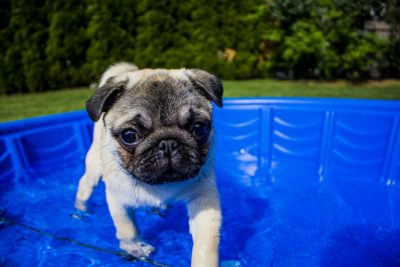
“Remember that dogs and cats do not perspire all over their body; they only really sweat on their paw pads,” explains Patterson. “Providing a shallow pool of water for your dog to stand in may be helpful keep your pet cool during the summer heat. Cats lick the bottoms of their paws and their chest and this moisture helps them to cool down.”
Your pet may also adapt to the heat by shedding some of its winter hair coat, notes Patterson. Losing body hair as the weather heats up is a natural occurrence and another way that mammals prepare themselves for the hot summer.
“It is extremely important to provide plenty of clean drinking water for your pet,” urges Patterson. “Because warm-blooded animals lose water when they cool themselves, it is important to give pets lots of drinking water, especially in the hot and humid summer.”
Different animals have come up with interesting means of surviving summer heat, notes Patterson. Rabbits radiate heat from their long ears. Blood flowing into the ears dissipates heat from the body and this cooler blood then returns to the bloodstream and decreases the rabbit’s body temperature.
Horses do have sweat glands in the skin along the majority of their body, notes Patterson. During exercise and extreme hot temperatures, horses will sweat like people as a means of removing excess body heat. After exercising, a cool water bath helps dissipate the excess heat from the horse’s body.
In the hot summer, help keep your pet cool by knowing how your pet does, or doesn’t sweat and what measures can be provided to make your pet more comfortable when the temperature rises.
Pet Talk is a service of the College of Veterinary Medicine & Biomedical Sciences, Texas A&M University. Stories can be viewed on the Web at vetmed.tamu.edu/news/pet-talk. Suggestions for future topics may be directed to editor@cvm.tamu.edu.

