
Should Your Pet be a Vegetarian?
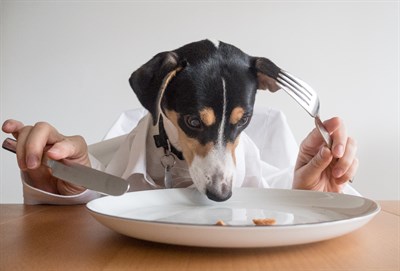
There are so many human vegetarians that some of you may have wondered if your beloved four-legged friend is able to share the same passion and cause as you. If you have ever been interested in having your pet become a vegetarian it should be helpful to know the certain nutritional needs that your pet has, in order to make the right decision regarding vegetarianism.
There is no scientific basis on the idea that a specific breed of cat or dog would fare better as a vegetarian, it is simply an issue between the species.
In the Canine world, being a vegetarian has no negative effect on their nutritional needs.
“Dogs are opportunistic carnivores” said Dr. John Bauer, M.L. Professor of Clinical Nutrition at the Texas A&M College of Veterinary Medicine & Biomedical Sciences, “which means they will eat meat when they have the chance or when no other type of food is available. For wild dogs, prey is not guaranteed, so especially in the colder seasons dogs will eat more plants and vegetables as meat is difficult to find. As for pet dogs, they can easily be converted to vegetarians, and if done properly, it is just as healthy as an omnivorous diet is for a dog.”
Dogs have the same types of protein balances in their bodies that humans have, therefore making it easy and safe for them to convert back and forth from a vegetarian diet to one of an omnivore.
“One problem with having your dog become a vegetarian” said Dr. Bauer “is that it is easier to feed him meat and vegetable based diets, without having to worry about protein types. There are commercial plant and vegetable based diets around for dogs, which seem to work well for the animal’s health and overall well-being.”
If you happen to be a cat lover, you must be aware that feline nutritional needs are entirely different from those of dogs.
“Cats are obligate carnivores” said Bauer. “It is essential for cats to have animal-based material in their diets for five specific reasons. The first reason is because cats have dramatically higher protein requirements than other mammals. Secondly, cats have an absolute requirement for one protein component called taurine (an amino acid) that is present in meat products, muscle and skeletal tissue. Both dog and human bodies are able to produce taurine, but cats cannot. Thirdly, cats have a special fatty acid requirement for a specific “omega 6″ fat, which is not present in vegetables. This particular Omega 6 fat is only present in high enough concentrations in animal tissues and cannot be manufactured by a feline’s body. Reason four is cats cannot make Vitamin A from Beta-Carotene that both dog and human bodies produce from vegetables such as carrots. Vitamin A is only present in animal tissues. The fifth and final reason cats are required to eat meat, is because the B Vitamin, Niacin, cannot be made from protein precursors, and is readily found in meat products.”
The five nutrients mentioned above, cannot be manufactured by a cat’s body. The exclusive place to get these nutrients is from animal derived tissues. Trying to make your pet cat become a vegetarian would be an ill-experiment, as you can be sure it is unhealthy.
“There is always the possibility that new vegetable based sources for cats may be discovered” said Bauer. “Also, as we learn more about metabolism in cats, it might be possible to make plant and vegetable based diets for them. Of course it is a very low possibility at this point, so it is best to not try out vegetarianism on your own cat, as it would be hazardous to their health.”
Pet Talk is a service of the College of Veterinary Medicine & Biomedical Sciences, Texas A&M University. Stories can be viewed on the Web at vetmed.tamu.edu/news/pet-talk. Suggestions for future topics may be directed to editor@cvm.tamu.edu.
Angela G. Clendenin
Director, Communications & Public Relations
Ofc – (979) 862-2675
Cell – (979) 739-5718

