
Sleeping Disorders in Animals
Maybe you’ve seen the comical home video on ‘YouTube’ titled “sleepwalking fail”? It is a short clip of a sleeping dog that starts to “run” horizontally in his sleep, then suddenly jumps up and slams into a wall! Although the video is seriously funny, there is nothing funny about what might be wrong with this animal. This dog could be dreaming, although it unknown for certain if animals dream according to Dr. M.A. Crist, Clinical Assistant Professor at Texas A&M College of Veterinary Medicine. Most likely this animal is displaying signs of a sleep disorder.
Sleeping disorders are not healthy, and as with humans, we see disturbed sleep patterns as a sign of old age, disease or life-altering illness. The two sleeping disorders that are most dangerous to an animal’s health are narcolepsy and cataplexy. If your pet has one of these disorders and is left alone, or unattended near water, they could possibly drown.
“Narcolepsy is the occurrence of uncontrollable Rapid Eye Movement (REM) sleep phase characterized by the presence of rapid eye movements and fast phase activity,” said Crist “Cataplexy is the sudden development of rapid duration voluntary muscle weakness, flaccidity, or paralysis of all muscles except extraocular and respiratory muscles. These two sleep disorders are usually a congenital and inherited condition that can be brought on by excitement such as playing, eating, drinking, or greeting owners and can last seconds to minutes, many times a day, or infrequently.”
Warning signs of one or both of these sleeping disorders are the animal may suddenly collapse into lateral or sterna recumbancy with no movements. With narcolepsy the animal appears asleep, and with cataplexy the animal is alert but can’t follow motion with eye movements. The pet can be aroused with petting, external stimuli, and loud noises. These disorders are not curable.
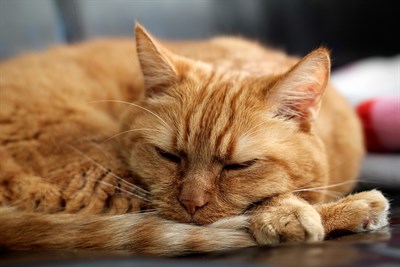
Older cats may also experience behavior changes in sleep cycles or waking in the night, restlessness and pacing. This is either related to senility or a disease called Hyperthyroidism.
“Hyperthyroidism occurs when the thyroid gland produces an excess amount of thyroid hormone which can lead to cardiac disease and high blood pressure,” said Crist. “A specific thyroid blood test can be checked to verify this abnormality and treatment can be initiated. Melatonin, an internal hormone secreted by the pineal gland during darkness, can also be given as an oral supplement usually with minimal side effects as a potential treatment for sleep disorders.”
Of course, there are several things that pet owners can do for their animals before their sleeping disorders become too severe.
“If owners notice their pet having a change in their sleeping pattern they want to take them to their veterinarian for a complete physical examination and laboratory analysis,” said Crist. “Medical problems may contribute to these disturbances and some medicines may need to be prescribed by a veterinarian to help combat their sleep disturbance.”
“While melatonin has been useful for treating sleep disorders that arise from hypothyroidism, senility, or cognitive dysfunction,” said Crist, “it is not regulated by the FDA, so ask a veterinarian the correct dose for your pet. Acupuncture and herbal medications are other modalities that might be used to treat sleep disorders in pets.”
Placing your pet on certain diets can also aid in their sleeping troubles.
“Omega 3 fatty acids and diets that are enriched with antioxidants are good for dogs with cognitive dysfunction and sleep issues,” said Crist. “Therapeutic diets supplemented with antioxidants such as vitamin C, mixed tocopherols, beta-carotene, flavenoids, carotenoids, and omega-3 fatty acids had dogs show improvement on the performance of cognitive tasks than dogs on a non-supplemented diet.”
It will always be a true mystery whether or not pets dream.
“In mammals and birds, studies have shown that long episodes of nondreaming sleep referred to as “slow-wave” or SW sleep is followed by short episodes of dreaming sleep referred to as “rapid-eye-movement” or REM sleep,” said Crist. “If a disturbance in this pattern occurs then sleeping problems can begin. However, we will never really know if pets dream because we cannot talk to them. However, we do know that dogs have the REM sleep phase and this is the dream activity period in people. Dogs do have leg movements, facial twitching, vocalizations, and tail movements. Therefore, it might be likely they are having a dream.”
Crist mentioned that it is important to know some sleep disorders require a lengthy behavioral consultation and examination by a veterinarian. Selective serotonin reuptake inhibitor antidepressants should be prescribed for these dogs and cats who have diagnosed obsessive-compulsive behavior disorders that are disturbing their sleeping patterns. She also reminded that by always taking our pets to the veterinarian for their regular check-up, many potential problems can be caught before they seriously affect your pet’s health.
Pet Talk is a service of the College of Veterinary Medicine & Biomedical Sciences, Texas A&M University. Stories can be viewed on the Web at vetmed.tamu.edu/news/pet-talk. Suggestions for future topics may be directed to editor@cvm.tamu.edu.
Angela G. Clendenin
Director, Communications & Public Relations
Ofc – (979) 862-2675
Cell – (979) 739-5718

