
First Academic Institution to Clone Three Species
COLLEGE STATION – Researchers at the College of Veterinary Medicine at Texas A&M University have cloned a litter of pigs, becoming the first academic institution in the world to have cloned three different animal species.
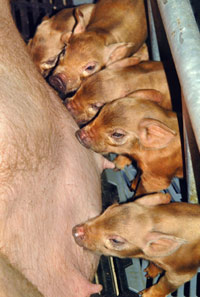 Texas A&M researchers have successfully cloned cattle, goats and most recently pigs and are aggressively working to clone dogs, cats, and horses. On Wednesday, September 5, cloned animals including five piglets, a goat, and two bulls were on display at a news conference held at the College of Veterinary Medicine at Texas A&M University where researchers and owners of the animals answered questions.
The first of five litters of piglets were born on August 12. “From the first litter, five piglets are healthy and growing quickly,” said Dr. Jorge Piedrahita who holds a joint appointment with the Texas Agricultural Experiment Station and the College of Veterinary Medicine and is the lead investigator on the project.
The swine cloning project was a collaborative effort involving scientists from the Center for Animal Biotechnology and Genomics (CABG). The CABG, includes researchers from the College of Veterinary Medicine, College of Agriculture and Life Sciences, The Texas Agricultural Experiment Station, The Health Sciences Center, and the George Bush School of Public Policy.
“Dr. Fuller Bazer, an internationally recognized expert in swine reproductive physiology, and his group provided essential expertise that facilitated successful completion of the swine cloning project,” added Dr. Piedrahita. Dr. Bazer holds a joint appointment with the College of Agriculture and Life Sciences and the College of Veterinary Medicine.
“Our research in cloning swine will help increase cloning efficiency and support the development of genetically modified cloned swine for use in medicine and agriculture,” added Dr. Piedrahita.
A cloned Boer goat named Second Addition (registered name Downen TX 63 684), was born on March 29. The donor was an 8-year-old Boer Champion doe and a top producer in Ewing and Donna Downen’s breeding program of Early, Texas.
Second Addition, nicknamed Megan, is the result of a collaborative research project conducted by Drs. Mark Westhusin, Ling Liu and Taeyoung Shin from the Department of Veterinary Physiology and Pharmacology, and Dr. Charles Long of Genetic Savings and Clone Inc. She has similar color markings to the donor and according to the Downens, is also quite similar in attitude and disposition. “Megan will play a major role in our Boer breeding program when she matures,” said Ewing Downen.
In November 2000, a team of researchers lead by Dr. Mark Westhusin at the College of Veterinary Medicine successfully cloned what was believed to be the first animal specifically cloned for disease resistance. The 10-month-old Angus calf, named “86 Squared” was cloned using cells that were frozen for 15 years, representing the longest time ever that genetic material has been maintained by cryopreservation, thawed and then successfully used in cloning. 86 Squared, named for his exponential genetic potential, was born three years after the death of Bull 86, his genetic donor.
In 1999, Dr. Mark Westhusin and a team of scientists at the College of Veterinary Medicine, became the first to successfully clone a calf from an adult steer, which was also the oldest animal ever cloned – a 21-year-old Brahman. University researchers accomplished the cloning of the steer, named “Chance,” in a yearlong project. Chance’s offspring, fittingly named “Second Chance,” displays identical markings as his father and has identical DNA.
“The knowledge we gain from cloning these animals could greatly affect several areas of science and medicine,” said H. Richard Adams, Dean of the College of Veterinary Medicine. That is what makes the CABG’s approach of developing multi disciplinary collaborative projects so powerful.
“With each successful cloned species, we learn more about cloning procedures and how to make cloning more effective. The potential benefits to the livestock industry and medical science could be immense,” said Dr. James Womack, Director of the CABG.
The center’s researchers have expertise in anatomy and cell biology, developmental biology, endocrinology, immunology, molecular and cellular biology, pathology, reproductive biology, molecular and quantitative genetics, physiology and pharmacology. The CABG provides a framework within which researchers can successfully integrate their expertise in interdisciplinary and multi disciplinary research efforts to benefit animal agriculture, veterinary medicine, and human medicine.
Established in 1916, the College of Veterinary Medicine is one of the world’s largest veterinary colleges and is an international leader in animal health care and research.

