
Hinrichs’ Foal
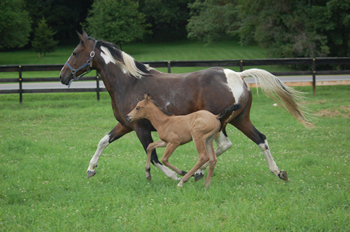
COLLEGE STATION, TX – Mira, a filly born August 4, 2009, trots happily in a pasture in Binghamton, N.Y., although her dam died over a year ago. The buckskin filly was born after shipment of oocytes (eggs), collected post mortem, to the Equine Embryo Laboratory at Texas A&M for fertilization. The Laboratory, directed by Dr. Katrin Hinrichs, professor of Veterinary Physiology and Pharmacology in the College of Veterinary Medicine, is one of a handful in the world capable of performing intracytoplasmic sperm injection, or ICSI, to fertilize equine oocytes and produce foals.
The oocytes were collected by Dr. Sylvia Bedford-Guaus and her laboratory team at Cornell University. They used special tools to scrape the wall of each follicle in each of the two ovaries obtained from the foal’s biological mother, Reba, who died after suffering from a ruptured intestine. After dissecting the ovaries, Bedford-Guaus packaged the oocytes for overnight shipment to Texas.
At A&M’s Equine Embryo Laboratory , the oocytes were incubated in a medium that would stimulate them to mature. Frozen semen was shipped to the laboratory from South Dakota, from the third-ranked barrel-racing stallion in the nation, and the sperm was used to fertilize the mature oocytes via ICSI. This procedure, performed at the Equine Embryo Laboratory by Dr. Young-Ho Choi, used a micromanipulation technique in which one sperm is injected into each egg. The fertilized eggs were cultured for 7 days, and embryos which developed were then shipped by air to Dr. David Hartman, adjunct professor of Large Animal Clinical Sciences at TAMU, at the Hartman Equine Reproduction Center, Whitesboro, Texas, for embryo transfer to a recipient mare.
Ultimately, 11 oocytes were collected by the team at Cornell; of these, two had already died. Of the nine shipped to Hinrichs’ laboratory, five matured; after fertilization and culture, two developed to embryos and were transferred, and one of these developed into a healthy foal.
“The process is time-sensitive and intricate,” said Bedford-Guaus, explaining that oocytes can only be seen microscopically and must be collected from the ovary within a few hours. “There were other approaches, such as shipping the entire ovary, but none that could offer the success rates we had with this procedure.”
“Using these techniques clinically is the culmination of the research we have been doing for the last 10 years” said Hinrichs, “It is really rewarding to be able to produce foals for owners under these trying circumstances.”
Kristin Contro owned Reba, a 14-year-old Quarter Horse. When Reba died, Contro knew that both her memory and her genes should be passed on. “Because there are so many horses in the world, prior to Reba I’ve never felt it was necessary to breed a horse,” said Contro, who began riding when she was 10 and has owned 20 horses. “Reba was as close to perfect as you could get. She was bred really well, so her genes were superb. Her conformation was perfect. And, she was a champion barrel racer. I am hopeful that her foal will also have her heart. That’s not something you can breed for. They either have it or they don’t.”

