
Texas A&M, UT MD Anderson Team Up to Treat Canine Lymphoma

HOUSTON – A new immunotherapy treatment for companion dogs with advanced-stage non-Hodgkin lymphoma (NHL) has been shown to improve survival while maintaining quality of life, according to a study published in the journal Scientific Reports. The study resulted from a collaboration between The University of Texas MD Anderson Children’s Cancer Hospital in Houston and Texas A&M University College of Veterinary Medicine in College Station.
Using a T-cell therapy developed at MD Anderson Children’s Cancer Hospital, veterinarians from Texas A&M saw a nearly four-fold improvement in tumor-free survival compared to dogs who received only chemotherapy. The median tumor-free survival for the Texas-based dogs increased by close to nine months, which is roughly equivalent to seven years in a human life span.
NHL is one of the most common cancers in dogs, according to Texas A&M veterinarians. Although standard chemotherapy treatment can achieve remission, it is rarely a curative treatment for non-Hodgkin lymphoma, with the dogs’ two-year survival rate remaining less than 20 percent. When investigators from MD Anderson and Texas A&M met, they explored the feasibility of administering T cells to improve survival.
“We followed the same rigid standards that we practice for human clinical trials at MD Anderson to ensure the safety of each dog,” said Laurence Cooper, M.D., Ph.D., professor and section chief of cell therapy at the children’s hospital and senior investigator on the study. “While these pets are benefiting from the T-cell infusions, this collaboration with Texas A&M is a driving force for undertaking similar clinical trials in humans.”
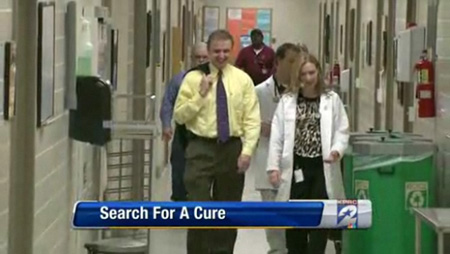
To accomplish the T-cell therapy, researchers took a sample of peripheral blood from each dog entering the study. Then the T cells were separated and expanded in Cooper’s laboratory over several weeks. As the T cells grew at MD Anderson, the dogs received a chemotherapy regimen treatment at Texas A&M similar to what humans with non-Hodgkin lymphoma receive, a combination of cyclophosphamide, vincristine, doxorubicin and prednisone. The T cells were then given back intravenously after the chemotherapy to improve the anti-tumor effects.
“The therapy was well tolerated in all dogs who received the infusions. We saw fewer side effects than with traditional chemotherapy, and the pet owners were please with how their dogs tolerated the protocol,” said Heather Wilson-Robles, DVM, DACVIM(Oncology), assistant professor at Texas A&M. “The owners were also very pleased to be supporting research that may further enhance cancer therapy in humans and pets with cancer.”
“Treating dogs with cancer provides us with a great comparative oncology model for humans,” said Colleen O’Connor, Ph.D., post-doctoral fellow at MD Anderson and one of the primary investigators on the study. “We learned important details about the interaction between chemotherapy and tumor cells that can be harnessed to improve the body’s immune response. This is something we hadn’t appreciated thus far from our clinical research in humans.”
From the trial, investigators found that:
- Chemotherapy, while damaging the canine tumor, also makes the tumor cells susceptible to recognition by the infused T cells
- Infusing back the patient’s T cells after chemotherapy can work to improve the survival of canines with NHL, since these T cells were held outside the body preventing damage from the chemotherapy
- Biomarkers were identified that can potentially play a role in determining prognosis
Overall the study further affirmed the ability to use the body’s own immune cells, such as T cells, to fight cancer. As a result, MD Anderson and Texas A&M collaborators are creating a program focusing on harvesting and expanding T cells at a large scale for broad clinical use.
Investigators at both institutions are working to open a new trial that will infuse genetically modified T cells that are tumor specific and potentially even more effective against the canine cancer cells.
Other contributors to the Scientific Reports study include Sabina Sheppard and Mark Johnson from Texas A&M and Cassie Hartline, Helen Huls, Shana Palla, Sourindra Maiti, Wencai Ma, Eric Davis, Suzanne Craig, Dean Lee and Richard Champlin from MD Anderson.
About MD Anderson
The University of Texas MD Anderson Cancer Center in Houston ranks as one of the world’s most respected centers focused on cancer patient care, research, education and prevention. MD Anderson is one of only 40 comprehensive cancer centers designated by the National Cancer Institute. For eight of the past 10 years, including 2011, MD Anderson has ranked No. 1 in cancer care in “Best Hospitals,” a survey published annually in U.S. News & World Report.
About MD Anderson Children’s Cancer Hospital
The University of Texas MD Anderson Children’s Cancer Hospital has been serving children, adolescents and young adults for more than 65 years. In addition to the groundbreaking research and quality of treatment available to pediatric patients, the Children’s Cancer Hospital provides comprehensive programs that help children lead more normal lives during and after treatment. For further information, visit the Children’s Cancer Hospital Web site at www.mdanderson.org/children. Get MD Anderson News Via RSS Follow MD Anderson News on Twitter
About Texas A&M College of Veterinary Medicine &
Biomedical Sciences
The Texas A&M College of Veterinary Medicine (CVM) is an institution that represents more than 95 years of growth from a small school of veterinary medicine in 1916 to its present role as a major veterinary educational, medical and research center. Through years of maturation and expansion, an institution emerged that has proudly produced some of the nation’s best practicing veterinarians who work to improve animal, public, and environmental health. The Texas A&M CVM continues to lead the nation in improving the quality of life for animals through excellence in education, research, and service. Get Texas A&M College of Veterinary Medicine News Via RSS
Follow Texas A&M College of Veterinary Medicine on Facebook
Contact Information:
Angela G. Clendenin
Director, Communications & Public Relations
Office – (979) 862-2675
Cell – (979) 739-5718


