
Reference Intervals
Dogs: 2.2 – 18.7 µg/g fecal material
A mean three-day α1-PI of ≥13.9 μg/g feces or a α1-PI of one individual sample of ≥21.0 μg/g feces is considered abnormal. Maximum and/or mean three time point a1-PI concentration(s) within the reference interval do not rule out protein losing enteropathy.
Please note, this assay has only been clinically validated for adult dogs (dogs that are one year of age or older). Fecal α1-PI concentrations have been shown to be increased in young healthy puppies. The reference range does therefore not apply for puppies.
Cats: This assay is no longer available for cats. We apologize for any inconvenience.
What is the principle behind this test?
GI disease can lead to a compromise of integrity of the intestinal mucosa leading loss of plasma proteins into the gastrointestinal lumen. Alpha1-PI is a plasma protein, similar in size to albumin, and is lost into the gastrointestinal lumen at about the same rate as albumin and other plasma proteins, such as antithrombin III. In contrast to other plasma proteins, α1-PI is a proteinase inhibitor and thus able to resist degradation by digestive and bacterial proteinases (see Figure 1). Alpha1-PI remains essentially intact in the gastrointestinal lumen and can, therefore, be detected in feces by use of an immunoassay.
Gastrointestinal protein loss can be associated with a variety of gastrointestinal and systemic disorders such as idiopathic inflammatory gastroenteropathies (also knows as IBD or CIE), gastrointestinal neoplasia, foreign bodies, intussusceptions, small intestinal dysbiosis, infectious enteritis, immune-mediated diseases, or intestinal lymphangiectasia. Therapy and outcome depend on the underlying disease process.
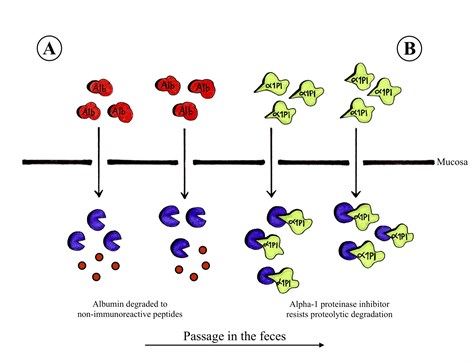
Figure 1:
A: After being lost into the intestinal lumen, albumin and other plasma proteins are readily degraded by digestive and bacterial proteinases. The resulting degradation products are not immunoreactive and thus cannot be measured by immunoassays.
B: Alpha1-PI has a similar molecular size to albumin. Unlike albumin, α1-PI resists degradation by proteinases present in the intestinal lumen and can thus be detected in feces by immunoassays.
How do fecal samples for this assay have to be collected?
Special pre-weighed fecal tubes have to be used and are available through the Gastrointestinal Laboratory. Fresh fecal samples (one gram each) from naturally-passed defecations from 3 consecutive days should be collected as soon as possible after defecation. Each sample tube must be immediately frozen after collection. All 3 samples should then be shipped frozen by overnight courier. To order fecal tubes, please email gilab@cvm.tamu.edu. The cost of 15 fecal tubes is $25. They will be mailed out via USPS for no additional charge. If you would like to receive the fecal tubes sooner, we can send them FedEx overnight for and additional $28.
Shipping guidelines for canine Alpha1-Proteinase Inhibitor (α1-PI)
Please note: Samples for this test must arrive frozen at the laboratory in order to avoid breakdown of proteins leading to false negative results. In our experience, samples have the best chances for arriving frozen when shipped either with dry ice or at least in a styrofoam container with several frozen gel ice packs. Unfortunately cardboard containers do not insulate well enough against average Texas temperatures. These samples also must be shipped overnight by either FedEx or UPS. Please do not use the US Postal Service as these samples generally tend to experience significant delays and are not delivered directly to the laboratory once they reach our campus. International shipments for this test must be sent on dry ice. Please do not ship samples later than on a Thursday since we are not able to receive any packages on weekend days.