
General information
The sensitivity of the assay is 1-2 eggs per 1 g of feces. The PCR will amplify DNA that is directly extracted from fecal material.
For this test we will require up to 1 gram of fresh feces. The sample should be taken from the abnormal loose stool.
For storage and shipping, please collect the sample and store in the refrigerator for up to one week before shipping. Fresh samples are ideal. Please ship samples cooled overnight with a gel ice pack.
Turnaround: 1-2 business days after receipt of samples.
General information about Heterobilharzia americana
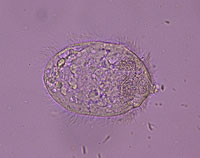
Recently, there have been several reports of canine schistosomiasis along the Gulf Coast. The causative agent, Heterobilharzia americana (Figure 1), is a trematode that is closely related to Schistosoma spp., which is known to infect humans in emerging countries. Transmission is via penetration of the skin by cercariae in water sources containing the snail intermediate host. The natural reservoirs for H. americana are raccoons and other varmints.
Clinical signs
Clinical signs of infected dogs are poorly described, but include weight loss, diarrhea, hematochezia, and other clinical signs related to the GI tract. Additionally, in severe infections, hepatic disease can be seen. Diagnosis can be difficult, primarily due to the lack of consistent clinical signs and the lack of suspicion by the veterinarian in endemic areas. A complete blood count and a serum chemistry profile are often normal. However, many dogs present with hypercalcemia with decreased serum parathyroid hormone concentrations and/or an increased serum parathyroid hormone-related protein (PTHrP) concentrations. Some dogs are erroneously diagnosed with neoplasia and hypercalcemia of malignancy when in fact these dogs have hypercalcemia due to the granulomatous disease caused by Heterobilharzia. Schistosomiasis should be on the differential list for dogs with the aforementioned clinical signs, living in endemic areas, and access to standing water.
Diagnosis
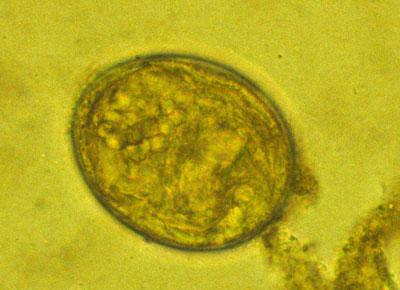
The clinical diagnosis is generally made by demonstration of the egg in feces (Figures 2 ) or by histopathology of intestinal or hepatic biopsies. However, the trematode egg can only be identified by sodium chloride sedimentation. As fecal sedimentations are not routinely performed in clinical practice, the GI Lab has developed a PCR-based assay for the detection of DNA from the eggs in feces. The PCR is highly sensitive and reliably detects 1-2 eggs per gram of feces. This PCR can also be used to demonstrate the organism in hepatic and intestinal biopsies.
For sample submission, at least one gram of fresh feces,stored in the refrigerator should be shipped overnight with ice packs. It may be of benefit to consider sending feces from 2 or 3 different days as shedding may be intermittent. There are no special sample handling requirements for this new assay.
Treatment
Treatment is usually with high doses of praziquantel (25 mg/kg PO q8h for 2 days) or prolonged treatment with fenbendazole (40 mg/kg PO SID for 10 days, repeat in 3 weeks).
Further reading
- Flowers JR, Hammerberg B, et al. Heterobilharzia Americana infection in a dog. J Am Vet Med Assoc 2002 Vol 220 (22) pp. 193-196
- Fradkin JM, Braniecki AM, et al. Elevated parathyroid hormone-related protein and hypercalcemia in two dogs with Schistosomiasis. J Am Anim Hosp Assoc 2001 Vol 37 pp.349-55
- Slaughter II JB, Billups LH, et al. Canine heterobilharziasis. Comp Cont Educ Pract Vet 1998 Vol 10 pp. 606-612
“This service is performed pursuant to an agreement with Roche Molecular Systems, Inc.”