Services
Notice!
Due to cost increases for all consumables and chemicals, cytogenetics and FKBP6 genotyping service prices were adjusted as of September 1, 2025.
Available Services
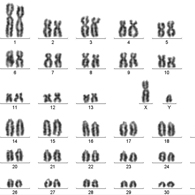
- Karyotyping from blood, tissues and cell lines
- Karyotyping with routine staining or G-banding of chromosomes
- Molecular cytogenetic analysis using Fluorescent In Situ Hybridization (FISH)

FISH Analysis
Carried out by request only and is used for:
- Unequivocal identification of chromosomes involved in autosomal or sex chromosome aneuploidies
- Refinement of the analysis of complex chromosomal rearrangements (translocations, inversions, deletions)
- Gene mapping
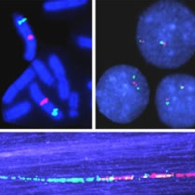
Specific details and cost of FISH experiments depend on the species, availability of hybridization probes and the aim of the experiment. Therefore, the prospective clients are advised to contact us beforehand to discuss the details.
Test for Thoroughbred stallion subfertility from blood or hair follicles
Fillable Forms (PDF)
Collection & Shipping Procedures
A. Collection:
- For large animals, send 5–10 mL blood in green top (Sodium or Lithium Heparin) and 10 20 mL blood in purple top tubes (EDTA).
- For small animals, send a minimum of 1–2 mL blood in green top and purple top tubes.
B. Shipping:
- Preferably overnight or 1–2 days mail.
- Please wrap the tubes in paper towels to prevent direct contact with ice bags and avoid freezing.
- Samples degraded during transit are sender s responsibility.
A. Collection Medium:
In a sterile cell culture hood prepare 15 ml sterile conical tubes containing:
- 10 ml Hank’s Balanced Salt Solution (sterile)
- 200 μl of 100XAntibiotic Antimycotic solution (sterile)
Store the tubes ready-to-go at 20oC
Hanks Balanced Salt Solution (HBSS) (1X), liquid
- Invitrogen SKU# 24020-117
- 500 ml
- Contains calcium and magnesium
Antibiotic-Antimycotic (100X), liquid
ThermoFisher (Gibco SKU# 15240-062 100 mL; #15240-096 20 mL)
Contains 10,000 units of penicillin (base), 10,000 μg of streptomycin (base), and 25 μg of amphotericin B/ml utilizing penicillin G (sodium salt), streptomycin sulfate, and amphotericin B as Fungizone® Antimycotic in 0.85% saline.
B. Setting Up Primary Cultures:
- Collect skin biopsy/necropsy as sterile as possible; transport and store in 10 mL collection media (see above).
- Change collection medium a few times during 1–2 days. Do not keep tissues in collection tubes longer than 3 4 days.
- Pass pieces of skin/biopsy/other through multiple (min 6X) petri dishes containing HBSS & anti-anti; cut pieces small (0.2×0.2 cm). Take time in cleaning each piece individually.
- Set up cultures in T25 flasks by planting 8–9 small pieces of tissue per T25 flask. Many pieces on a small territory is important for cell cell communication via growth factors and will facilitate cell emergence and proliferation. Add about 1 mL of sterile alpha MEM containing 20% FBS and anti anti into each.
- Keep on checking cultures for cell growth every day. Change medium in every 2 3 days.
- Once the cells emerge and start to proliferate, remove pieces of tissue.
- Grow T25 flasks to confluency. Passage into 2 T75 for chromosome perps, otherwise freeze in LN2.
A. Transport of Attached Cells:
Please send two semi confluent (about 60%) T75 flasks for karyotyping and one T25 seed flask (in case we need to grow more cells). The flasks must be filled with media up to the cap in order to prevent damage to the cells. Each flask must be individually wrapped into bubble wrap and plastic bag to prevent flask cracks and/or contamination due to damage during transport.
B. Transport of Unattached Cells:
Please send unattached cells in sterile 15 mL centrifuge tubes filled with media up to the cap. The tubes must be individually wrapped into bubble wrap and plastic bag to prevent cracks and/or contamination due to damage during transport.
C. Culture Conditions:
Please include detailed description about cell culture conditions (culture media, temperature, CO2 %, etc.). NB! In case the cells are using media other than Alpha MEM with Glutamax and nucleosides + 10% FCS, please provide us with the media.
D. Cells in LN2:
Cell in LN2 must be sent in cryovials on dry ice. The cells must be accompanied by information about the number of cells in each vial and about culture conditions.
Shipping Address
All Samples Should Be Addressed and Sent to:
Texas A&M University, VMBS, VIBS
Molecular Cytogenetics Lab (VMR #314; Raudsepp)
664 Raymond Stotzer Pkwy. | VICI 126, Bldg. #1814
4458 TAMU | College Station, TX 77843-4458 | USA
Attn: Dr. Terje Raudsepp | Tel: 979.862.2879