
VMBS Advances Environmental Health Research With Three NIEHS Grants
Story by Courtney Price
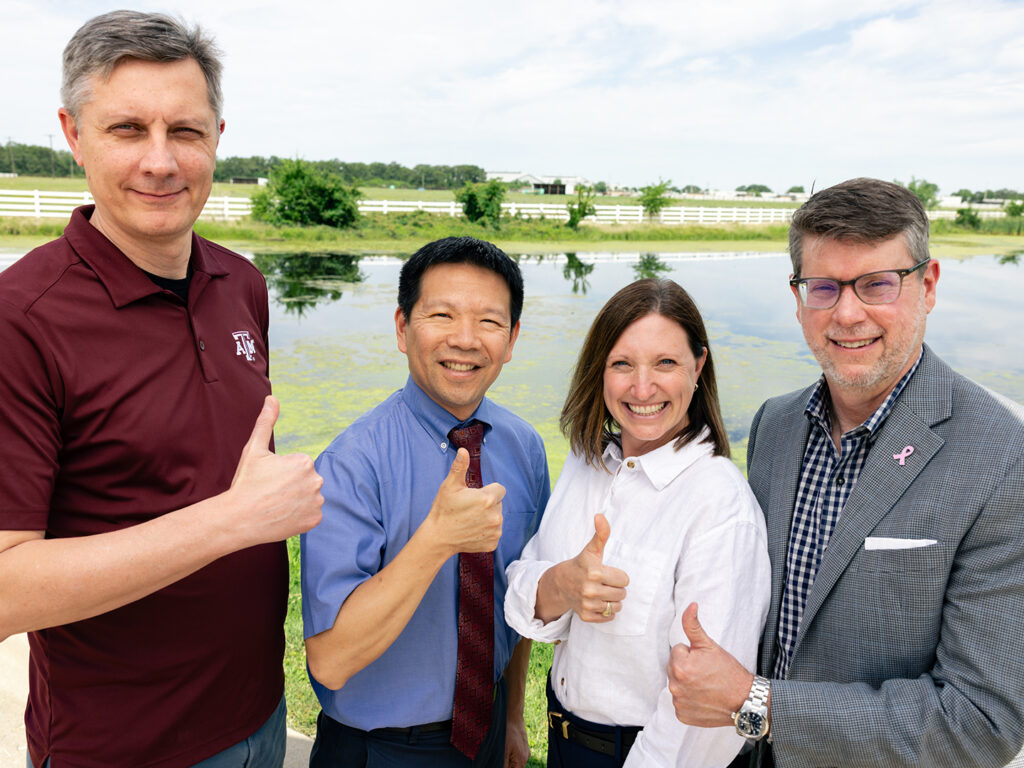
At the Texas A&M College of Veterinary Medicine & Biomedical Sciences (VMBS), “One Health” isn’t a buzzword — it’s a central philosophy that recognizes the vital, synergistic relationship between animal, human, and environmental health.
In order to better understand environmental impacts on humans and animals, faculty within the VMBS work to address these issues, now and into the future, through three NIEHS grants — the Texas A&M Center for Environmental Health (TiCER), the Texas A&M Superfund Research Center, and the T32 Institutional Research Training Grants program.
Together, these grants allow VMBS scientists to conduct innovative environmental health research, connect community organizations with health resources, provide funding and networking opportunities for early-career scientists, mentor graduate and postdoctoral students in areas where there are research shortages, and, as importantly, collaborate with faculty members from a variety of disciplines across campus.
They also set Texas A&M apart from other universities in the United States.
“There are only a handful of universities — and no other vet schools — that have all three of the NIEHS’ most significant grant awards,” said Dr. Michael Criscitiello, the VMBS’ associate dean for research and graduate studies. “We are very proud to make Texas A&M a nexus for environmental
health studies.”
Creating Collaborations At TiCER
As one of only 26 National Institutes of Health (NIH) Environmental Health Sciences Core Centers in the U.S., TiCER facilitates collaborative research that studies the relationships between climate, air pollution, and health; policy and environmental burdens; environmental stressors and responses; and environment and metabolism.
“We look at environmental issues like climate change and pollution and how they affect living conditions in urban areas,” said Dr. Weston Porter, the center’s director and a professor in the VMBS’ Department of Veterinary Physiology & Pharmacology (VTPP).
“For example, rising global temperatures can be exacerbated by large stretches of pavement, which absorb heat and raise the temperature in cities. Heat also plays a role in how ozone particles behave on Ozone Action Days, when ozone levels rise to unhealthy levels. Many of the issues we research at TiCER have multiple layers to them,” he said.
With its $7.6 million in NIEHS funding, the center promotes a cross-disciplinary approach to solving complex problems, even recruiting researchers whose main focus may not be environmental health.
“TiCER’s efforts are concentrated on environmental concerns in the ‘Texas Urban Triangle’ between Houston, Dallas-Forth Worth, San Antonio, and Austin, which contains the largest suburban area within the state,” Porter said. “Because Texas A&M is right in the center of this triangle, TiCER researchers are uniquely positioned to examine issues in support of the university’s land-grant mission.”
“It’s really part of our mission as faculty and researchers to reach as many Texans as possible,” said Dr. Natalie Johnson, TiCER associate director and an associate professor in the Texas A&M Department of Environmental and Occupational Health. “Our location allows us to have access to some of the
most heavily populated areas of Texas as well as the rural communities in between.”
Research That Serves Texans

Working with communities is an essential part of how of TiCER operates; through its Community Engagement Core, important health information is both shared with and gleaned from Texans, which allows TiCER scientists to determine where they need to direct their research.
“The established way that basic science often gets translated to public health is one-directional — from ‘bench to bedside,’ or from the lab bench to the hospital,” Johnson said. “But we want to interrupt that pattern so that people don’t have to go to the hospital in the first place. For us, research is from bench to the community and back.
“For example, in my own research, I look at how air pollution impacts the developing fetus. I ask questions like, ‘What does it mean for an infant’s immune system development when the mom breathes in pollution during pregnancy?’” she said. “It’s great to understand the science, but then we need to get the message back to the community, so people know what precautions to take, and work with them to understand how they are impacted.”
Opening Doors For New Research
One goal for TiCER’s leadership is to make sure junior faculty and those who have not worked with the NIEHS before feel like they, too, can participate in environmental health research.
“Once you get one grant to fund part of your research, it’s easier to get others that will help you continue,” Porter said. “But for junior faculty, it can be difficult to get that ‘first- project stage’ started. We hope that TiCER will help generate grants and increase the possibility for early career scientists to get started. These grants will also benefit researchers at any point in their careers who have new ideas they want to test before applying for larger amounts.”
TiCER has multiple grant levels, including pilot project awards of up to $50,000 and smaller vouchers that can award $1,000, $5,000, or $10,000. This allows TiCER to fund a variety of projects in different stages, from kickstarting a small study to funding a major part of a larger project.
“We want to help scientists look at their work from an environmental and public health angle to assist them with funding,” Porter said. “By helping researchers make connections between the work they do and the impact it has on people’s health, we can make it more likely that they will get the funding they need to continue.”
Defending Against Environmental Hazards

Scientists in the Texas A&M Superfund Research Center — one of 25 university-based, multi-project centers across the U.S. funded by the NIEHS’ Superfund Research Program — evaluate hazardous chemical exposures and the dangers they pose to human, animal, and environmental health, particularly during disaster situations.
Among the Superfund Center’s research focuses are per- and poly-fluoroalkyl substances (PFAS). Thousands of PFAS chemicals are commonly used in everything from food packaging to clothing and cosmetics — despite growing concerns that PFAS are linked to health problems in humans and animals. Because they break down incredibly slowly, PFAS have earned the nickname “forever chemicals.”
At the Superfund Center, researchers like director Dr. Ivan Rusyn are working to understand how PFAS impact human health so that better regulations can be developed. Rusyn, a VTPP professor, leads one of the center’s five major research projects, studying how different tissues and individuals respond to hazardous substances — including PFAS.
“PFAS are concerning because of their wide use, persistence, and potential to be hazardous to both humans and the environment,” Rusyn said. “Unfortunately, scientists lack toxicology and exposure data for most commercially used PFAS, so we are using innovative methods to build a library of data that can help identify which PFAS have the highest associated health risks.”
Making A Community Impact
Scientists at the Superfund Center prioritize two aspects of working with communities in their research — first, they engage with communities to find practical, real-world solutions to disaster effects and environmental hazards, making their work directly applicable to the lives of Texans.
Second, they strive to make their work accessible to communities throughout Texas; this is central to the center’s Community Engagement Core (CEC), led by Dr. Galen Newman, head of the Texas A&M Department of Landscape Architecture and Urban Planning.
Through the CEC, Newman collaborates with local outreach organizations and has partnered with more than 30 communities across the state, many of which are located near industrial facilities where heavy storms and floodwater can carry toxic chemicals into residential areas.
To help communities build resilience and protect themselves against these potential hazards, Newman and his team create maps that show water settling points, which is where concentrations of toxic chemicals tend to be higher. Armed with this knowledge, communities are able to incorporate green infrastructure features that absorb rain and redirect stormwater runoff, protecting residents from waterborne hazards.
“Our goal is to help improve human health outcomes through improvement of the conditions of the built and natural environments within the communities with which we work,” Newman said. “We not only work with the other disciplines in the grants through the CEC to both create new knowledge and assess data, but we also visualize findings and make them digestible to community partners and stakeholders. We then use their feedback on our findings to create prevention and interventions strategies to solve local issues and provide them with a tangible plan to grow in the long-term. Through actual implementation of these strategies and/or the obtainment of external funding to help fix their unique neighborhood issues, we always strive for positive local impact.”
Training The Next Generation

As VMBS researchers work to uncover environmental health hazards and ensure that their findings reach the communities most likely to be impacted, they also train the next generation of environmental health experts who will follow in their shoes — thanks, in part, to an NIH T32 training grant, funded by the NIEHS and directed by Rusyn.
The grant, which has so far funded 36 doctoral students and post-docs from across Texas and the U.S., is through the Interdisciplinary Faculty of Toxicology program and focuses on regulatory toxicology and environmental health.
“Our goal from the beginning was to create career-ready toxicologists who could go into any related field, not just academia,” said Johnson, who is director of the Toxicology training program alongside Rusyn and VTPP professor Dr. Weihsueh Chiu, deputy director of the Superfund Center and externship director for the T32 program.
“They are getting jobs in different levels of government, looking at regulation of chemicals; in companies overseeing chemical safety protocols prior to going onto the market; and in consulting — we’re really preparing them to be regulatory toxicologists, not just helping them to graduate,” she said.
“I have been very fortunate to be supported by the T32 program as a Ph.D. student and now as a postdoctoral fellow,” said Dr. Lucie Ford ’24, who works in Rusyn’s lab. “The grant has provided me with many opportunities for professional and personal development, from attending national conferences to networking. It has also allowed me to interact with and explore various career paths and has allowed me to be mentored by professionals across various industries.”
“The training grant enabled me to expand my knowledge beyond coursework and research, fostering my development into a well-rounded scientist prepared for my professional career,” said Dr. Alina Roman-Hubers, an alum of the T32 program who is now a toxicologist at Chevron.
The toxicology T32 training grant isn’t the only NIH training grant that the VMBS has been involved with. Dr. Albert Mulenga, head of the VMBS’ Department of Veterinary Pathobiology, leads a T32 grant to train Doctor of Veterinary Medicine students as pathobiologists. In previous years, there have also been two other T32 grants — the Initiative for Maximizing Student Development that supported trainees seeking degrees in biomedical sciences, and a T32 grant through the Interdisciplinary Graduate Program in Genetics and Genomics that included VMBS faculty mentors.
“There have only been a few T32 grants at Texas A&M,” Criscitiello said. “The VMBS has a long history of involvement with almost all of them. We’re proud to be training so many new experts in One Health research.”
###
For more information about the Texas A&M College of Veterinary Medicine & Biomedical Sciences, please visit our website at vetmed.tamu.edu or join us on Facebook, Instagram, and Twitter.
Contact Information: Jennifer Gauntt, Director of VMBS Communications, Texas A&M College of Veterinary Medicine & Biomedical Sciences, jgauntt@cvm.tamu.edu, 979-862-4216
You May Also Like

Texas A&M Researcher Combats Colic Complications
McAllen BIMS Student Pursues Specialized Nursing Career

Texas A&M Researchers Revolutionize Nebulized Therapies

Texas A&M Veterinarians Restore Persian Cat’s Ability To Eat

Harnessing The Power Of Clay To Protect Communities From Toxins


