
Aggie PACT to Bring More Science Teachers to Texas Schools

College Station, TX – The College of Veterinary Medicine, Texas A&M University celebrated the official kick-off of the Aggie Program of Accelerated Certification for Teaching (PACT) with a luncheon, hosted by the College’s Department of Biomedical Science, the College of Science, the College of Education and the College of Agriculture and Life Science’s Department of Wildlife and Fisheries on October 30, 2001.

Over 60 school superintendents across the state of Texas were invited to the luncheon to interact with 30 currently enrolled students and to learn more about the Aggie PACT program.

Dr. F. H. “Skip” Landis, Director of the Biomedical Science program and Dr. Norm Dronen, professor and composite field advisor for biology and science, designed the Aggie PACT Program to address the shortage of science teachers throughout the state of Texas and train highly qualified individuals for quick classroom placement.

“Texas is currently in need of approximately 15,000 teachers qualified to teach science. Our program is an accelerated certification plan that provides an alternative to the traditional model by allowing us to work with the Region IV Education Service Center and place students in paid internships immediately following graduation,” said Landis.

Students majoring in Biomedical Science or Wildlife and Fisheries Science are eligible to participate in the program. The course content between both departments varies except for the final 15 hours in their senior year, which are determined by the College of Education’s Office of Continuing Education. When the undergraduate work is completed, students must participate in a one-year paid internship available in most Texas school districts and facilitated through Region IV.

“The internship completely replaces the need for student teaching and provides Aggie PACT participants with a distinct advantage and a good starting point because they already have a job lined up and a secure future,” said Landis.

During the internship the students take two tests in science and education to certify professional competency called Examination for the Certification of Educators in Texas (ExCET). Upon completion of the ExCET certification exams and the internship, the student teachers will be qualified to teach secondary school grades 8-12. The ExCET in the subject matter is administered prior to the internship. The ExCET professional exam will be taken during the internship.

With the help of the Region IV Education Service Center the Aggie PACT program provides the state of Texas with a distinct advantage by creating another option for students to quickly increase the number of qualified science teachers. This program is excellent for students who want a career in education and allows them accelerated access into the classroom only one year after graduation.

Contact Information:
Angela G. Clendenin
Director, Communications & Public Relations
Ofc – (979) 862-2675
Cell – (979) 739-5718
Tom & Joan Read Chair in Veterinary Surgery

Dr. H. Richard Adams, dean of the College of Veterinary Medicine at Texas A&M University, is pleased to announce that Dr. Theresa W. Fossum has been appointed the first Tom and Joan Read Chair in Veterinary Surgery.

Described as “driven” by her colleagues, and “compassionate” by the clients who entrust their animals to her care, Fossum’s passion is rivaled only by her determination to help build a world-class cardiothoracic program at the College of Veterinary Medicine. “When anyone thinks about cardiac surgery, I want them to think of Texas A&M University,” she said. “We have the faculty expertise and the commitment to make it happen.”

Fossum has been on faculty at the College of Veterinary Medicine since 1987. She earned a Bachelor of Science in Agriculture at the University of Idaho, a Doctor of Veterinary Medicine at Washington State University, a Master of Science in Veterinary Anatomy at the Ohio State University, and a Doctor of Philosophy in Veterinary Microbiology at Texas A&M University. She completed a surgery residency at the Ohio State University in 1986 and is a diplomate of the American College of Veterinary Surgeons. She held the Wiley Distinguished Professor of Veterinary Medicine at Texas A&M University from 1994 to 1997.

Fossum’s research areas include cardiothoracic surgery, angiogenesis, lymphatic system, and chylothorax. She was instrumental in establishing the Michael E. DeBakey Institute at the College of Veterinary Medicine. Her research in biomedical devices using a calf model led to clinical trials of The MicroMed DeBakey VAD (ventricular assist device) in human patients with heart failure. The device, weighing less than four ounces, can be implanted in children or small adults and will assist the heart in pumping blood. In the near future, Fossum hopes to apply this same technology to veterinary medicine by implanting the device in animals with heart disease to prolong their lives.

Fossum has authored more than 70 scientific publications in refereed journals, 18 abstracts, 33 book chapters, served as editor for three books, and made over 130 scientific presentations. Her honors include the Carl J. Norden Distinguished Teacher Award, Texas A&M University, the American Veterinary Medical Foundation and American Kennel Club Excellence in Canine Research Award, and she was an intern for the Center to Leadership in Higher Education Administration program at Texas A&M University. She is a member of the AVMA, TVMA, and numerous other scientific organizations. Fossum has served on the editorial and review boards of Veterinary Surgery, J American Animal Hospital Association, J Am Vet Med Assoc, and others.

“The College is truly fortunate to have someone as accomplished as Dr. Fossum, with her dedication and expertise, to serve as the first Tom and Joan Read Chair in Veterinary Surgery,” said Dean H. Richard Adams.

The purpose of the Chair is to provide educational leadership for the faculty and students of the College of Veterinary Medicine with an initial emphasis in cardiothoracic surgery.

Associate Director of Biomedical Science Program Retires After 32 Years with College of Veterinary Medicine

After 32 years with the College of Veterinary Medicine, Associate Director of Biomedical Science, Mr. Lyndon Kurtz, was honored by friends and colleagues at a retirement reception held at the college on February 5, 2002.

Kurtz served as an administrative assistant in the dean’s office from 1969 to 1979 and then as Assistant to the Dean until 1990. During the last eleven years as Associate Director of Biomedical Science, Kurtz has played a key role in recruiting students from a wide range of backgrounds into the College of Veterinary Medicine; promoting the college to prospective students, counselors and employers; counseling students and parents in areas of vocational and career interests; providing orientation for incoming undergraduate students in the Department of Biomedical Science; and supervising Veterinary Enrichment Camps. During this time, Kurtz has seen enrollment in the Biomedical Science Program grow from 700 to 2100 students.

In addition, during Kurtz’s employment, the Biomedical Science Program (BIMS) was awarded the Diversity Award (April 2000) and a four-year Health Career Opportunity Program grant (1985-1988) designed to attract and retain veterinary students, and to reinforce the sciences for students interested in entering into the professional program.

“Perhaps the most enjoyable time that I’ve spent here has been at commencement. In the 32 years I’ve worked at the college, I’ve only missed one veterinary commencement ceremony. It just happened that both commencement and the birth of my first grandchild happened on May 10, 2001.”

Reflecting on his time at the college with much affection, Kurtz said, “I’ve looked forward to coming to work every day. The veterinary college has given me 32 years of opportunity to help young people reach the next level.”

“Mr. Kurtz has made an indelible mark on the lives of so many students at the College of Veterinary Medicine,” said H. Richard Adams, Dean of the College of Veterinary Medicine. “He has contributed greatly to the college’s student recruiting success.”

Kurtz officially retired on February 28, 2002, however, as of April 1, 2002, continues to work part time as needed in the Biomedical Science Program.

Doctors Perform First Successful Heart Bypass at the College of Veterinary Medicine

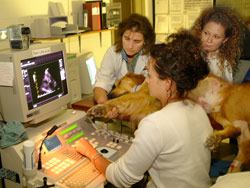
College Station – In a collaborative effort, veterinarians and human health professionals worked together to perform the first successful heart bypass surgery at the College of Veterinary Medicine, Texas A&M University. On Saturday, October 20, Dr. Theresa W. Fossum, Professor of Surgery and Endowed Chair and Dr. David Nelson, Clinical Assistant Professor from the College of Veterinary Medicine, Dr. Mark Felger, a cardiovascular surgeon with Cardiothoracic and Vascular Associates of Austin, Texas and their surgical team performed surgery on Luke, a two-and-a-half year-old Golden Retriever from, San Antonio, Texas.

Heart Scan MD

“Luke had a condition known as sub-aorta stenosis, which is one of the most common congenital heart defects,” said Dr. Sonya Gordon, a Veterinary Cardiologist at the college who has overseen Luke’s treatment since he was a puppy. “Usually, this condition causes sudden death before the patient turns three years of age. Over the past few months, Luke has lost weight and we knew that we were running out of time.”

The 92-minute heart procedure included surgical entry through the right ventricle, through the septum into the left ventricle to remove the obstruction. “We took out a large window of tissue in the septum which relieved some of the pressure and allowed us to see better into the left ventricle. The window in the thickened septum was repaired with a thin patch made from Luke’s own tissue.”

While a similar procedure has been performed on children, this approach was considered aggressive treatment in animals. “Colorado State has done a series of these cases using a different approach which hasn’t been determined to change the long term survival of the patient,” said Gordon.

In measuring the speed of blood flowing through Luke’s heart doctors saw a vast improvement in his condition. The blood flow went from eight meters per second before surgery to 3.3 meters per second after surgery. “This is a tremendous improvement. The narrower the opening, the faster the blood flows and the harder the heart has to work,” added Gordon.

What is not known is how much damage was done to Luke’s heart over the past two-and-a-half years and whether that damage is reversible. “We will see Luke in a month, and then again in three months. If everything goes as hoped, he will have annual checkups and as a result of the bypass surgery, live to a ripe old age,” said Gordon.

Due to the life-threatening nature of the condition, plans were made to attempt a surgical correction of the problem. However, a year ago when the plans were first discussed, there weren’t a lot of options.

The Michael E. DeBakey Institute for Comparative Cardiovascular Science and Biomedical Devices was established at the College of Veterinary Medicine at Texas A&M University in 1999 to facilitate such procedures. However, bringing the necessary expertise and equipment together takes time. “We are still in the process of building a heart surgery program so that we can perform bypass procedures on pets and other animals,” said Fossum. “We are fortunate to have an outstanding team of surgeons, cardiovascular perfusionists, anesthetists, and a cardiothoracic criticalist on staff to help us build the heart surgery program.”

The program is in need of funding to purchase a dedicated ultrasound machine and other equipment necessary for sophisticated heart procedures. “Heart disease, including the need for valve replacement or repair, is common in dogs,” said Fossum. “It is expensive to set up a program like this and to make these procedures available.” Many people, like Cindy Norris, Luke’s owner, love their animal and desire to seek advanced medical attention for their pet, but can’t afford the tremendous cost of surgery.

“When Luke was a puppy I took him to the veterinarian and she didn’t like what she heard. The results of that examination were devastating. Over time, Luke’s condition kept getting worse. When he was four months old, I prayed for a miracle and this successful procedure is my answer,” said Norris.

Luke was discharged on Friday, October 26th, after veterinarians and technicians working on his case presented him and owner Norris with a cake and a Texas A&M University sweatshirt signed by members of the surgical team.

Established in 1916, the College of Veterinary Medicine at Texas A&M University is one of the world’s leading institutions in animal health care and research.

###

For more information about the Texas A&M College of Veterinary Medicine & Biomedical Sciences, please visit our website at vetmed.tamu.edu or join us on FacebookInstagram, and Twitter.

Contact Information: Jennifer Gauntt, Director of CVMBS Communications, Texas A&M College of Veterinary Medicine & Biomedical Sciences; jgauntt@cvm.tamu.edu; 979-862-4216

First Academic Institution to Clone Three Species

COLLEGE STATION – Researchers at the College of Veterinary Medicine at Texas A&M University have cloned a litter of pigs, becoming the first academic institution in the world to have cloned three different animal species.

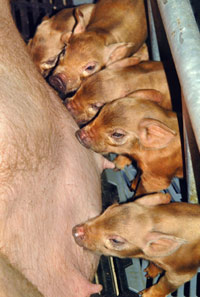
Piglets Texas A&M researchers have successfully cloned cattle, goats and most recently pigs and are aggressively working to clone dogs, cats, and horses. On Wednesday, September 5, cloned animals including five piglets, a goat, and two bulls were on display at a news conference held at the College of Veterinary Medicine at Texas A&M University where researchers and owners of the animals answered questions.
The first of five litters of piglets were born on August 12. “From the first litter, five piglets are healthy and growing quickly,” said Dr. Jorge Piedrahita who holds a joint appointment with the Texas Agricultural Experiment Station and the College of Veterinary Medicine and is the lead investigator on the project.

The swine cloning project was a collaborative effort involving scientists from the Center for Animal Biotechnology and Genomics (CABG). The CABG, includes researchers from the College of Veterinary Medicine, College of Agriculture and Life Sciences, The Texas Agricultural Experiment Station, The Health Sciences Center, and the George Bush School of Public Policy.

“Dr. Fuller Bazer, an internationally recognized expert in swine reproductive physiology, and his group provided essential expertise that facilitated successful completion of the swine cloning project,” added Dr. Piedrahita. Dr. Bazer holds a joint appointment with the College of Agriculture and Life Sciences and the College of Veterinary Medicine.

“Our research in cloning swine will help increase cloning efficiency and support the development of genetically modified cloned swine for use in medicine and agriculture,” added Dr. Piedrahita.

A cloned Boer goat named Second Addition (registered name Downen TX 63 684), was born on March 29. The donor was an 8-year-old Boer Champion doe and a top producer in Ewing and Donna Downen’s breeding program of Early, Texas.

Second Addition, nicknamed Megan, is the result of a collaborative research project conducted by Drs. Mark Westhusin, Ling Liu and Taeyoung Shin from the Department of Veterinary Physiology and Pharmacology, and Dr. Charles Long of Genetic Savings and Clone Inc. She has similar color markings to the donor and according to the Downens, is also quite similar in attitude and disposition. “Megan will play a major role in our Boer breeding program when she matures,” said Ewing Downen.

In November 2000, a team of researchers lead by Dr. Mark Westhusin at the College of Veterinary Medicine successfully cloned what was believed to be the first animal specifically cloned for disease resistance. The 10-month-old Angus calf, named “86 Squared” was cloned using cells that were frozen for 15 years, representing the longest time ever that genetic material has been maintained by cryopreservation, thawed and then successfully used in cloning. 86 Squared, named for his exponential genetic potential, was born three years after the death of Bull 86, his genetic donor.

In 1999, Dr. Mark Westhusin and a team of scientists at the College of Veterinary Medicine, became the first to successfully clone a calf from an adult steer, which was also the oldest animal ever cloned – a 21-year-old Brahman. University researchers accomplished the cloning of the steer, named “Chance,” in a yearlong project. Chance’s offspring, fittingly named “Second Chance,” displays identical markings as his father and has identical DNA.

“The knowledge we gain from cloning these animals could greatly affect several areas of science and medicine,” said H. Richard Adams, Dean of the College of Veterinary Medicine. That is what makes the CABG’s approach of developing multi disciplinary collaborative projects so powerful.

“With each successful cloned species, we learn more about cloning procedures and how to make cloning more effective. The potential benefits to the livestock industry and medical science could be immense,” said Dr. James Womack, Director of the CABG.

The center’s researchers have expertise in anatomy and cell biology, developmental biology, endocrinology, immunology, molecular and cellular biology, pathology, reproductive biology, molecular and quantitative genetics, physiology and pharmacology. The CABG provides a framework within which researchers can successfully integrate their expertise in interdisciplinary and multi disciplinary research efforts to benefit animal agriculture, veterinary medicine, and human medicine.

Established in 1916, the College of Veterinary Medicine is one of the world’s largest veterinary colleges and is an international leader in animal health care and research.

ECR Grant Funding

The College of Veterinary Medicine awarded the Educational and Communications Resources (ECR) department a $367,000 grant for technological advancements throughout the college.

“The funds will help us to deal with the frequent bottleneck experienced with increased traffic,” said Dr. Jim Snell, information systems manager.

In previous years, the ECR used cabling that allowed 72 computers to share a single 10MB space; however, this system can no longer support the large number of system users. In the past ten years the number of workstations connected to the college increased dramatically from 100 to 1500, with between 400 and 500 people logged-in at any one time. Audio and video streaming, workgroups, peer networking, and VMIS hospital database downloads have stressed the system creating a bottleneck, which affects all system users.

“The technology has served the college well over the last seven years, but with the steady increase in high bandwidth applications it is apparent that the existing infrastructure will not continue to meet our needs or support the college’s growth,” Snell said.

The ECR plans to combat the problem by installing fiber optic cables that will provide users with more network space and room to work freely during peak hours. Traffic from each workstation will be taken to its destination without interfering with other system users.

“The system provides an infrastructure that will last five years while accommodating the increased requirement for videoconferencing, distance education, higher bandwidth applications, and support future expansion,” said Rick Young of ECR Network Support.

The expansion will fully accommodate the increased demand posed by the VMIS system and provide equal access for all faculty, staff, and students of the college. The new system will allow system administrators to monitor computers and shut down those engaged in activities unrelated to work that cause the system to slow down, Young said.

Multiple Sclerosis (MS) Research

New ground is being broken in the fight against Multiple Sclerosis (MS) at the College of Veterinary Medicine, Texas A&M University. Dr. Jane Welsh, an Associate Professor in the Department of Veterinary Anatomy and Public Health, and her team have made extraordinary discoveries benefiting the medical and scientific field, and many MS sufferers in the world, demonstrating the vital role veterinary research plays in promoting public health.

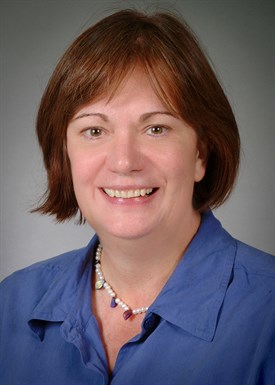
Dr. Jane Welsh
Dr. Jane Welsh

In order to bridge the gap between scientists and patients, Welsh recently hosted an English Tea for members of the Brazos Valley Multiple Sclerosis Support Group (BVMSSG) and her scientific team, composed mainly of graduate students and researchers. In its seventh year, the English Tea provided a forum for discussion concerning advances in MS, and allowed graduate students to present the discoveries to the BVMSSG.

“Our work highlights the diversity of research at the College of Veterinary Medicine, in particular we work on an animal model of a human disease, which may surprise the public,” Welsh said. “Our work is aimed at understanding the pathogenesis of a model system of multiple sclerosis and advances may aid the understanding of the disease process in MS. Also, therapies that function in our model system may be beneficial to MS patients.”

For the past three years, Welsh and her team have conducted tests using interferon tau, a protein produced by sheep during pregnancy, discovered by Dr. Fuller Bazer. This new protein could possibly replace interferon beta, which is given to MS patients as a shot and, although highly beneficial to MS patients, does have numerous side-affects.

The difference with the interferon tau is that it can be taken orally and is less toxic to the body. It appears to be effective in combating the relapse of MS-like symptoms in mice by increasing levels of immunosuppressive cytokines, which turn off the auto- immune response. Once the inflammatory cells are suppressed they stop attacking the myelin and repair mechanisms are allowed to function and restore the myelin surrounding the nerves, Welsh said.

Multiple Sclerosis is an autoimmune disease that is thought to be triggered by a viral infection. In MS patients the immune system attacks the virus and the myelin membranes causing many of the sensory nerves to have difficulty conducting electrical impulses.

“When myelin dissolves as a result of MS, the body forms a scar in its place which interferes with the passage of signals,” said Sharon Boston, Facilitator of the BVMSSG and an MS sufferer. “Essentially that is what multiple sclerosis means – many scars.”

These scars prevent signals from traveling through the body and can be aggravated by stress levels. At the onset of MS more than 80 percent of those diagnosed had suffered a highly stressful life event in the preceding year. The theory is that if you have the genes that predispose to MS and high stress levels, which interfere with the ability to amount an effective immune response to MS causing agents, then the agent will persist and lead to illness, Welsh commented. Her team, which also includes Dr. Mary Meagher, Dr. Tom Welsh and Dr. Ralph Storts, are currently analyzing stress and how it affects MS.

The Brazos Valley Multiple Sclerosis Support Group has also dedicated its time to assisting the sufferers, their family, and friends in the fight against MS. The group is comprised of 30 members and when a new member joins, the group rallies around them and helps them get through the initial shock and then, speakers proceed to show each member how to effectively live with MS until researchers are able to find a cure.

CVM Global Veterinary Leadership Program

Veterinary students are taking their education on the road. Students at the College of Veterinary Medicine, Texas A&M University are going global, utilizing their skills and knowledge by participating in the Global Veterinary Leadership Program.

Drs. G. Gale Wagner, Professor, and Isabel Carbajal, Lecturer, Department of Veterinary Pathobiology, developed the program in response to the changing career goals of veterinary students. Dr. Corrie Brown, Professor, Department of Pathology, College of Veterinary Medicine, University of Georgia, has developed a matching program. In the past most graduates went straight into general veterinary practice. However, today there is a growing number of students who are unsure of which direction to take but they know that the DVM degree will be an asset to their career. Through the success and high visibility of current research and education programs, most veterinary colleges are well positioned to engage industry, government and university leaders in ways to use the program to increase the flow of new ideas and talent throughout the world.

“The program will allow us to engage a few of our students in a process that makes them aware of the vital role they can play in protecting public health and it will better equip them for a successful career in the world community,” Wagner said.

The program is geared toward incoming first-year veterinary students. Each student accepted into the college’s DVM program is sent a letter describing the Global Veterinary Leadership program and given the opportunity to apply. The four to six students selected participate in a preliminary leadership seminar held outside the United States before starting their fall semester.

At the conclusion of the seminar, Wagner provides students with the opportunity to evaluate the seminar and decide if they would like to continue. Those continuing with program will complete 12-18 hours of directed electives in addition to those required for the DVM degree.

Students will also complete either a full-time 9-12 month internship or a 4-12 week externship involving some aspect of veterinary medicine related to food safety and international livestock trade. The assigned internship/externship is company directed and requires the student to respond to practical yet challenging projects and expose them to international career opportunities. At the conclusion of the internship the student will receive a Master’s of Science degree in Veterinary Medical Science; students participating in the externship will receive an international certificate added to the DVM degree expressing the graduate’s knowledge of international veterinary medicine, Wagner stated.

Dr. Wagner is developing corporate support for the Global Veterinary Leadership Program and hopes to create a pool of leading international companies, which are shaping the world’s food supply and interested in fostering a relationship with U.S. veterinary colleges. The network of corporate partners will help support the program by providing up to eighteen students with internship and externship opportunities per year. The participating students will come from a network of several veterinary schools in the U.S. that have expressed interest in participating in the program.

“Selected veterinary students will enter externships with multinational companies that operate within the sphere of food safety and the international livestock trade,” said Lynn Fondon, a Consultant for Brakke Consulting Inc. “The Global Veterinary Leadership Program combines a global orientation, leadership training, language study, with access to study and work opportunities that will prepare veterinary students for the expanding global demand for veterinary expertise.”

Veterinarians today must respond to global issues, which have expanded their role in society. Many countries currently look to the U.S. in developing their own approaches to risk analysis, food safety, and trade policy decisions that directly relate to veterinary medicine. The breadth and quality of the education that veterinarians now receive clearly impacts international trade, Wagner commented.

“The Global Veterinary Leadership Program will combine the diverse veterinary research and education system with our strong national and international network of collaborators to provide globally competent veterinarians who will be needed in the corporate and public sectors of the future,” said Wagner.