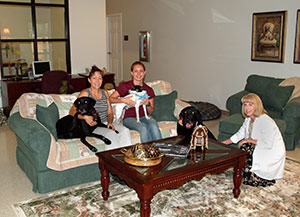
Dedication Ceremony for the Stevenson Companion Animal Life-Care Center Expansion Is October 1

COLLEGE STATION – September, 2004, Dedication of the newly completed expansion area of the Stevenson Companion Life-Care Center, which provides lifelong care of pets whose owners can no longer do so, will be held at 10 a.m. Friday, Oct. 1, at the College of Veterinary Medicine and Biomedical Sciences at Texas A&M University.
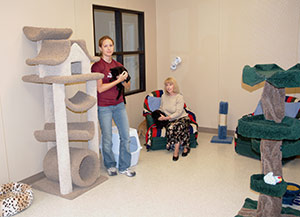
 

All of the pet residents receive the personal attention they need to be healthy and happy All of the pet residents receive the personal attention they need to be healthy and happy


The new 3,500-square feet addition will greatly expand the Stevenson Center, which was established in 1993. Clients of the center include pet owners who want to assure their pet’s future prior to entering a retirement home, being hospitalized for an extended period or predeceasing their pet. It is the only such center in the Southwest and one of the few in the United States.

“We are so grateful to all the people who donated more than $600,000 toward the expansion project,” said Dr. Henry L. Presnal, Director of the Center. “The five-year fund raising initiative resulted in 125 gifts from 98 donors. Special plaques have been placed throughout the building to recognize our major donors.”

The expansion increases the facility to 8300 square feet for small animals. Current residents include 15 cats, 11 dogs, a pony and a llama.

“The expansion was needed to accommodate our growing number of animal enrollees,” Presnal explained. “We have 94 owners from 18 different states with approximately 250 animals enrolled to enter the Center at various times in the future. This expansion allows us to comfortably care for our future residents in a home-like atmosphere.”

The new addition includes a large living room, memorial garden area honoring deceased residents, three canine living areas each with an adjoining exercise yard, two feline bedrooms, an aviary, and a student apartment with a living area and attached patio.

The Stevenson Companion Animal Life-Care Center opened its doors in 1993, and is an integral part of the College of Veterinary Medicine and Biomedical Sciences. The privately funded center provides the physical, emotional and medical needs of companion animals whose owners are no longer able to provide that care due to illness or death.

Pet owners establish an endowment with the Texas A&M Foundation generating a perpetual income to support the lifetime care of their animal. “When the pet passes away, the income from the endowment may be directed toward other college initiatives such as scholarships, a particular research project or can remain with the center in accordance with the owner’s wishes,” said Presnal.

The minimum endowment to secure enrollment in the Center depends on the age of the youngest owner at the time of enrollment. “The endowment for each animal can be established by bequest through a will or trust, or can be fully paid-up at the time of enrollment with a considerable discount,” Presnal explained.

The majority of enrolled pets at the Center have no family guardian to care for them, or the family is not able to take on this additional responsibility. “I want to emphasize that the people who enroll their pets in our program are ordinary people who share a special love for their animals,” noted Presnal. “Typically, they are people who have accumulated some savings over the years, and have planned ahead to ensure their pet is cared for when they are no longer able to take care of it.”

The Center, because of its close association with College of Veterinary Medicine and Biomedical Sciences, offers many unique benefits. “We are still the only facility of this kind associated with a major university that offers the extent of care we provide to our animals,” Presnal said.

Texas A&M students live in apartments at the Center and provide daily care and companionship for the animals in a home environment. “This is a mutually rewarding situation for both the students and the animals,” according to Presnal. “The students are typically aspiring veterinarians, so the Center provides hands on educational experiences for them.”

When the pets need medical attention, their care is provided by the Texas A&M Veterinary Medical Teaching Hospital. “Their knowledge of the latest advances in veterinary medicine, combined with their specialized facilities, ensures the best possible care for our residents,” Presnal noted.

Presnal, a retired veterinarian, has served as the Center’s director for about seven years. “This is the perfect job and second career for a veterinarian who has organizational and business skills that they want to use, while still getting to work with veterinarians, pet owners and their animals,” said Presnal. “I get to deal with all the good things in life.” The Center is located on ten acres adjacent to the College of Veterinary Medicine and Biomedical Sciences, and is named after the late Madlin Stevenson, a Houston-area animal fancier, and early major supporter of the project. Stevenson died in 2000 and her for cats, seven dogs, pony and llama came to reside at the Center upon her death. The Center is located in the W.P. Luse Building, named in recognition of the Luse Foundation’s support of the Center’s early development.
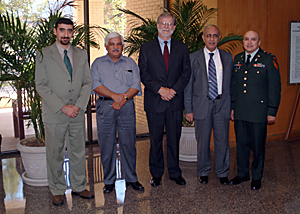
Guests

College Station – Three Iraqi veterinarians spent two weeks in August at the Texas A&M University College of Veterinary Medicine and Biomedical Sciences to learn how veterinary medicine is taught and practiced in the United States. Dr. Majid Hamid Nijidi, Dean of the College of Veterinary Medicine at the University of Baghdad was accompanied by Dr. Majid Nassir Hussain, an assistant professor and assistant dean for administration, Dr. Ali Fuad Ibrahim, an assistant lecturer at the school, and Captain Lawrence Camacho from the U.S. Army’s 1st Cavalry Division. The request to host the Iraqi veterinarians came from the United States Military and the U.S. State Department.

Iraq GuestsFaculty and staff from Texas A&M University presented information on the student selection process and curriculum for the professional program, classroom technologies, academic departmental overviews, and provided a tour of the Veterinary Medical Teaching Hospital for their Iraqi colleagues.

“We were pleased to assist the U.S. Military by hosting the veterinary delegation from Iraq and hope that we’ve helped to support their efforts to advance veterinary medicine and higher education in their country,” said Dr. H. Richard Adams, dean of the Texas A&M University College of Veterinary Medicine and Biomedical Sciences.

In 2003, the U.S. Military’s 414th Civil Affairs Battalion, based out of Utica, NY helped to renovate the University of Baghdad, School of Veterinary Medicine which had been used by Republican Guard soldiers as a fighting position during the war. Although the facilities were never bombed, the battles fought there and the looting that followed caused considerable damage. The school reopened on October 4, 2003 and continues to receive support from around the world in the form of donated textbooks and supplies.

“Veterinary medicine is an important component in public health, food production, and it improves our quality of life through strengthening the human-animal bond,” said Adams. “It was a great privilege for the college’s faculty and staff to meet and share information with our colleagues and new friends from Iraq.”

College Has New Name, Department Names

(College Station, TX) The Texas A&M University Board of Regents and the Texas Higher Education Coordinating Board approved a new name for the College of Veterinary Medicine (CVM) and three of its academic departments.

The College of Veterinary Medicine is now officially the College of Veterinary Medicine and Biomedical Sciences. The former Department of Veterinary Anatomy and Public Health is now the Department of Veterinary Integrative Biosciences. The former Department of Large Animal Medicine and Surgery is now the Department of Large Animal Clinical Sciences. And, the former Department of Small Animal Medicine and Surgery is now the Department of Small Animal Clinical Sciences. These new designations are effective immediately; however, stationary, directory listings, and signage will gradually be replaced.

“After college efforts reaching back well over a decade, I am pleased to announce a historic change for the nomenclature of our college and three departments,” said Dr. H. Richard Adams, Dean of the College of Veterinary Medicine and Biomedical Sciences. “These changes better reflect the depth and breath of veterinary medical science today and our commitment to graduate future biomedical scientists at both the graduate and undergraduate levels, in addition to our traditional responsibility of educating veterinarians.”

“Inclusion of Biomedical Sciences in our college name not only acknowledges our unique 2000-student undergraduate baccalaureate degree in Biomedical Sciences; it also lends emphasis to our biomedical research program that generates over $20 million per year in grant and contract awards,” added Adams.

Dedicated to serving the state of Texas, Texas A&M University’s College of Veterinary Medicine and Biomedical Sciences is one of only 31 colleges of veterinary medicine in the United States and Canada. Texas Aggie veterinarians proudly serve our state, our nation and indeed the world in countless ways. From highly sophisticated veterinary practices serving the residents of Texas and their animals, to military, industrial, government, and university roles, Aggie veterinarians hold positions of prestige and responsibility.

AVMA President

College Station, Texas – Dr. Bonnie Beaver, a professor at Texas A&M University’s College of Veterinary Medicine, assumed the Presidency of the American Veterinary Medical Association at a special installation ceremony on Tuesday, July 27, at the association’s national meeting in Philadelphia. Dr. Beaver is the second woman and the eighth veterinarian from Texas to serve as President of the 141-year old, 70,000-plus member organization.

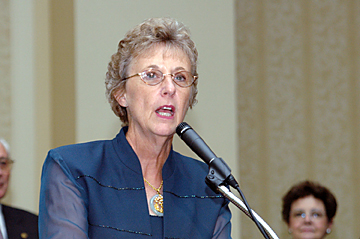
Dr. Beaver
Texas A&M University’s Dr. Bonnie Beaver addresses attendees at the American Veterinary Medical Association’s President’s Installation Reception. Beaver is only the second woman to be installed as president of the 141-year old, 70,000-plus member organization. Photo courtesy of the American Veterinary Medical Association.

In her Friday, July 23 speech to the opening session of the AVMA House of Delegates, Dr. Beaver identified three areas of importance for her presidency – Excellence – Communication – Animal Welfare. “As health care professionals,” said Dr. Beaver, “we are expected to deliver the highest quality of veterinary medicine in the private and public practice areas. For a small profession, we have a lot if responsibility. We serve two publics,” Dr. Beaver added, “the animals and the people.”

“The ability of our profession to meet the diverse needs of society is as strong as it has ever been. Our challenge is to keep it that way,” said Dr. Beaver. According to Dr. Beaver the AVMA is working on excellence in professional activities on many fronts, including education, diversity, productivity, and quality of life.

“Our educational evaluation programs will continue to undergo reevaluation and improvements to ensure they are the best. It is important that we all work to protect the educational excellence of our profession from challenges that are or will occur from inside our borders as well as outside,” said Dr. Beaver.

“In order to effectively serve society with excellence, the profession must promote diversity,” said Dr. Beaver. “This applies to diversity in the expertise we have, and it applies to the racial, ethnic and gender diversity of our colleagues,” she added. “How can we fully appreciate the nature of animal relations to the Native Americans, Asians, or Hispanics in our country,” asked Dr. Beaver, “if we do not seek out the best young people in those cultures?”

Communication establishes the relationship of veterinary medicine with society. The profession, according to Dr. Beaver, needs make a concerted effort to educate the public and even members of the profession about who veterinarians are and what we do. “As a small profession,” said Dr. Beaver, “we must all speak with one voice to be heard in defense of the animal and human publics we serve. We must be willing to listen to each other so that we become advocates for all segments of our profession.”

“Veterinarians,” said Dr. Beaver, “are the ultimate authorities on animal welfare, and it is important that we retain this authority in light of challenges by animal rightists and humane organizations, as has been made evident in recent newspaper attacks. As the world changes,” Dr. Beaver added, “our need to become more outspoken in this area has increased so that the image of the veterinarian being the one true advocate for the animal is not lost. Animal rightists are pushing their agenda in small increments under the guise of animal welfare and with mistruths.”

In order for veterinarians to hold the position as leaders in animal welfare, according to Dr. Beaver, “the AVMA must become more proactive in several areas. First we must recognize that the animal industry and the general public have been asking us to lead in this area. In fact,” added Dr. Beaver, “they expect it.”

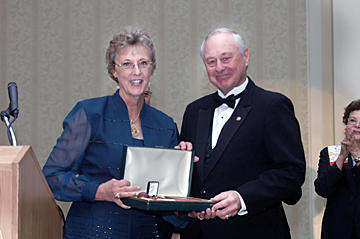
Dr. Bonnie Beaver receives her award from Dr. Jack O. Walther
Texas A&M University’s Dr. Bonnie Beaver receives the president’s gavel from Dr. Jack O. Walther, the immediate past president of the AVMA. Photo courtesy of the American Veterinary Medical Association.

Dr. Beaver has proposed and the AVMA Executive Board has accepted a recommendation to develop a Task Force on the Legal Status of Animals to address the hot topics of animal guardianship and non-economic status of animals.

“To retain a high visibility as leaders in animal welfare,” said Dr. Beaver, “the AVMA will need to increase time resources and efforts in the area. This,” she added, “will mean instituting and phasing in a Division of Animal Welfare within the AVMA, staffed by veterinarians who remain current on the global aspects of animal welfare science and issues, and who are respected throughout animal related industries.”

Dr. Beaver is a charter diplomate of the American College of Veterinary Behaviorists, and a former President of the Texas Veterinary Medical Association. Dr. Beaver is an internationally recognized authority on animal behavior, animal welfare and the human-animal bond. She has authored eight books, nearly 200 scientific articles, and presented over 400 seminars.

Dr. Beaver will serve as President of the American Veterinary medical Association, through the association’s 2005 meeting in Minneapolis, Minn., July 16-20, 2005. Established in 1916, the Texas A&M College of Veterinary Medicine is one of the world’s leading institutions in animal health care and research.

Student AVMA President-Elect

COLLEGE STATION, Texas- Travis McDermott, third-year student at The College of Veterinary Medicine, Texas A&M University, was elected Student AVMA President-Elect at the American Veterinary Medical Association (AVMA) Convention held in Philadelphia, Pa., July 24-28, 2004.

Travis McDermottMcDermott will serve as SAVMA President-Elect until its March 2005 Symposium when he will be installed as the Student AVMA President. His term will run through March 2006.
As Student AVMA President, McDermott will attend AVMA Executive Board meetings, serve as a delegate to the AVMA Governing Board and participate on the AVMA Legislative Advisory Committee.

“I feel this is a great chance for me to represent the Texas A&M College of Veterinary Medicine within the SAVMA and AVMA,” said McDermott. “There will be many occasions to help educate and inform veterinary students of the opportunities available to them through organized veterinary medicine.”

Brazos Valley Multiple Sclerosis Support Group

The 10th Annual English Tea benefiting members of the Brazos Valley Multiple Sclerosis Support Group (BVMSSG) was hosted at the College of Veterinary Medicine, Texas A&M University on May 15, 2004 by Dr. Jane Welsh, Associate Professor in the Department of Veterinary Anatomy and Public Health and her scientific team.

The English Tea provided a forum for discussion of advances in Multiple Sclerosis (MS), and allowed graduate students to present their research to members of the BVMSSG, demonstrating the vital role that veterinary medical research plays in promoting public health.

This year’s discussions focused on the impact of stress on the MS patient and the important role of the blood brain barrier.

In MS patients, the immune system attacks the virus and the myelin membranes making it difficult for the sensory nerves to conduct electrical impulses. When myelin dissolves as a result of MS, a scar forms in its place. These scars prevent signals from traveling through the body and can be aggravated by stress levels. At the onset of MS more than 80 percent of those diagnosed had suffered a highly stressful life event in the preceding year.

Current research suggests that neurological disease combined with stress can initiate the breakdown of the blood brain barrier thereby allowing an influx of immune cells to cross over.

The theory is, that if you have the genes that predispose to MS and high stress levels, which often interfere with the ability to generate an effective immune response to MS causing agents, then the agent will persist and lead to illness, Welsh commented.

Members of the BVMSSG welcomed the scientific information and shared their own unique perspectives on living with MS, which included suggestions on which medications to take, how to deal with depression and finding the right doctor or neurologist to care for their needs.

The English Tea proved to be a tremendous success and allowed researchers to meet and discuss their findings with the patients that they hope will one day benefit from their work.

Dallas County Community College District

College Station, Texas – The Texas A&M University College of Veterinary Medicine and the Dallas County Community College District (DCCCD) have signed an agreement to facilitate the admission and academic transfer of students from the DCCCD campuses at Brookhaven, Cedar Valley, Mountain View and North Lake into the undergraduate Biomedical Science Program at Texas A&M.

As DCCCD students progress successfully toward the completion of the Associate of Arts degree, this agreement will ensure the seamless transition of students into the Biomedical Science program according to the following academic provisions and conditions. Students must meet all the standard admissions requirements and maintain a 3.60 grade point average in courses taken at DCCCD, have completed 67 hours in a designated degree plan, and not earned below a “B” in their math and science courses.

“Partnerships in education are one key to providing opportunities for our high achieving students,” said Dr. H. Richard Adams, Dean of the College of Veterinary Medicine, Texas A&M University. “The College of Veterinary Medicine is pleased to join the Dallas County Community College District in offering this opportunity to students in the Dallas area.”

The Bachelor of Science degree in Biomedical Science is the largest major on the Texas A&M University campus, with approximately two thousand students enrolled in the program. Most students pursuing this degree are preparing for a career in the allied health field, which includes such professions as medicine, optometry, veterinary medicine, nursing, ophthalmology, and dentistry.

“DCCCD continuously seeks to form partnerships with senior institutions to provide greater educational and transfer opportunities to our students,” said Dr. Jesus “Jess” Carreon, Chancellor for the Dallas County Community College District. “We are really excited by our continued relationship with this outstanding university and our vision of supporting our student’s educational goals and dreams.”

DCCCD is one of ten community colleges in Texas to be selected to participate in this opportunity. The agreement will take effect Fall 2004, and any student meeting the requirements will be guaranteed admission to the Biomedical Science Program as a junior.

Partners in Caring

College Station, TX, February 20, 2004- Dr. Margaret Slater, Associate Professor, Department of Anatomy and Public Health has been awarded a “Partners in Caring” grant with The Brazos Feral Cat Allies (BFCA). They are working with the Veterinary Medical Teaching Hospital (VMTH), College of Veterinary Medicine, Texas A&M University, to provide additional veterinary medical care for homeless cats in the Brazos Valley. The grant will provide CVM students with the opportunity to spay/neuter, vaccinate and microchip feral cats on scheduled surgery days.

The American Society for the Prevention of Cruelty to Animals (ASPCA) has awarded BFCA a “Partners in Caring” grant to help fund their Trap, Neuter and Return Feral Cat Program in the Bryan-College Station area. This grant will be used to support BFCA’s efforts to spay/neuter, ear-tip, vaccinate and microchip feral cats in our area.

“The ‘Partners in Caring’ grant program is one way that we support worthy organizations and initiatives,” says ASPCA President Ed Sayres. The ASPCA views its grant recipients as their true Partners in Caring. This honor is a mark of their support of the sponsored program.

BFCA is a 502c3 non-profit tax-exempt organization that works with cat caretakers in the area. Donations can be sent to: BFCA, PO Box 10738, College Station, TX 77842. For more information visit their website at www.catfriends.org.

Real-Life Pet Project: Student, Age 56, Seeking DVM Degree

COLLEGE STATION, Jan. 27, 2004 – Future veterinarian Pat Ryan looks at it this way: if she were a dog, she’d be 392 years old.

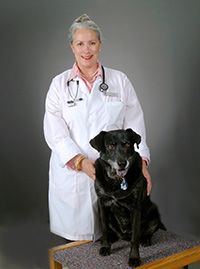
Pat Ryan
Future veterinarian Pat Ryan

The 56-year-old Ryan is in her third year of studies at Texas A&M University’s College of Veterinary Medicine, a highly rigorous academic program for 20-somethings, much less a senior adult. When she graduates next year, she’ll be the oldest person ever to receive a DVM degree at the school, Texas’ only veterinary college.

While it’s not uncommon for older adults to go back to college to earn their bachelor’s degree, it’s extremely rare for professional schools, such as law, medicine or dentistry, to have someone begin his or her practice at age 57.

Ryan thinks it’s great.

“I’m living a dream just being here and that’s the truth,” the Houston resident laughs. “I wanted to be a veterinarian 25 years ago, but a thing called ‘life’ had different plans for me.”

Ryan has had a life of almost Forrest Gump-like scale.

At various times, she’s been a highly paid fashion model who walked runways from New York to Houston, a writer and editor for Mademoiselle magazine, a flight attendant for Pan American Airways, a former Junior Miss of Connecticut, a theatrical producer, a public relations specialist for Neiman Marcus, an award-winning charity organizer who raised $200,000 for the Houston SPCA (Society for the Prevention of Cruelty to Animals), and her most important role – a wife of 32 years and mother of two grown daughters.

In between all of that, she battled cervical cancer and was hospitalized for weeks following surgery, which rid her of the disease that struck in her mid-30s.

Like one of the felines she will probably be treating in a year, Ryan has seemingly had nine lives – or at least lived nine different ones.

All students seeking admission to the College of Veterinary Medicine are required to fill out a “personal statement” form, which is more or less an essay on why they should be selected. Ryan’s began, “I’ve waited 25 years to write this essay. Like that of the tortoise in Aesop’s fable, the path leading to this moment has been slow but steady, deliberate and determined. I bring a half-century of life experience to the table, a background as varied as a patchwork quilt and a resume described by a friend as a ‘Renaissance woman gone mad.”

Admissions counselors were hooked – she got in, but not before taking three years worth of prerequisite courses, such as advanced chemistry, physics and others. Ryan graduated in 1970 from all-women’s Smith College in Massachusetts, but her degree was in theater, which is a tad different than doing emergency canine surgery.

She enrolled at Houston Baptist University and the University of St. Thomas to get the required courses behind her, then three years ago headed for Texas A&M’s College of Veterinary Medicine, which has an international reputation and the long hours of hard study that go with it. While her architect husband Jeff, who has degrees from Rice and Harvard and whose firm designed the Owls’ state-of-the-art baseball stadium Reckling Park, stayed home in Houston, Ryan rented a house in College Station and settled in with three dogs she adopted – sort of.

“The first year was very, very difficult for me,” Ryan admits. “Besides the course work, which is very demanding, I found out that I just didn’t have the stamina that these 22-year-olds have. I found myself stressing a lot, but I was determined to get through it.”

One big adjustment: computers.

“These kids grew up working and doing research on computers. I didn’t, and I had a lot of catching up to do,” she recalls.

Fellow veterinary medical students, she admits, have been highly supportive of her.

“At first, I had a few ‘hey grandma’ jokes thrown at me, but overall, the students and faculty have been wonderful,” Ryan says. “I’ve come here to learn. I’m certainly not shy about asking questions.”

When she graduates next year, she hopes to work in a small animal practice for a long time.

“I’m not about to go through all of this and practice just a few years and retire,” Ryan says. “I’m living a dream I’ve had for decades. When I get that diploma, it’s the start of my new career. To be a veterinarian is the deepest desire of my heart, so early retirement for me is just not an option.”

Ryan, who proudly says that her silver-colored hair goes well with her white lab coat, is proof that you can teach an old – better make that middle-aged – dog new tricks. Anatomy class, anyone?

CVM Researchers First to Clone White-tailed Deer

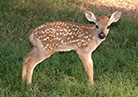
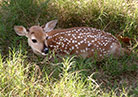
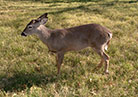
COLLEGE STATION – In what is believed to be the first success of its kind, researchers at the College of Veterinary Medicine at Texas A&M University have cloned a white-tailed deer. A fawn, named “Dewey,” after Duane Kraemer, one of the researchers, was born to “Sweet Pea” a surrogate mother, on May 23, 2003.

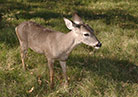
Dewey, the world's first deer clone was born - May 23, 2003DoeDoeDoe

The fawn is believed to be the first successfully cloned deer, and Texas A&M is the first academic institution in the world to have cloned five different species. Previously, researchers at the College of Veterinary Medicine have cloned cattle, goats, pigs and a cat.

The announcement of the successful deer cloning was delayed until DNA analysis could be performed to confirm genetic identity.

This breakthrough in deer cloning at the College of Veterinary Medicine at Texas A&M was a joint project with Viagen, Inc. and may be useful in conserving endangered deer species including the Key West deer of Florida.

“Dewey is developing normally for a fawn his age and appears healthy,” said Dr. Mark Westhusin, who holds a joint appointment with the Colleges of Veterinary Medicine and Agriculture and Life Sciences and is the lead investigator on the project. “A DNA analysis confirmed that Dewey is a clone, i.e. a genetic copy of the donor,” adding that “future scientific advances resulting from the successful cloning of the deer are expected.”

The clone was produced using fibroblast cells which were isolated from skin samples derived from a deceased male white-tailed deer, expanded in culture then frozen and stored in liquid nitrogen. White-tailed deer oocytes were collected from ovaries of does and matured in vitro. Two teams of research scientists led by Dr. Mark Westhusin and Dr. Duane (Dewey) Kraemer of Texas A&M University and Dr. Charles Long of Viagen Inc. performed the nuclear transfer procedures and transfer of the cloned embryos. Dewey is under the medical care of Dr. Alice Blue-McLendon, a veterinarian at the College of Veterinary Medicine, Texas A&M University.

“With each new species cloned, we learn more about how this technology might be applied to improving the health of animals and humans,” said Westhusin.

In December 2001, the first cloned cat was born at the College of Veterinary Medicine, Texas A&M University. Other cloned animals born at the university include several litters of pigs, a Boer goat, a disease-resistant Angus bull, and the first Brahma bull.

“The knowledge we gain from cloning these animals could greatly affect several areas of science and medicine,” said H. Richard Adams, dean of the College of Veterinary Medicine. “With each successful cloned species, we learn more about cloning procedures and how to make the process more efficient.”

White-tailed deer represent the most abundant, wide-spread big game animal in North America. They are popular game animals and are prized for their meat and antlers. Deer farming to produce meat and antlers is common-place in many parts of the world, including Texas. When breeding animals die or are harvested as a result of hunting, cloning may provide a valuable tool for conserving the genetics of superior animals.

Established in 1916, the College of Veterinary Medicine at Texas A&M is one of the world’s largest veterinary colleges and is an international leader in animal health care and research.