Having plants in your home can make your space more decorative, or even calming. However, certain plants also can be toxic to pets. Dr. Christine Rutter, clinical assistant professor at the Texas A&M College of Veterinary Medicine & Biomedical Sciences, described some of the potentially dangerous plants in our homes.
“The plants in our homes that are toxic to pets are often colorful and showy,” Rutter said. “The plants that are the most deadly (especially to cats) are true lilies of the family Liliaceae. All portions of the plant, including pollen, are considerably toxic.”
In addition, Rutter said oleander and sago palms, a favorite decorative palm, also are dangerous to pets if consumed.
“All parts of sago palms are toxic, especially the seeds,” Rutter continued. “Dogs commonly eat the seeds, which can cause both immediate and delayed life-limiting effects.”
Though we try our best to keep our pets safe, we never know when a pet may accidentally ingest something toxic.
Symptoms of toxic plant ingestion include salivating, pawing at the mouth, vomiting, diarrhea, weakness, altered mentation, and agitation. It is also possible that an animal may act normal for one to two days after ingestion before the signs of illness are apparent.
If you think your pet has ingested a poisonous plant, Rutter recommended contacting the ASPCA animal poison control (APC). In addition, she said to take your pet to see a veterinarian immediately.
“There is a small fee for contacting the ASPCA APC, but it provides great information on many levels,” Rutter said. “It not only helps owners decide whether or not treatment is necessary, but it is also an ongoing resource for veterinarians because it provides the most up-to-date toxin database and treatment recommendations.”
While plants may look beautiful in our homes, it is important to make sure they will not harm our pets. To be sure a plant is safe, Rutter recommended referring to the ASPCA’s online list of toxic and non-toxic plants. Be sure to research any plant before bringing it home.
Pet Talk is a service of the College of Veterinary Medicine & Biomedical Sciences, Texas A&M University. Stories can be viewed on the Web at vetmed.tamu.edu/pet-talk. Suggestions for future topics may be directed to editor@cvm.tamu.edu.
“Bench to Shop” trainees and trainers outside of the Agricultural Research Council-Onderstepoort Veterinary Research Transboundary Animal Diseases Facilities in Onderstepoort, South Africa.
A team of Texas A&M University faculty and staff accompanied eight next-generation trainees through the U.S. and Africa in June and July for an innovative international training course that is part of the Scientific Business Development & Management Program’s “Bench to Shop” program.
The experiential training course embarked at the Texas A&M College of Veterinary Medicine & Biomedical Sciences (CVM) before travelling to three institutions, at the University of Texas Medical Branch-Galveston, Colorado State University, and the Agricultural Research Council-Onderstepoort Veterinary Institute in South Africa.
Eight early career faculty, postdoctoral, and graduate student trainees, who shared the common academic interest in livestock transboundary animal diseases (TAD), originated from Texas A&M, Texas A&M Health Science Center, the University of Georgia, Kansas State University, Plum Island Animal Disease Center (New York), the University of Texas Medical Branch-Galveston, North Carolina State University, and the University of Pretoria (South Africa).
The “Bench to Shop” program is expected to cultivate a new generation of scientists to further contribute to the DHS science and technology mission through innovation and research that contributes to the defense of U.S. agriculture.
The hands-on training across different institutions in the U.S. and Africa was invaluable for the trainees, offering exposure to different teaching methods that addressed livestock transboundary animal disease problems, the opportunity to learn different methodologies for handling TAD, exposure to international work, interacting with vaccine manufacturers, and the different practices for biocontainment training which varied between institutions.
Trainees and trainers inside the Agricultural Research Council-Onderstepoort Veterinary Research Transboundary Animal Diseases Biocontainment Facilities in Onderstepoort, South Africa.
“The knowledge, relationships, and experiences I have gained through the ‘Bench to Shop’ training program are vital tools I can utilize in my pursuit of a career in transboundary disease research,” one trainee said. “Through the online curriculum, I gained an understanding and appreciation for the commercialization pathway, and the experiential portion of the training not only solidified my goals of pursuing a future in this type of research, but also allowed me to experience working in high-containment research laboratories for the first time.
“This unique training program connected me with lifelong mentors and invaluable future collaborators, while illuminating multiple career paths that I would not have been exposed to in my current formal education, and I feel incredibly fortunate to have had this opportunity.”
The program also included 17 partner academic, industry, and government partners, with the goal of developing an innovative multi-modality, interdisciplinary training course.
“Bench to Shop” refers to taking discoveries from the bench (or laboratory) to the shop (or marketplace) through technology transition and commercialization. Trainees earn a training certificate in scientific business development and management.
In 2015, the CVM and the Institute for Infectious Animal Diseases (IIAD) were awarded a three-year funding contract to create a nationwide training program to help animal researchers learn to transition research discoveries, such as vaccines or diagnostics, to the marketplace.
The funding was awarded from the U.S. Department of Homeland Security Science (DHS) and the Technology Directorate, the DHS research and development arm of the department.
The training is intended to support the federal government’s transition from the Plum Island Disease Center to the National Bio- and Agro-Defense Facility.
Selection of a second cohort of trainees to participate in 2018 is currently underway. For more information on the “Bench to Shop” program, visit https://vetmed.tamu.edu/benchtoshop.
Dr. L. Garry Adams, a senior professor in the Texas A&M College of Veterinary Medicine & Biomedical Sciences’ (CVM) Department of Veterinary Pathobiology (VTPB), was honored with the American Veterinary Medical Association’s AVMA Award during the annual conference in Indianapolis.
Adams was recognized on July 22 for his contributions to organized veterinary medicine via collaboration.
“It was an indescribable honor to receive the highest award presented by the AVMA and to be supported by my peers, a pinnacle for my career, although I am far from being finished with my contributions to veterinary medicine and science,” Adams said. “As the immediate past president of the Texas Veterinary Medical Association, I am forever in the debt of Dr. Sam Miller and the Texas Veterinary Medical Association for nominating me for the American Veterinary Medical Association 2017 Award.”
This is not Adams’ first recognition by the AVMA; in 2012, he received the AVMA Lifetime Excellence in Research Award.
“Dr. Garry Adams is an extraordinary veterinary scholar who is most deserving of this prestigious AVMA Award,” said Dr. Eleanor M. Green, the Carl B. King Dean of Veterinary Medicine. “He has been passionate about the veterinary profession and has been tireless in his work over his entire, illustrious career. His impacts span the research laboratory, the classroom, and organized veterinary medicine.
“Although he is ‘retired,’ his pace has not wavered at all,” Green said. “I look forward to watching for all he will continue to contribute.”
Growing up in a small town in the mountains, in a remote part of Texas, Adams always had livestock and companion animals and worked for two local practitioners who encouraged him to attend Texas A&M to become a veterinarian.
At Texas A&M, he earned his veterinary degree in 1964 and his doctorate in veterinary anatomic pathology in 1968, and then joined the faculty.
Working with the Rockefeller Foundation and U.S. Agency for International Development, Adams went to Colombia to develop diagnostics and vaccines for anaplasmosis, babesiosis, and trypanosomiasis. Along the way, he became a diplomate of the American College of Veterinary Pathologists.
He returned to Texas A&M after five years to teach pathology and continue studying infectious diseases.
Adams’ research has focused on diseases such as brucellosis, tuberculosis, and salmonellosis. In the past decade, researchers have begun to understand the interaction on more of a molecular level.
Adams has been active in the AVMA and other veterinary organizations throughout his career. He has served as a member of the AVMA Council on Research, Council on Education, and Committee on International Veterinary Affairs; on the working group that developed the concept for the AVMA Animal Health Studies Database that launched last summer; and on the organizing committee for the AVMA Global Food Security Summit that was held earlier this year.
He is engaged in the AVMA because of his commitment to the veterinary profession.
Adams has been a member of the Texas Veterinary Medical Association’s (TVMA) Research Committee for many years. Among other activities in organized veterinary medicine, he served on the board of directors of the American Association of Veterinary Immunologists.
“One of the most accomplished veterinary professionals in the world, Dr. Adams is also one of the nicest, most unassuming individuals I have had the pleasure of meeting during my career in veterinary medicine,” wrote Dr. Sam G. Miller Jr. in nominating Adams for the AVMA Award on behalf of the Texas VMA. “He is truly one of those people who leads by example and whose quiet confidence has helped build and strengthen the reputation of every organization that has had the privilege of his service.”
Adams lives by a “team of teams” collaborative approach to complex issues, saying that he relies on his personal, faith, academic, and professional teams.
To share some of his thoughts on collaboration in research, he published “Putting together a scientific team: collaborative science” in the September 2014 issue of Trends in Microbiology.
Adams encourages his students to stay engaged in the veterinary profession through local, state, and national associations.
“Through organized veterinary medicine, I have formed lifelong networks and continue to find inspiration from interacting with my colleagues,” Adams said.
###
For more information about the Texas A&M College of Veterinary Medicine & Biomedical Sciences, please visit our website atvetmed.tamu.eduor join us onFacebook,Instagram, andTwitter.
Contact Information: Megan Palsa, Executive Director of Communications, Media & Public Relations, Texas A&M College of Veterinary Medicine & Biomedical Science;mpalsa@cvm.tamu.edu; 979-862-4216; 979-421-3121 (cell)
CVM employees listen to a speaker during the Association of Veterinary Advancement Professionals Conference.
Texas A&M College of Veterinary Medicine & Biomedical Sciences professionals from a variety of backgrounds converged at Indianapolis for the Association of Veterinary Advancement Professionals (AVAP) and American Veterinary Medical Association (AVMA) conferences.
Development officers Chasity Carrigan, Bubba Woytek, Eliana Brown, Linzy Woolf, and Monika Blackwell and CVM executive director of communications, media, and public relations Megan Palsa attended the three-day AVAP conference from July 19-21.
The AVAP is an organization of development, public relations, and alumni relations professionals that seeks to promote the success of veterinary medical education through the professional development of its membership.
The sessions included presentations by Lynne Wester, of the University of Texas at Austin; Bill Stanczykiewicz, director of The Fund Raising School and senior lecturer in philanthropic studies at the Indiana University Lilly Family School of Philanthropy; Leslie Carmona, director of donor relations at Wayne State University; and Courtney Downey, director of alumni, donor, and public relations at Purdue University.
The CVM group had presentations from the Indianapolis Zoo, a trip to a local horse racing track, and opportunities to network with colleagues from across the country.
CVM veterinary professionals and administrators also were on hand for the AVMA Conference in Indianapolis from July 21-25, which offered five days of continuing education sessions, hands-on learning, and interactive labs.
The conference keynote speaker was paleontologist, explorer, and champion of One Health Paul Sereno, who discussed “Insights for One Health from Centuries and Millennia Past.”
Aggies enjoy conversation during the July 25 AVMA Alumni Reception.
A variety of panels were offered on companion animal medicine, food animal/equine medicine, practice management, veterinary technology, public and corporate practice, and other hot topics.
Attendee also had the chance to explore new products and services from many exhibitors and participate in extracurricular events and networking opportunities.
The CVM wrapped up the conference with the annual AVMA Alumni Reception, at The Tin Roof, where guests were treated to good food, conversation, and live music. It was a great opportunity to network with fellow Aggie veterinarians and their families.
This summer, five Aggie Doctor of Veterinary Medicine students, Veterinary Leadership Institute (VLI) board members Karen Cornell and Kenita Rogers, and faculty representative Kristin Chaney attended the Veterinary Leadership Experience (VLE), a week-long intensive leadership training program that encourages participants to “think outside the box” for personal and professional growth.
Below students share some of their experiences.
Taylor E. Adams, Class of 2020
Q: Tell us about your experience at Veterinary Leadership Experience, the lessons learned, the opportunities to network, and the impact the experience will have on your future. A: My experience at VLE was by far the best of vet school. I learned lessons about myself, how I communicate with myself and others, how to more effectively lead those around me, how I react under pressure, and many more. I had the opportunity to network with some of the best in the profession and the future of the profession and have stayed in contact with them since. I just attended the AVMA Convention in Indianapolis and had the opportunity to reconnect with them. This experience definitely affected my future inside and outside of the profession. It shaped the way I see myself, others, and the world, and how I make daily decisions.
We focused on personal and servant leadership and the components of those, including communication, conflict resolution, emotional intelligence, and resilience. Each of these is an important aspect to develop, personally, and for the good of the profession, as a whole. I reference these ideas each day as I communicate with others and make decisions.
Q: Why did you attend the VLE? A: I attended VLE after the insistence of previous attendees. Many of my friends in the classes above me approached me and told me about their experiences there and I was convinced, so I applied and was chosen by the administration to attend.
Q: Was this your first time? A: Yes, this was my first time to attend this program or anything like this program.
Q: What were some of the highlights of the experience for you? A: Highlights of the experience for me included outside small group activities, which apply to school now, my future in the profession, and life outside veterinary medicine. Our daily activities corresponded to the topics of the day and those topics were interwoven throughout the experience. I also loved the boating cruise one night and group meals with the fabulous food.
Q: What would you tell other students about the VLE to encourage them to attend? A: I would tell other students that VLE encourages and fosters your personal growth by putting you in your stretch zone and having incredible mentors lead you the whole way. You are in an environment in which more growth can occur in your leadership and the way in which you approach the world than anywhere else. You also get to meet and become close with amazing current and future professional in veterinary medicine, gaining friends and mentors.
Q: Where are you from and what plans do you have after you graduate? A: I am from Dallas, Texas, and plan to pursue a specialty in small animal medicine, focusing on dogs and cats—though I also love horses! Basically, I do not know what I want to do with my life yet but am excited for the journey.
Q: What year are you in starting in the fall? A: I am starting my second year in the fall.
Q: Is there anything else you’d like to add? A: One of the most exciting aspects of VLE this year is that those who attended are able to work with the administration, many of whom are on the board of the VLI (that puts on VLE), to improve and reorganize orientation for the incoming first years. We are going to implement exercises and discussions used at VLE to improve orientation this year. I am excited to bring elements of VLE back to offer new tools and improve the lives of those incoming first years as they begin this journey in veterinary school. I appreciate our administration and their involvement in continuously improving this process and our time during vet school. Our plans for orientation are engaging and very different, and I am so glad to get to be a part of it—I am excited for the Class of 2021!
Pamela May, Class of 2019
Q: Why did you attend the Veterinary Leadership Experience? A: I attended the VLE because I will become the director of Open House 2018 and I wanted to further my leadership abilities to make sure we can have the best, most successful, and most cohesive Open House executive team. I also wanted to learn aspects about myself to help in my future career.
Q: What did you hope to learn? A: I hoped to learn how to host effective meetings and handle difficult conflict situations.
Q: What did you learn? A: I learned a lot about myself and my journey to where I am now that I think helps shape the way I think. I learned a lot about teamwork through all the team-building activities that I think will help in group activities in the future. I learned about when to speak up and when to listen to others.
Q: Has the experience impacted your future career? If so, in what ways? A: I absolutely think the VLE has impacted my future career. I think there are many situations as a clinician in veterinary medicine when you have to be more of a leader when it comes to making decisions for your patients. I also hope to own a clinic one day and I would have to be a leader to effectively lead a team of veterinarians to work with.
Q: Where are you from? A: I am from South Padre Island/Brownsville, Texas
Q: Why did you choose the Texas A&M veterinary school? A: I chose the Texas A&M Veterinary School because I wanted to stay in Texas, I went to Texas A&M for undergrad, and I knew that the TAMU Vet School was the perfect fit for me.
Q: Do you recommend other DVM students attend the VLE next year? Why? A: I recommend as many DVM students attend the VLE as possible especially those who are going to lead organizations because it helps people understand themselves and be able to use that to effectively lead people better.
Amanda Tabone, Class of 2020
Q: What will your attendance at the Veterinary Leadership Experience help you with in the DVM program and beyond? A: I think that VLE will definitely benefit me when I am working with my classmates as well as other students from different programs or different career paths. I felt I gathered a lot of valuable lessons as far as being able to really connect and understand those with different personality types or tendencies. I think that I will go about resolving conflict in a totally different way and will reflect much more before acting or speaking.
Q: Where are you from and what year of the DVM program are you in? A: I am from Colleyville, Texas, and I am part of the class of 2020.
Q: Why did you choose Texas A&M? A: When I was applying, A&M was the only school I applied to because I knew there was not another school that I would go to. I have always been impressed with the level of education and the remarkable reputation that comes with becoming an Aggie vet. Also, my dad is an Aggie vet, so I have always known I would end up at A&M’s vet school and did not have a back-up plan to attend any other school.
Q: Did you meet people from other colleges? Was the networking piece good for you to experience? A: I met a large group of people from other schools and the networking opportunities were awesome. The small group to which I was assigned all became friends on Facebook and created our own subgroup for VLE. I think we will all keep in touch, especially when there are conference opportunities for us to meet up. We are also friends with our facilitators on Facebook and keep in touch with them.
Q: What are the takeaways for you after going through this experience? A: My personal takeaways will be how I go about handling conflict, how I will interact and communicate with those of different personality types in order to make sure they know I am being sincere in my listening and communication, and how to self-manage and step back from a problem and re-evaluate how I am going about the situation.
Q: Did having your peers with you help build rapport with them? A: I think that the five of us who went together from A&M are definitely closer than we were before going.
Q: What do you plan to do when you graduate and how will those plans be affected by this experience? A: I plan to practice in small animal medicine, and I cannot count all the ways that this training will help me to become the best vet, leader, and customer service representative that I can be, along with being the best teammate for those that I will work with.
The innocent look cats give us when they misbehave may melt our hearts, but like any pet, cats need to be properly trained. For both the first-time cat owner and a “kitty veteran,” Dr. Sarah Griffin, lecturer at the Texas A&M College of Veterinary Medicine & Biomedical Sciences, has some advice on training your feline friend.
Kittens are playful and full of energy. Though biting and scratching are considered undesirable behaviors, they are part of the kitten’s natural instincts to hunt, even though no pet owner wants their kitten to see them as prey.
“There are many cat toys available that kittens love and also allow them to interact with their owners in appropriate ways,” Griffin said. “I recommend redirecting these natural biting and clawing tendencies to toys. When the kitten attacks your hand, give it a toy to attack and ‘praise’ the kitten with a gentle pet when it follows your redirection. If the kitten is scratching furniture, redirect them to a scratching post.”
For older felines that love exploring the highest of places in your home, Griffin said there are products and home remedies that can be used to keep cats off of furniture or counter tops. For instance, a sensory buzzer could be used to train a cat to not jump on an inappropriate surface. Griffin added that many cats don’t like walking on foil—so try placing foil on areas where the cat isn’t allowed until it learns.
Naughty behavior isn’t always about how your cat interacts with you; sometimes cats can misbehave in other ways, such as refusing to use the litter box. But before you blame your kitty for bad behavior, Griffin said this can be caused by a number of reasons, including feline lower urinary tract disease, kidney disease, arthritis, back pain, or anxiety.
In addition, your kitty’s refusal to use the litter box could be related to the condition and placement of the litter box.
“In general, I recommend one litter box per cat, plus one extra,” Griffin said. “Litter boxes should be kept in a quiet part of the home away from the cat’s food and water. The same type of litter should be purchased each time because cats are creatures of habit. It is also important to clean the litter box daily.”
Whether your feline is young or old, the easiest way to help prevent naughty behavior is keeping them entertained. Encourage their natural instincts to hunt by providing cat trees, places to hide, toys that encourage exercise, and scratching posts.
“Some of the neatest toys that have been created include toy mice that have food hidden inside them,” Griffin said. “The mice can be placed around the home so that the cat can hunt and play with the mice to get food.”
No matter the age of your feline friend, providing entertainment and discipline for your cat is an essential part of pet companionship. Though many cats have independent personalities, every cat needs a little training to be a well-behaved companion.
Pet Talk is a service of the College of Veterinary Medicine & Biomedical Sciences, Texas A&M University. Stories can be viewed on the web at vetmed.tamu.edu/pet-talk. Suggestions for future topics may be directed toeditor@cvm.tamu.edu.
For more than 16 years, researchers and volunteers have been observing wildlife along the clay cliffs of Southeastern Peru’s Tambopata River. They’ve gathered data every day, logging more than 20,000 hours and building one of the most extensive datasets on tropical parrots in the world.
In particular, the two explore the potential drivers behind geophagy — or intentional soil consumption — they’ve regularly observed in 14 different parrot species there.
This region of the Tambopata River in Southeast Peru is an ideal spot to study the nearly two-dozen parrot species that live nearby in the Amazon rainforest. In the thick foliage of the jungle, the birds are difficult to see, but when they emerge to gather up beakfuls of the sodium-rich clay soil, “it’s a crazy, screaming kaleidoscope of color,” Hobson said.
“They’re all quiet when they take flight, but in a few seconds, they all begin to scream, and some drop bits of the clay from their mouths,” said Brightsmith, who has led the Tambopata Macaw Project since 1999. “It’s an incredible experience.”
But the parrot’s geophagy is a somewhat confounding behavior—clay soil is basically inert.
“It doesn’t have proteins, carbohydrates, or really anything that you’d need,” Brightsmith said. “If we can understand why it’s so important to these parrots, we can learn more about the ecosystem and how it affects the other insects, birds, and mammals who also eat this soil.”
Geophagy occurs around the world and in many types of animals, and scientists have proposed many explanations for the behavior. In their paper, Hobson and Brightsmith explore the two leading theories for these Amazonian parrots—that clay soils help protect the birds from food toxins when ideal food sources are scarce and that clay soils provide necessary minerals not available in the parrots’ regular diet.
Like previous studies, their analysis suggests that toxin-protection is not a driver. But parrot geophagy there is highly correlated with breeding season, suggesting the increased nutritional demands are likely behind the soil consumption. This study also joins a large body of research suggesting that hunger for sodium, specifically, is that driver.
“There’s lots of evidence that’s pointing in that direction,” Hobson said. “Sodium in the rainforest is really rare, and the place on these clay licks most preferred by the birds also has the highest sodium content.”
Understanding how nutritional needs are—and are not—being met during breeding season becomes even more important in light of climate change, according to Brightsmith. Some of the larger macaws are already breeding right before a seasonal crash in food supply, requiring parents take their fledgling young on long flights to find food.
“If climate change starts messing with the macaw’s food supply, it could disrupt their ability to breed,” he said.
A team of scientists including Texas A&M College of Veterinary Medicine & Biomedical Sciences (CVM) associate professor of immunology Dr. Michael Criscitiello have achieved a significant step forward in HIV research, eliciting broadly neutralizing antibodies (bNAbs) to the virus by immunizing calves.
Dr. Michael Criscitiello
The National Institutes of Health (NIH)-supported scientists reported the findings in a paper published online July 20 in the academic journal Nature. Those findings offer insights for HIV vaccine design and support further study of modified bovine antibodies as HIV therapeutics or prevention tools in humans.
Researchers have observed that about 10-20 percent of people living with HIV naturally develop neutralizing antibodies to the virus, but usually only after nearly two years of infection. These neutralizing antibodies have been shown in the laboratory to stop most HIV strains from infecting human cells and to protect animal models from infection.
However, scientists have so far been unsuccessful in prompting the human immune system to produce these antibodies through immunization. Further, while bNAbs isolated from people with HIV infection have demonstrated promise in primate studies and have entered human studies for HIV prevention and treatment, questions remain about whether effective antibodies could be produced rapidly and at a scale suitable for widespread distribution.
The researchers have determined that cattle may offer some help in solving these problems.
“This work is exciting because a structural and genetic oddity in cattle antibodies appears to allow them to easily and quickly make effective antibodies to HIV that humans cannot,” Criscitiello said. “The cattle antibodies may themselves be useful—with a few tweaks—in humans.”
While bovine neutralizing antibodies are not likely suitable for clinical use in humans in their current form, exploring this rapid production may help answer important research questions.
“From the early days of the epidemic, we have recognized that HIV is very good at evading immunity, so exceptional immune systems that naturally produce broadly neutralizing antibodies to HIV are of great interest—whether they belong to humans or cattle,” said Dr. Anthony S. Fauci, NIAID director.
“We never dealt with the entire HIV virus here (at Texas A&M), but the cattle received immunizations containing a protein designed to mimic a surface protein on HIV,” said Criscitiello, who coordinated the A&M efforts with Scripps, managed the animal work, and analyzed the antibody immunogenetics.
While no one knows definitively why these powerful antibodies evolved in cattle, one theory holds that the animals’ long HCDR3 loops are tied to their extensive gastrointestinal systems. Cattle and other ruminant animals have multi-chambered stomachs and a robust population of bacteria in their digestive tracts to help break down a diet of tough grasses. However, these bacteria can pose an infection risk if they escape the gut, so cattle with a versatile mechanism for producing potent antibodies would greatly benefit from the increased protection.
“A minority of people living with HIV produce neutralizing antibodies, but only after a significant period of infection, at which point virus in their body has already evolved to resist these defenses,” said Dennis R. Burton, Ph.D., a lead author on the study, director of the NIH’s Center for HIV/AIDS Vaccine Immunology and Immunogen Discovery and scientific director of the IAVI Neutralizing Antibody Consortium at the Scripps Research Institute. “Unlike human antibodies, cattle antibodies are more likely to bear unique features and gain an edge over complicated HIV immunogens.”
Further study on how this mechanism contributed to the elicitation of bNAbs to HIV in cattle may inspire novel approaches to HIV vaccine development.
“HIV is a human virus,” said Devin Sok, a study leader and IAVI collaborator at the Scripps Research Institute, “but researchers can certainly learn from immune responses across the animal kingdom.”
Researchers may also explore mimicking or modifying the potent isolated bNAb, or those like it, to develop antibody-based HIV therapeutics and prevention tools, as well as treatments for other pathogens that have evolved to avoid human antibody responses. Because the current research indicates that the bovine immune system may typically work quickly to produce effective antibodies against difficult pathogens such as HIV, immunizing cattle and discovering such antibodies may become a useful approach to ensure these tools are readily accessible.
Members of the Texas Health Occupations Association (THOA), in College Station for the Texas Health Science Teachers Conference, toured the CVM’s Veterinary & Biomedical Education Complex, the Veterinary Medical Teaching Hospital, the Diagnostic Imaging & Cancer Treatment Center, and the Stevenson Companion Animal Life-Care Center during their three-hour stop at Texas A&M.
The tour began with a welcome by CVM executive associate dean Dr. Kenita Rogers, who shared with the guests the history of the CVM and the VBEC, as well as some of the college’s unique aspects, including its focus on student wellness, the cutting-edge research that correlates human diseases to animal diseases, and key pieces of art found around the complex.
Following the greeting, the group was guided by the CVM Ambassadors, veterinary technician Bruce Worley, and Stevenson Center associate director Ellie Greenbaum at their stops across campus.
The CVM tour was one of the activities offered for THOA members preceding the start of their summer professional development conference. It was organized by Experience Bryan College Station.
“Someone on the tour said it was wonderful and told me all about it,” said Sydney Murrell, director of servicing and events for Experience Bryan College Station, which helped organize the THOA tour. “She said that everyone that attended the tour was so impressed. The group truly loved it.”
THOA president Deanie Gold, a 1980 Texas A&M graduate, echoed those sentiments, adding that the tour was an opportunity to see and learn more about veterinary medicine, an area many of the THOA members’ students express interest in.
“Each and every department we visited was interesting; however, the group all agreed that our student ambassadors were the best part of the trip, followed closely by the visit at the Stevenson Center,” Gold said. “The two young ladies who guided us were superb! Both of them were friendly, knowledgeable, energetic, and great ambassadors for TAMU! They kept the group engaged and did great at splitting up if needed to help people hear better or to facilitate movement through a particular area.
“The talk given by Dr. Rogers at the beginning also was very informative and enlightening,” Gold continued. “She was warm and welcoming, with an obvious love for TAMU and excitement about her job.
As the only Aggie in the group, Gold said she was especially happy to see Revielle XIII at the Stevenson Center and was overjoyed to take a picture with her.
THOA is the professional organization for Texas health science educators and is dedicated to helping health science teachers across the state provide the most current and relevant instruction possible to Texas students.
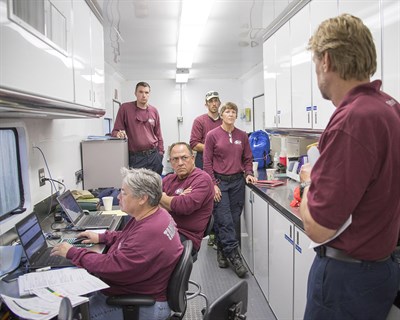
VET leadership participate in an operational planning session.
Early June 2016 brought devastating floods and tornadoes to southeast Texas. In emergency situations such as these, it is important to have safe and efficient evacuation plans prepared for our communities, including our family pets and livestock. Just like people, animals need care and shelter when a disaster strikes, and the Veterinary Emergency Team (VET) at the Texas A&M College of Veterinary Medicine & Biomedical Sciences (CVM) is there to provide such care.
“We are Aggies,” said Dr. Wesley Bissett, the executive director of the VET. “Aggies do special things in tough times, they stand up and serve.”
The VET was a dream brought to life in response to Hurricane Ike in 2008. After Hurricanes Katrina and Rita hit the Gulf Coast in 2005, Bissett noticed that the care of animals in disasters was practically nonexistent. Many disaster victims were not willing to evacuate because they couldn’t take their pets with them. They often stayed in place to protect their pets, putting their own lives at risk.
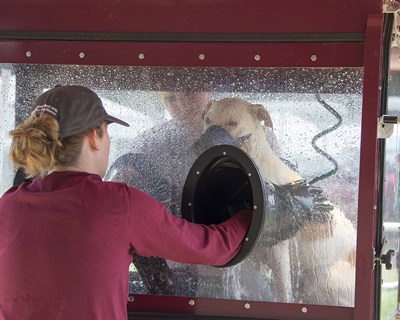
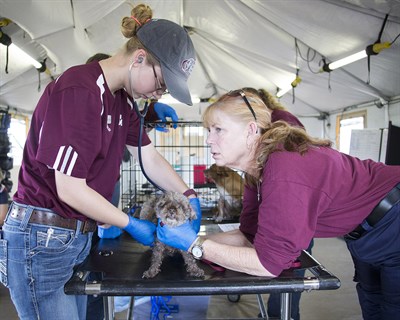
Erin Wilkens decontaminates flood victims.
In 2006, the Pets Evacuation and Transportation Standards (PETS) Act was passed at the federal level and required communities to have a plan for the evacuation of people with their animals during emergencies. The passage of PETS motivated Bissett to begin forming a veterinary emergency response team in 2008 at the CVM.
The VET was fully established in 2009. Since proving their effectiveness in the 2011 wildfire disaster in Bastrop, the VET has expanded to over 30 dedicated veterinarians, veterinary technicians, volunteers, and Texas A&M faculty, students, and staff. In addition, the VET also allows veterinary students a unique opportunity for field experience and is a required rotation in veterinary school at Texas A&M, something unique to the CVM.
“The bulk of the team is primarily faculty and staff that volunteer their time to be there,” said Angela Clendenin, public information officer for the VET. “However, students participate in a two-week rotation called Community Connections, which is taught by the faculty members on the VET. When there’s a disaster, we are able to take students that happen to be on the Community Connections rotation if they are able to go. Some of them have obligations that preclude them from going, and it’s not mandatory that they deploy with us, but they are encouraged to go and share in that experience.”
Melissa Bean and Cindy Schocke triage flood victims in Brazoria county.
The program is unique because students’ experience with disaster relief goes beyond theoretical knowledge. Instead, they learn first-hand about animal issues in disasters. When there’s not a disaster, the students work with faculty, local governments, and communities around the state of Texas to develop evacuation, sheltering, and medical operations plans for animals impacted by disasters.
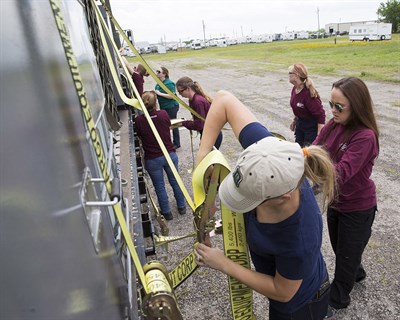
Working out of several trailers and tents when on duty, the team has worked hard to secure equipment to serve their needs since its formation. It can be hard to anticipate the condition of animals when a disaster strikes; therefore, the team has developed special equipment, including a decontamination unit, to aid in the recovery of wounded or sick animals.
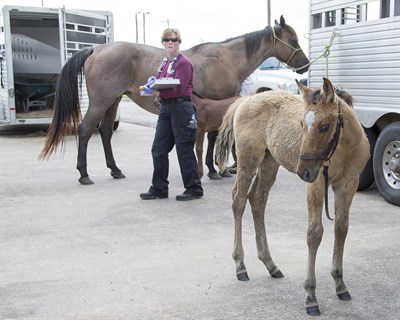
In June 2016, special equipment, like the decontamination unit, played a key role in treating animals affected by the flooding in Fort Bend and Brazoria Counties in southeast Texas. The portable decontamination unit, which helps VET members safely remove bacteria and debris from animals, allowed animal victims to be placed in a shelter or back in the homes of their families. The VET was deployed to the two counties and spent two weeks treating more than 100 animals—including livestock, cats, ducks, horses, and dogs—in the flooded community. Along with decontaminating animals that may have come into contact with toxic chemicals in the flood water, the team treated many other conditions, such as dehydration and submersion injuries.
VET members prepare for the return to campus.
Students say they found the experience rewarding and eye-opening. “Spending my time in Brazoria County was such an unforgettable experience. I gained so much knowledge in veterinary medicine from my time there,” said Heather Cook, a fourth-year veterinary student at the CVM. “The first couple of days I was deployed, I worked with small animals because I am focusing on small animal medicine. I gained a lot of experience performing physical examinations on dogs and cats, coming up with my own diagnoses and treatment plans. I also talked with clients about spaying, neutering, and vaccinating their pets, as well as putting them on heartworm and flea and tick prevention.”
When deployed by the state or county, the VET works with the county’s local veterinarians for extra supplies. AgriLife Extension is also included in the relief efforts to care for livestock, and shelters make sure the animals are kept safe and healthy until they can be returned to their owners.
VET members triage large animal flood victims during the Brazos River flooding.
“It’s a large group effort that we try to bring together. Linking with local veterinarians is crucial,” explained Dr. Deb Zoran, medical operations officer for the VET. “In Brazoria County, the local veterinarians came out to our base of operations and would bring things that we needed, such as supplies and equipment. They were out there almost every day, checking on us to make sure we were okay. The relationship between our team and local veterinarians is vital to our success.”
The VET’s formation was a result of Bissett’s dream and a group of passionate, caring Aggies who wanted to make a difference for people and their pets during emergency situations. The PETS Act of 2006 solidified the need for animals to be cared for in disasters, and the VET’s proven effectiveness led to the team’s expansion. Now, as one of the most seasoned veterinary emergency response teams in the country, the VET has demonstrated time and time again that it can be counted on to care for animals in crises.