Faculty, staff, administrators, and students celebrated the service of Dr. Evelyn Tiffany-Castiglioni to the Texas A&M College of Veterinary Medicine & Biomedical Sciences (CVM) and wished her a fond farewell as an administrator in the college during a reception on Monday, May 15, in the VENI Building’s Mark Francis Room.
Castiglioni, who previously served as CVM associate dean for undergraduate education and head of the Department of Veterinary Integrative Biosciences (VIBS), began as an assistant provost in the Texas A&M Office of the Provost in March and continued to serve as VIBS department chair until June.
Now, Castiglioni remains as a part-time faculty member in VIBS while serving as assistant provost, a newly created position designed to develop strategies and programs to encourage more faculty nominations to prestigious awards.
“This new position is in keeping with the prominent goal of President (Michael K.) Young and Provost (Karan) Watson to ‘raise the bar’ at TAMU to reach an even higher level of excellence,” said Dr. Eleanor Green, the Carl B. King Dean of Veterinary Medicine at Texas A&M. “I can think of no one more suited to this position.”
In the CVM, Castiglioni developed an enviable reputation for successful nominations of faculty and staff for awards at all levels, according to Green.
“Her letters were consistently compelling in content and well-targeted to the respective reviewers and decision makers; her impact in CVM in helping faculty receive awards which set them up for higher level awards is impressive,” Green said. “I have no doubt she will make an impact on TAMU in this new role.”
In Castiglioni’s absence, Dr. Jane Welsh will serve as VIBS interim department head until a permanent department head is named.
See more images from Dr. Castiglioni’s farewell reception at the CVM Flickr account.
VET members traveled to Port O’Connor, Texas, May 19-21 to support the service animals of veterans who converged from all over the country for Wounded Warriors’ Weekend.
The College of Veterinary Medicine & Biomedical Sciences’ (CVM) Veterinary Emergency Team (VET) traveled across the eastern half of Texas to offer a healing hand to those afflicted by the tornadoes that struck Van Zandt County on April 29 and to support veterans and their service companion animals for Wounded Warriors’ Weekend, May 19-21.
The team deployed on the morning of April 30 and spent three days at Canton Junior High, where they provided medical support for injured animals, both large and small, and helped reunite lost or missing pets with their owners. They arrived to conditions resulting from an F4 tornado that brushed one side of town and an F3 on the other; the F3 was on the ground for approximately 50 miles.
“As has been the case with every deployment, we were amazed by two things: the power of Mother Nature and the incredible generosity, kindness, and sense of community that is so prevalent in our state,” said Dr. Wesley T. Bissett, VET director and assistant professor in the CVM’s Large Animal Clinical Science Department.
During their efforts, the team coordinated with local veterinarians, including Canton Veterinary Clinic’s Dr. Tim Eberhart—whose home was destroyed in the tornado but was at his clinic in the morning to be available for his community—and the Texas Animal Health Commission.
“This community was remarkable; they rallied around each other and all of the first responders. They were incredibly thankful for all of the assistance and also intent on transitioning to the recovery phase. This is truly an incredible group,” he said. “We have yet to go to a Texas community that I wasn’t convinced would come back from a disaster even better than it was before.”
Also remarkable were the efforts of the VET members who represented Texas A&M, the CVM, and all of VET extremely well.
Fourth-year veterinary students Erin Tolson and Amy Eiland help Bear cool off during Wounded Warriors’ Weekend in Port O’Connor.
“Professionalism, kindness, compassion, and an incredible work ethic were so prominently on display; they are working hard and do so with a smile,” Bissett said. “Our faculty, staff, and students have a rich history of serving our state and nation in incredibly remarkable ways, and our history is one of impact every single day, even those that are the darkest. Aggies stand up and are counted when it counts.
During the three-day deployment—“long enough to help out through the worst” and to allow the community to begin “the hard work of getting back to normalcy”—Bissett said he appreciated everyone who came together for the cause.
“The Texas A&M Forest Service supported incident management; they did an incredible job of guiding a community through these types of incidents. They bring a level of organization and leadership that is desperately needed when disaster strikes and it is an honor to work with such a highly professional group of people,” he said. “Texas Task Force 1 and 2 functioned as they always do, with the highest level of expertise focused on finding the lost. We work with them so frequently and yet I continue to be surprised by just how good they are.
“Texas A&M AgriLife was actively engaged, as well. Tommy Phillips, the local extension agent was an integral part of the response,” Bissett continued. “Just as we saw in Brazoria County, the leadership and local knowledge that they bring to a response is incredibly important and very well done.”
A small team also traveled to Port O’Connor, Texas, for the 11th annual Wounded Warriors’ Weekend, during which veterans, their families, and their support companion/service animals from across the country enjoy a weekend of fishing, food, and fun.
Founded in 2007, Warrior’s Weekend is a non-profit, 501(c)(3) corporation dedicated to the support of U.S. veterans, with an emphasis on those wounded in the Global War on Terrorism.
The VET has provided veterinary support to the special canines for the past two years at the Port O’Connor Community Center in the event that one of the dogs is injured or overheats during the festivities.
The sponsors for the event were worried because the closest small-animal veterinarians are 45 minutes away, so they contacted Dr. Deb Zoran, professor in the Department of Small Animal Clinical Sciences and VET member, to see if the VET would be willing to provide on-site veterinary support.
“The dogs that come with these soldiers are special,” Zoran said. “They are therapy dogs, service dogs, and retired military working dogs. In their own way, they continue to serve our nation by assisting these brave men and women who sacrificed so much for our country. Our presence is small way that we can give back to these special people and their companions, and we are pleased to be able to support this event.”
To see more pictures from the Warriors’ Weekend activities, visit the CVM Flickr page.
Distinguished Graduate Student Award winners, with Marty Holmes and Dr. Sue Bloomfield (flanking winners in the back row), include: (standing, from left) Zachary Schultzhaus, Nima Jalili, Rachael Muschalek, Robert Hinck, John Kainer, Rachel Curtis-Robles, Corrine Metzger, Dr. Karen Butler-Purry; (sitting, from left) Landon Nash, Robyn Woollands, Elizabeth Seto, Guillermo García Ureña, Christopher Schalk, Ying-Pin Chen, Inchul Cho, and Crystal Dozier.
Curtis-Robles was among seven selected from students across Texas A&M’s 17 colleges for the AFS’s “Excellence in Research—Doctoral” awards.
Her recognized research focused on the ecology and epidemiology of Chagas disease—a parasitic disease spread by triatomine “kissing bug” vectors—in Texas. In addition to studies of Chagas disease vectors, she led studies of infection prevalence’s in canine, wildlife, and human populations throughout the state.
Curtis-Robles also was cited for her dedication to public outreach and education.
She co-founded the Texas A&M Kissing Bug Citizen Science Program, which accepts kissing bug vectors from across Texas and the U.S. for acceptance to a testing and research collection.
Along with her public outreach education activities, she has presented at many scientific conferences and work and presentations have garnered her presentation awards at national and international conferences
Curtis-Robles was a National Science Foundation Graduate Research Fellow, as well as a Texas A&M College of Veterinary Medicine Merit Fellow, and is now completing postdoctoral work in lab of Dr. Sarah Hamer, assistant professor in the CVM’s Department of Veterinary Integrative Biosciences.
Each year, the AFS chooses graduate students to receive Distinguished Graduate Student Awards in one of three categories: “Excellence in Research-Doctoral,” “Excellence in Research-Master’s,” and “Excellence in Teaching.”
Student nominations arrive from faculty advisers or departments, and nomination represents a true honor and accomplishment in itself, due to strenuous eligibility requirements. Recipients are selected by a panel of reviewers including faculty and administrators.
Texas A&M Technology Commercialization executive director Brett Cornwell and vice president for research Glen Laine (flanking recipients) present a Patent Award to Drs. Allison Ficht, Thomas Ficht, and Garry Adams during the 2017 Patent and Innovation Awards Luncheon on May 4.
Three professors in the College of Veterinary Medicine and Biomedical Sciences’ (CVM) Department of Veterinary Pathobiology (VTPB) were among the 64 faculty members recognized by Texas A&M Technology Commercialization on May 4 with a Texas A&M Patent Award.
Dr. Garry Adams, senior professor of veterinary pathobiology, and Drs. Allison Ficht and Thomas Ficht, both of whom are professors in VTPB, were honored for their patent on “Controlled Release Vaccines and Methods for Treating Brucella Diseases and Disorders.” The patent represents a decade of research for Thomas Ficht and Allison Ficht, who are the primary inventors of the vaccine, according to Adams.
The faculty members and other researchers from Texas A&M or Texas A&M System’s research agencies were presented with 45 Patent Awards during the 2017 Patent and Innovation Awards Luncheon at the Annenberg Presidential Conference Center in the George Bush Presidential Library at Texas A&M.
The luncheon recognized 88 faculty members and other researchers from across the A&M System who secured U.S. patents or plant variety protection certificates for their innovations during the 2016 calendar year.
“Texas A&M faculty strive for excellence as comprehensive scholars, including excellent teaching, research, discovery and impact,” said Texas A&M Provost and Executive Vice President Karan L Watson. “These awards acknowledge their success in applying new knowledge to the issues of our day, through partnership with industry, commercialization of new ideas and transfer of knowledge to the people of our state, nation and world.”
###
For more information about the Texas A&M College of Veterinary Medicine & Biomedical Sciences, please visit our website atvetmed.tamu.eduor join us onFacebook ,Instagram , andTwitter.
Contact Information: Megan Palsa, Executive Director of Communications, Media & Public Relations, Texas A&M College of Veterinary Medicine & Biomedical Science;mpalsa@cvm.tamu.edu; 979-862-4216; 979-421-3121 (cell)
The work of the Stevenson Companion Animal Care Center at the Texas A&M College of Veterinary Medicine & Biomedical Sciences and resident/student Lauren Schwerdfeger are featured in Women’s Day magazine.
The one-page article, found in the current edition, explores the “Rowdy Roommates” of the Stevenson Center, detailing the nearly 600 pets—including six miniature donkeys and two rabbits—currently on the endowment list and some of the center’s more prominent residents, including Reveille VIII.
Writer Christa Melnyk Hines also examines the unique opportunity the center provides to its four live-in student residents, including fourth-year veterinary student Schwerdfeger, who supplement the staff and gain practical experience working with the clientele during the evenings and holidays.
To read more about the Stevenson Center and Schwerdfeger’s experiences working there, pick up the June 2017 edition of Woman’s Day magazine.
Jessica Israel, a graduate student pursuing a non-thesis master’s in biomedical sciences at the Texas A&M College of Veterinary Medicine & Biomedical Sciences (CVM), is trekking her own path to a veterinary medicine degree by first immersing herself in research, an unconventional path for most non-thesis graduate students. Through her research experience, she hopes to contribute a different perspective to veterinary medicine. As a member of the deaf community, she will add to the diversity of the veterinary community.
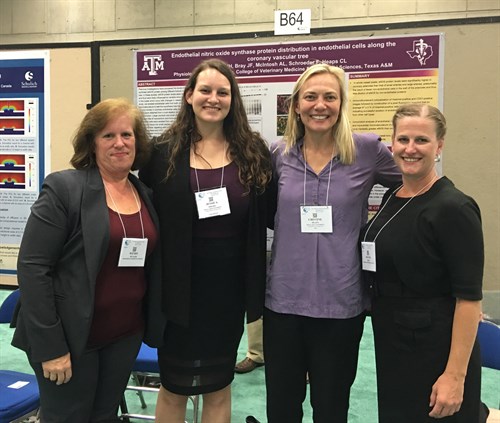
Wendy McNair (interpreter), Jessica Israel, Dr. Cristine Heaps, Amanda Rose (interpreter)
Although some may consider her deafness a challenge, Israel has not let it get in the way of her research. In April 2016, Israel was selected to present her research at the Experimental Biology Conference in San Diego—a conference that presents novel research discoveries in the fields of anatomy, biochemistry and molecular biology, investigative pathology, nutrition, pharmacology, and physiology. Israel’s selection to present at the conference was in recognition for her research and her position as a non-thesis major involved in research.
At the conference, Israel worked alongside interpreters to present her work to fellow scientists. “I had the chance to present my poster to scientists, who listened with interest and wanted to compare and discuss data from their research,” she said. “Scientists with years of experience in their field gave me feedback on how I could improve my experiments. I found this experience stimulating, and it boosted my confidence. The chance to interact with others, network, and listen to what others had to say was an amazing experience.”
There was much preparation for the poster presentation, Israel explained, “the conference provided me with two interpreters who would act as my voice during the duration of the presentation, and I was hesitant to put my trust in those interpreters because I didn’t know if they had a scientific background until I met them. So, I prepared a script with exact wording I would say during the presentation and tried to help them understand what the research project was about prior to giving the presentation. In the morning, I spent four hours practicing my presentation with them, and it took a while for them to learn. In the end, the presentation turned out great.”
The conference also introduced Israel to several scientists who were interested in collaborating with her. This was an opportunity Israel was grateful for. “I would encourage everyone to have a similar experience because it helps develop better interpersonal skills and increase networking,” she said. “I met several people who I would like to stay in touch with and could help me grow professionally.”
Israel’s interests in biomedical sciences and veterinary medicine include small animal surgery and research that could help build an even stronger bridge between human and animal health. Under the direction of Dr. Cristine L. Heaps, an assistant professor in the Department of Veterinary Physiology & Pharmacology at the CVM, Israel conducts research on the circulatory system, something she may continue to focus on after acquiring her master’s degree.
“I haven’t decided specifically which area of focus I want to study in veterinary school, but knowledge of the circulatory system would be beneficial,” Israel said. “I do know I want to focus on the surgical aspect of veterinary medicine and do more extensive surgery.”
Using pigs as models, Israel’s research focuses on endothelial nitric oxide synthase—or eNOS—distribution along the blood vessels that supply the heart and how this can affect blood pressure regulation. These eNOS receptors—which are released by the heart in reaction to stress—aid in the dilation of blood vessels and help regulate blood pressure. The potential to help better understand the role of blood pressure regulation in heart disease attracted Israel to study the cardiovascular system.
“I used to work in a different lab last year under Dr. Thomas Ficht, whose research focus is on brucellosis—an infection spread from animals to people through unpasteurized dairy products,” Israel said. “After working for him for a year, my interest of working in a different lab was piqued by my advisor, Dr. Heaps, who enthusiastically discussed her lab with me. I became curious and thought working in her lab would be fun, especially after being asked the question, ‘Have you ever seen a pig run on a treadmill?’ It was something I have never envisioned, and I was hooked. I asked her if I could work in her lab this year, and she agreed. I managed to see several pigs running on a treadmill; it was a funny and awesome sight.”
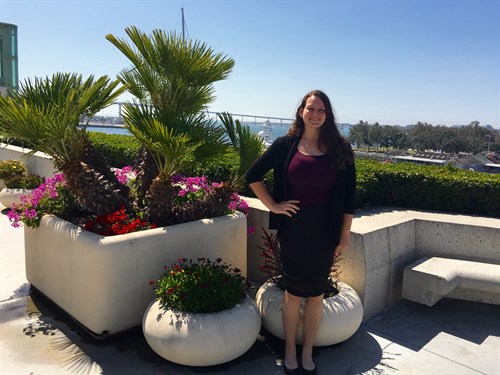
Jessica Israel at the Experimental Biology Conference in San Diego
Before Israel was inspired to pursue her education at the CVM, she earned her undergraduate degree in biology and a minor in chemistry at Gallaudet University in Washington D.C., a university for the deaf. Growing up in a deaf community, she attended a deaf school from elementary through high school. The shift to a university full of hearing people for her master’s degree was a challenge. However, Israel quickly adapted to the change.
“It was a huge change for me, using interpreters and other modes of communication besides sign language,” Israel said. “In itself, it was and still is a challenge and great experience.”
Her transition from being immersed within a deaf community to attending Texas A&M University helped prepare Israel for the beginning of her journey toward applying for veterinary school at Texas A&M. Since then, Israel has made Texas A&M her home and is not afraid to push past her obstacles. Her mentors have helped Israel explore her interests and fulfill her goals as a future veterinary student. Israel said she feels the opportunities at Texas A&M are limitless.
“Texas A&M has accommodated my needs and the professors here do a lot to give me the best access to information,” she said. “Several professors were willing to learn sign language in order to communicate with me better. They went beyond my expectations and I am grateful for this.”
Israel’s independent and confident attitude has helped her succeed at the CVM. Her devotion to her research has opened many doors to future collaborations with other scientists, as well as future opportunities to strengthen the connection between human and animal health. Israel is admired by other students and CVM staff and faculty alike.
“I am thoroughly impressed with Jessica’s tenacity as she navigates her way through the curriculum for the non-thesis master’s degree,” Heaps said. “She has performed superbly despite the obstacles to learning that she has had to overcome. In addition to her persistence in the classroom, Jessica has gone beyond that required in the non-thesis master’s program and has spent considerable time in the laboratory and preparing her scientific poster for presentation in San Diego. Jess maintains an incredibly positive attitude while negotiating every hurdle. She is a role model for all students, regardless of whether they are members of the deaf or hearing communities.”
“I am here to educate about deaf culture and show that anyone can do anything,” Israel said. “Members of the deaf community can do as much as anyone else, and I am an example of that.”
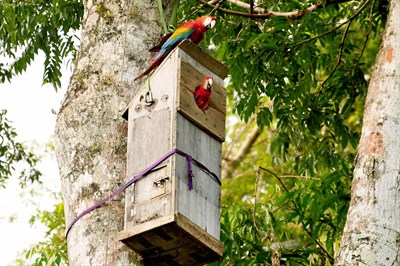
Scarlet macaws use an artificial nest box designed by the research team. (Credit: Liz Villanueva Paipay)
Deep in the Peruvian rainforest, 20 kilometers from the nearest road, stands the headquarters of the Tambopata Macaw Project, a combination ecotourism lodge and scientific research station. Waking up well before sunrise, teams of dedicated parrot researchers make daily trips into the jungle, braving intense humidity, thick forests, and unpredictable rivers to observe macaws in their native habitat. They climb up 150-foot trees; spend hours counting birds at clay licks; and carefully gather, measure, and return chicks to nests—while keeping a close eye on the birds’ movements through the rainforest canopy.
These adventures are all in a day’s work at the Tambopata Macaw Project, where an ever-changing crew of scientists, graduate students, foreign volunteers, and Peruvian employees work under the leadership of Dr. Donald Brightsmith, assistant professor in the Department of Veterinary Pathobiology at the Texas A&M College of Veterinary Medicine & Biomedical Sciences (CVM).
Since Brightsmith took over as director in 1999, the group has collected years of data on macaws. “I’ve had researchers recording data every single day since November 2000,” he said. It’s a treasure trove of research that Brightsmith hopes will fill in the knowledge gaps about macaw conservation and ecology.
From Long Island to the Amazon
The Brightsmith family (Gaby, Mandy Lu, and Don) celebrate Christmas 2014 at Tambopata. (Credit: Tambopata Macaw Project)
Brightsmith grew up on Long Island, New York, just outside New York City. Despite his urban roots, he has been a lifelong naturalist and bird watcher, “much to the joy of my classmates, who would pick on me for it all the way through graduate school,” he observed humorously. That early love of birds propelled him through academia, from his bachelor’s degree in natural resources at Cornell University, to his master’s degree in wildlife ecology at the University of Arizona, to his doctorate in zoology at Duke University.
During these years, Brightsmith’s passion for birds focused on a growing interest in parrots. A trip to Costa Rica in graduate school sparked his fascination with tropical birds, and his first wife introduced him “to the world of crazy parrot owners,” he said. But Brightsmith credits a single book—Beissinger and Snyder’s New World Parrots in Crisis (1992)—for opening his eyes to the plight of tropical parrots. “It pointed out that we don’t know much about parrots in the wild,” he said. “They’re having serious problems. They’re highly valuable both as a tourism resource and a captive resource. Yet, especially in the early ’90s, we knew almost nothing about where parrots breed, what they eat, or what habitats they use in the wild. It was an incredible disconnect.”
Around the time he was finishing up his doctoral research in zoology at Duke, Brightsmith was introduced to the Tambopata Macaw Project. Established in 1989, the project had briefly earned international recognition for its work on parrot clay licks and macaw nesting, but since the early 1990s had been languishing. Brightsmith said he saw a golden opportunity to revitalize the project and “make a difference by looking at this group of birds that are hard to work with.” In 1998, he flew to Peru and met with the project leaders. “I convinced them that if they gave me a small amount of money, I wouldn’t be a full-time employee, but I would start to run this research as a scientific endeavor again,” Brightsmith said. His pitch was successful, and the Tambopata Macaw Project was reborn under his enthusiastic leadership.
A marriage of ecotourism and research
The project began in 1989 when Peruvian researchers and entrepreneurs, Eduardo Nycander and Kurt Holle, founded both Rainforest Expeditions, a for-profit ecotourism company, and the Tambopata Macaw Project. From the beginning, Rainforest Expeditions owned and operated the remote lodge that served as both a research base and a tourist destination. “From the beginning, it was always a mixture of tourism and research,” Brightsmith explained. “They wanted the two to feed off of each other.”
So far, the venture has been uniquely successful and financially sustainable. Rainforest Expeditions provides lodging, food, and utilities, charging the macaw researchers a reduced fee. Foreign volunteers pay higher daily fees, and the difference goes toward paying wages and lodging for Peruvian workers. In exchange, every group of tourists at the ecolodge receives a scientific presentation from the researchers about current research and threats to macaws.
The marriage of ecotourism and conservation research is not only a boost to the Peruvian economy, but also one of the main reasons the Tambopata Macaw Project has been able to carry on so successfully for decades. Brightsmith estimated that Rainforest Expeditions provides over $30,000 in project funding every year. “It’s not a completely sustainable system right now, but all it requires is a few thousand dollars of extra financing, which is much cheaper than a full research lab,” Brightsmith said. “This is one of the reasons why the project is still going after 20 years.”
The Schubot connection
Of course, the data they collect still requires a laboratory and experts to analyze it. That’s where Texas A&M’s Schubot Exotic Bird Health Center comes into play. Brightsmith was recruited to Texas A&M by Schubot Center Director and Distinguished Professor Dr. Ian Tizard in 2005. After some initial research collaborations with Brightsmith, Tizard visited the Tambopata Center and offered Brightsmith a job as a lecturer at the CVM.
For Brightsmith, the Schubot Center was an irresistible draw, and the relationship has paid off. “The Schubot Center provides the platform for my work,” he said. “Over the years, they have provided financial assistance and a community of scholars. Because the center exists and it’s endowed, it will always attract a group of people interested in bird research, even those who don’t know that they’re interested in bird research.”
Brightsmith credits Tizard with making the Schubot Center a vibrant hub for avian research, always bringing new scientists from different disciplines into the fold. “If he needs a microbiologist, he finds a microbiologist who knows what a bird is,” Brightsmith said. “Right now we’re working with a geneticist who works on conifer trees, but all of these people are now working on bird-related issues because the Schubot Exotic Bird Health Center exists. I am within that milieu, and it provides a community of people interested in exotic bird issues.”
Current research
Groundbreaking studies about macaws using clay licks to gather essential minerals put Tambopata on the map in the 1990s, and that research continues today. Brightsmith’s team has also published papers explaining their success using artificial nest boxes to increase breeding success. However, over time, the Tambopata project’s main focuses have shifted to new questions.
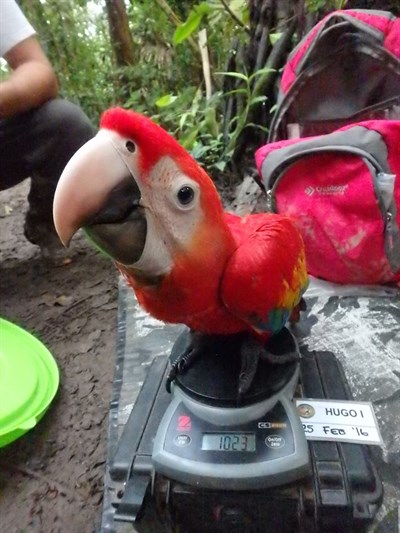
A scarlet macaw is weighed in February 2016. (Credit: Liz Villanueva Paipay)
Right now, Brightsmith’s main interest is the macaws’ movements and how they change in relation to seasonal events. Researchers use lightweight collars to track the movements of individual birds. Brightsmith said he is concerned about the macaws’ most recent breeding season, which was off to a late and slow start. He speculates that the El Niño weather patterns and the resulting low food supply might have something to do with it. To sort out the irregularities and what they might mean for the future of the species, he hopes to compare data from the past several years.
“At this point, we’ll be able to reflect back and see what happens when you have this odd change in plant resources and how that impacts [macaw movements and breeding],” explained Brightsmith. “Understanding what happens in an El Niño year may give us a better view into the future of what happens as larger-scale climate change alters the plants and their fruiting and flowering.”
Similarly, a shift in movement from one clay lick to another has piqued Brightsmith’s curiosity about the future. “We don’t understand how climate change and clay lick use are rippling through the environment and changing things. We need to look more carefully at these climate-related issues—the annual variations and how they correlate with the environment—which will give us a better ability to predict global change ideas.”
Brightsmith’s wife, Gabriela Vigo Trauco, Peruvian ecologist, Tambopata project coordinator, and current Ph.D. student in Wildlife and Fisheries Sciences at Texas A&M, is “studying scarlet macaw breeding systems using a combination of ecology, animal behavior, and genetic analysis.” The Tambopata location is perfect for her research because that species is not yet endangered in the Peruvian Amazon. “There we can study things that you cannot study in areas in which the species is endangered,” Vigo Trauco explained. “So, that’s the way I want to lead my research.”
CVM students are also using Tambopata as a site for fieldwork and graduate research. Every year, Brightsmith and Dr. Sharman Hoppes, clinical associate professor at the CVM, take two to four veterinary students on a study abroad experience at the station. Students from around Texas A&M’s campus spend time in Tambopata as both volunteers and doctoral researchers.
Hope for the future
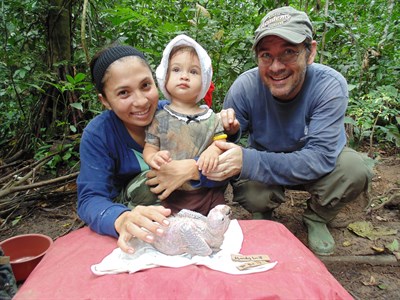
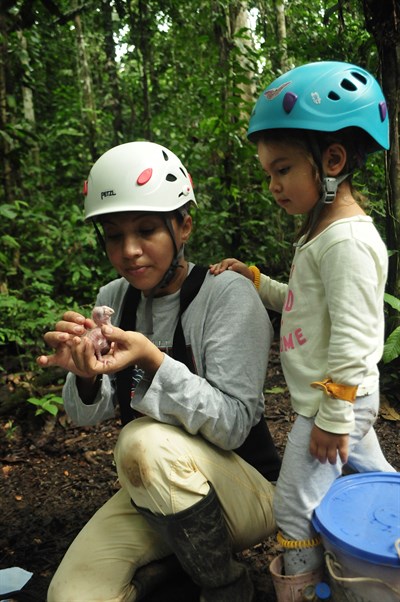
Gaby Vigo Trauco shows daughter Mandy Lu how to handle a macaw chick. (Credit: Liz Villanueva Paipay)
These days, Brightsmith and Vigo Trauco make it to Tambopata only twice a year. It’s not as much as they’d like, but their life in College Station keeps them busy. Brightsmith is a full-time assistant professor and admits that he spends most of his time behind a computer, analyzing and writing up data collected from years of research. “Right now, if you told me I could never take another data point on a macaw, I probably could finish out my career publishing on the amount of information we have,” he joked. “We’re currently publishing some of the important relationships between breeding and clay lick use and food and movement. It’s building a jigsaw puzzle where the first thing you have to do is build each piece. We’re building the pieces and fitting them together as we go.”
Vigo Trauco is immersed in reviewing video data from macaw nests. “We have collected over 30,000 hours of video in the past six years,” she said. Additionally, she is restarting her genetic research; a 10-year ban on exporting genetic materials out of Peru was lifted this year, allowing her to move forward with her projects.
Most of all, the couple is devoted to raising their daughter, four-year-old Amanda Lucille, or “Mandy Lu.” For the Brightsmith family, the Tambopata Macaw Project is now a family affair. Brightsmith and Vigo Trauco met on the project, and now they bring their daughter to share in their love of the rainforest and its vibrant inhabitants. Mandy Lu—”our little rainforest monster,” as Brightsmith affectionately calls her—seems to share her parents’ enthusiasm for the Amazon. “Maybe it’s because we like it, and she sees that we’re super happy in the rainforest,” Vigo Trauco speculated. “Maybe she is connecting happiness with being in the jungle.”
Either way, sharing her beloved rainforest with Mandy Lu has shifted Vigo Trauco’s long-term goals for the Tambopata Macaw Project. She envisions the Tambopata project as an opportunity to get Peruvian students interested and involved in conserving their country’s unique natural resources. “I think it would be nice to involve young people—young adults, in high school or their first years of college—and try to put that seed in their brains that conservation can actually help and actually can happen and be fun,” she said.
Brightsmith is also enthusiastic about the opportunities to teach conservation values to people in Peru and around the world. “We’ve had thousands of tourists who have gone through our talks and seen the site and the birds and really gotten a feel for what the real rainforest is like,” he said. He’s also seen changes in local attitudes. “The project has played into this shift in mindset,” he explained. “While some locals use the money they make from ecotourism to buy bigger chainsaws, there is the development of a mindset that has led this community to be much more deliberate in their planning as to how they’re going to use their natural resources.” Both Brightsmith and Vigo Trauco look to the younger generation of Peruvians and conservationists—hopefully some from the CVM—to build a brighter future for macaws and the rainforest.
If you want to visit the site as a tourist or guest, check out Rainforest Expeditions at www.perunature.com.
Dr. Sharman Hoppes: Avian Veterinarian in the Jungle
Dr. Sharman and her husband, Dr. Bruce Nixon
Since teaming up with Brightsmith in 2008, Sharman Hoppes, DVM, ABVP, and clinical associate professor at the CVM, has been flying south for the winter, straight to the Tambopata Macaw Project.
For two to three weeks, Hoppes trades in her exotic animal clinical duties at the Small Animal Hospital for a small, rustic Amazonian research facility with minimal electricity and no air conditioning. There, she runs the veterinary side of the operation, training students and making sure everybody’s projects stay on track.
Hoppes’ main concern is animal welfare. Working with wild birds unused to human handling adds a layer of complexity to her research. “I’m always very aware that we don’t want to over-stress a bird that we are handling, making it weak or tired and making it a greater risk from predators,” she explained.
Most of the work they do is with the chicks, taking them out of the nest for measurements and sampling. Hoppes states that “they become more used to the handling over time, but even with the chicks, you have to be prepared and monitor how long you have them out.”
When they are trapping adult birds, Hoppes trains her team to work with assembly-line efficiency. Her goal is to minimize contact with the birds, aiming for 10–11 minutes from capture to release. Her team practices their roles in advance using bundled-up towels. “The most important thing is that we’re really prepared and make sure that we have everything within hand’s reach, everything ready to go,” Hoppes said. “Everybody knows their part, and we all know that when we get to this time period, even if we’re not done, we let the bird go.”
Veterinary work in a hot, humid jungle can be challenging, but this self-professed “city girl” revels in it. “This project changed my life,” she said. “I love it there!”
The Texas A&M Foundation Board of Trustees named Brenda Castillo as one of two recipients of its fifth Outstanding Student Award during a dinner on May 3 at the Sanders Corps of Cadets Center on the Texas A&M University campus.
Castillo, a graduating senior who is the first in her family to attend college, was recognized for excelling academically while distinguishing herself as a leader at Texas A&M and in the community.
She set her heart on attending Texas A&M after coming to the campus as a high school student to participate in the state science fair.
“When we visited the campus, I immediately liked the environment and the people,” the Regents’ Scholarship recipient said. “I applied to other schools, but Texas A&M was the only one that I could see myself attending.”
Castillo, a molecular and cell biology major and Spanish minor, plans to pursue a medical degree after graduating this month. Originally born outside of Chicago, Castillo moved with her family to a small Mexican town when she was a young girl. There, she watched as relatives and community members were unable to easily access medical care. One of these relatives was her father Eduardo, who died of leukemia when Castillo was 2.
As a teenager, Castillo moved with her mother to San Antonio. There, she saw how many U.S. doctors have difficulty communicating effectively with Spanish-speaking patients, thus creating a barrier to quality health care. After completing medical school, Castillo plans to help fill this gap by working primarily with Spanish-speaking patients.
“Brenda’s desire to help people who are experiencing difficulties in accessing quality health care is the epitome of selfless service that every Aggie strives to exemplify,” said Bill Toler, chairman of the Foundation’s Board of Trustees. “She is an excellent representative of the kind of student and Aggie for whom this award was originally created.”
She served as the vice president of the Hispanic President’s Council and managed the website and social media for Alpha Epsilon Delta Pre-Medical Honor Society. As a sophomore, she also participated in the Spring Leadership Exchange, during which she had the opportunity to travel to Texas A&M’s Qatar campus. In addition, she worked as a mentor for the Regents’ Scholarship FOCUS Learning Community and as a supplemental instruction leader.
“Texas A&M has been a place of growth for me in different ways,” Castillo said. “The academics were challenging, and I’ve had to overcome a lot to graduate. The opportunities I’ve had have made me a better individual by allowing me to understand people from different cultures and backgrounds.”
Castillo will enroll in Texas Tech University Health Sciences Center El Paso Paul L. Foster School of Medicine in the fall.
“The Trustees’ Outstanding Student Award is like a farewell gift from Texas A&M,” Castillo said. “This award will allow me to begin the path toward being able to serve both of my countries as a bilingual physician.”
Former Foundation trustee Melbern Glasscock and his wife Susanne created the endowed Outstanding Student Award in 2012 to honor exceptional students at Texas A&M University. Besides succeeding academically and as leaders, recipients have overcome significant personal or family financial challenges to attend Texas A&M. The Outstanding Student Award includes a cash prize of $2,500.
To read about the other recipient, Joshua Sutton, click here.
The Texas A&M Foundation is a nonprofit organization that solicits and manages investments in academics and leadership programs to enhance Texas A&M’s capability to be among the best universities. To learn more about scholarships, fellowships and program-focused giving to benefit Texas A&M University, contact the foundation at txamfoundation.com, 800.392.3310, or 979.845.8161.
This story was written by Monika Blackwell, Texas A&M Foundation.
The Texas A&M College of Veterinary Medicine & Biomedical Sciences (CVM) and the North American Veterinary Community (NAVC) welcomed game-changers, innovators, entrepreneurs, and visionaries to the Veterinary Innovation Summit on April 28-30. At the event, veterinary and non-veterinary entrepreneurs and health professionals shared fresh perspectives on the latest technologies, debated controversial issues, fostered new ideas, and catapulted the profession into the future with fearlessness and innovation.
Veterinary Innovation Summit presentations in the VENI Building explored fresh perspectives on the latest technologies, controversial issues, new ideas, and catapulting the profession into the future with fearlessness and innovation.
Dedicated to sparking and fostering ingenuity, the Veterinary Innovation Summit featured a combination of unique programming, a diverse attendee pool, and an immersive learning environment for veterinary professionals.
This innovative intersect of processes for people to have conversations was one of brilliance and discovery. The many breakout sessions, the networking opportunities, and the conversations in the hallways created an ambiance hard to describe to those who did not attend.
Texas A&M President Michael Young welcomed the participants and told a story about his and his wife Marty’s love for animals. They came to Texas with a horse and now have a ranch full of animals, all of which have visited the Texas A&M Veterinary Medical Teaching Hospital. Dr. Eleanor Green, the Carl B. King Dean of Veterinary Medicine, spoke about the CVM’s incredible faculty and the innovative technology and teaching methods they have brought to the college. Dr. Adam Little, CVM director of Veterinary Innovation and Enterprenuership, discussed his first meeting with Dr. Green during which they shared the vision of this summit and prepared everyone for the two-day journey ahead.
In all, the Veterinary Innovation Summit welcomed more than 380 participants, 24 of whom were from nine different countries, including 11 from the United Kingdom, nine from Canada, two from France, one from Germany, and one from Palestine.
Veterinary professionals who successfully have started their own companies or created new software and programs for the industry spoke on a panel Saturday, encouraging other practitioners to awaken their own innovative and entrepreneurial spirits.
A few examples of the amazing keynotes at the Veterinary Innovation Summit included:
Ben Jacobs, co-founder and chief executive officer of Whistle, a GPS and activity tracker for dogs, who spoke about finding and developing a product that would address a pain point in the customer market, while looking for the quantified patient;
Stephen Chen, the founder and chief executive officer of PETNOSTICS, a company that provides at home urine test kits for pets, who talked about democratizing diagnostics and making diagnostics accessible to pet owners;
Raymond McCauley, chair of digital biology at Singularity University, who discussed the digital biology engineering of healthy animals, which allows for DNA microarrays for any species that can be customized for around $60, and how whole genome sequencing is no longer a thing of the past;
Benjamin Lewis, a fourth-year veterinary student at the University of Pennsylvania and the chief executive officer and co-founder of The One Health Company, who discussed how the company is crowdsourcing the everyday veterinarian to take part in biomedical research, which can not only double the revenue for the veterinarians but also have them participate in groundbreaking research to help advance their field;
and Jon Ayers, chief executive officer at Idexx, who spoke about the human-animal bond and innovation at Idexx as it strives for “innovation with intelligence.” Eighty-six percent of Idexx’s revenue is in companion animal health, and it is approaching $2 billion in worth, all of which was organically grown from within the company.
Planning has already begun for the summit to return to College Station in 2018. Ideas and suggestions are welcomed.
To see more images from the Veterinary Innovation Summit, visit the CVM Flickr page.
Getting a new puppy, kitten, or older cat or dog is an exciting experience, but having pets comes with certain responsibilities, including potty training. It may be a time-consuming process to potty train your pet, but Dr. Mark Stickney, clinical associate professor at the Texas A&M College of Veterinary Medicine & Biomedical Sciences, said it is necessary to develop a long-lasting, positive relationship with your pet.
“Inappropriate eliminations are one of the biggest reasons pets are surrendered,” Stickney said. “Developing good bathroom habits early is key to having a pet you will enjoy for a long time.”
Potty training should begin as soon as you bring your pet home. If you’re training an adult dog or a puppy, be sure to give them plenty of time to use the bathroom and stay with them until they go. Then, reward the animal with a treat or positive praise so they understand that eliminating outside is good behavior.
If you’re training a kitten or cat, Stickney said finding a litter box that your pet is comfortable getting in and out of is key. Additionally, if your kitten was using a litter box before it came to live with you, it could be helpful to start potty training your pet with that specific litter.
“Cats can be texture-and odor-specific with their litter,” Stickney said. “So if you start with that litter you can gradually transition them to another litter later, if you prefer.”
Because using a litter box is instinctive for cats, the potty-training process could be quicker than with dogs. However, if your pup is having a hard time learning where it is appropriate to eliminate, don’t give up. There are other strategies pet owners can use to potty train their canine, such as crate training.
“Crate training takes advantage of a dog’s natural inclination to rest in a den,” Stickney explained. “Dogs will not urinate and defecate in their den (crate) because they prefer to eliminate outside.”
If you’re going to crate train your dog or puppy, Stickney said the crate should be large enough for the animal to stand up, stretch out, and turn around, but not any larger.
Additionally, maintain a consistent schedule for allowing your pet to go outside.
“A good rule of thumb is the puppy needs to go outside every hour per month of age,” Stickney said. “So a three-month-old puppy needs to go outside to eliminate every three hours. A puppy that begins to whine and become anxious should be taken outside immediately.”
Though crate training can be effective, Stickney said it’s important to remember that puppies and even adult dogs still will have accidents occasionally. In this case, Stickney said instead of punishing your pup, ignore that the accident even happened.
“Once an accident happens in the house, the puppy has already forgotten what it did,” Stickney said. “Clean up the mess and remove the smell so the puppy does not revisit that spot.”
In addition, Stickney said if your adult dog or cat is already potty trained and suddenly starts having reoccurring accidents, this could be a sign of health problem. In this case, your pet should see a veterinarian for a check-up.
No one should pass up an opportunity for pet companionship to keep their home clean and fresh-smelling. If you’re consistent in your potty training plan, both you and your new pet will be happy.
But remember, if you’re planning on getting a furry friend, patience and positive reinforcement are key throughout the process of potty training.
Pet Talk is a service of the College of Veterinary Medicine & Biomedical Sciences, Texas A&M University. Stories can be viewed on the web at vetmed.tamu.edu/pet-talk. Suggestions for future topics may be directed toeditor@cvm.tamu.edu .