The Partnership for Environmental Education and Rural Health (PEER) program at the Texas A&M College of Veterinary Medicine & Biomedical Sciences (CVMBS) promoted One Health and diversity at the San Antonio Hispanic Chamber of Commerce CORE4 STEM Expo on Nov. 17 and 18. PEER presented “Science and You” and offered hands-on activities to 300 inquisitive and at-risk 10th graders and their 12 teachers. This is the fourth year the PEER program has worked with the San Antonio Hispanic Chamber of Commerce CORE4 STEM Expo to promote careers in Science Technology, Engineering, and Math (STEM), specifically veterinary medicine, to at-risk K-12 students.
On Dec. 3, the PEER program worked with Aggie Pals to promote One Health and diversity. Aggie Pals is a Regents’ Scholars program that encourages fourth and fifth graders who would be first-generation college students to pursue higher education by interacting with current Aggies. PEER presented on science and science careers, emphasizing veterinary medicine. The group also facilitated hands-on activities for 107 enthusiastic and receptive fourth and fifth graders and their 10 teachers. At the event, PEER program undergraduate fellows honed their communication skills, shared their knowledge, and participated in STEM outreach to rural communities.
###
For more information about the Texas A&M College of Veterinary Medicine & Biomedical Sciences, please visit our website at vetmed.tamu.edu or join us on Facebook, Instagram, and Twitter.
Contact Information: Jennifer Gauntt, Director of CVMBS Communications, Texas A&M College of Veterinary Medicine & Biomedical Sciences; jgauntt@cvm.tamu.edu; 979-862-4216
Giving an adorable puppy or kitten as a gift this holiday season may seem like a wonderful idea, but it is important to remember that pets need a lifetime of care and commitment long after the holiday season.
Surprising your family with a new fuzzy friend on that special holiday morning is tempting, but be sure to first consider these facts to avoid being unprepared when bringing a pet home.
Giving the gift of a pet’s companionship requires a considerable amount of research and preparation. There can be many reasons why a pet may be unsuitable for a home, such as if the receiver is not financially or mentally prepared for a pet.
Dr. Stacy Eckman, clinical assistant professor at the Texas A&M College of Veterinary Medicine & Biomedical Sciences, explained how pets can often come with hidden expenses. “Pets, even healthy ones, require a financial commitment for basic requirements, such as food, collars, and leashes, as well as medical needs, such as basic vaccinations,” she said. “Unexpected illnesses or injury may also add to that financial burden, which can be too much for some owners to handle.”
Other reasons a pet may not be an appropriate gift this year is if the receiver is allergic to pets, if the receiver does not have an appropriate place to keep the pet, or if the receiver does not want a pet or have time to commit to a pet.
Taking care of a cat or dog is a responsibility that is often simplified in the minds of children, but the reality is that pets need care throughout their entire lifetime. Giving a pet as a gift to children who are not yet responsible to care for it can lead to pets being seen as “play-things,” rather than living and dependent animals. Adults often take on the responsibilities of feeding, bathing, and cleaning up after the pet when the initial newness wears off. Sometimes adults are guilty of neglecting the pet too, especially if they were unaware of the financial commitment from the beginning. This can lead to many pets entering shelters for the remainder of their lives or until another family adopts them.
Although there are many reasons why giving a pet as a holiday gift can be a bad idea, a pet can make a great holiday gift for someone if the proper amount of research and preparation is done. If the receiver has expressed their commitment to a pet, proven their responsibility, and are financially and mentally ready for a pet, the gift giver must then consider the receiver’s pet preferences for gender and breed. Adoption is also a great option, especially if the new owner prefers an older dog or cat. Many pets are patiently waiting in shelters for a forever home, and the adoption staff at the shelter will be able to help you choose the perfect pet for the new owner.
Although giving a pet as a gift this holiday season may seem like a wonderful life-long memory for your family, there is a considerable amount of research and preparation involved in bringing a pet into a new home, especially if it is a surprise to the new owner. If the receiver has proven their responsibility and expressed their desire for a new fuzzy companion, be sure to consider their pet preferences as well as adoption.
Pet Talk is a service of the College of Veterinary Medicine & Biomedical Sciences, Texas A&M University. Suggestions for future topics may be directed toeditor@cvm.tamu.edu .
This award recognizes Womack’s efforts in advancing the fundamental boundaries of knowledge in the veterinary profession and for facilitating the research careers of veterinarians. The Excellence in Research Award is one of the highest honors bestowed by the AAVMC and is given to the outstanding researcher of the year.
As a leader in genomic research, Womack has a tradition of excellence in research, having won the Bush Excellence Award for Faculty in International Research (2008) and the Wolf Prize in Agriculture (2001) among others. In addition, he earned recognition from the National Academy of Sciences in 1999, and was named a Fellow of the American Association for the Advancement of Science that same year.
Womack’s research in genomics and genome mapping has led to discoveries impacting cattle, chickens, horses, and humans. His comparative studies between animal genomes and the human genome are paving the way for an improved understanding of gene function and expression.
“Dr. James Womack has a distinguished history of research excellence, ” said Dr. Eleanor M. Green, the Carl B. King dean of veterinary medicine. “His past discoveries and future research endeavors are unlocking the mysteries of the genome in different species, which are leading to novel approaches in diagnosing and treating genetic disorders in animals and humans. Dr. Womack’s commitment to promoting research careers for veterinarians is a legacy that will define our profession and ensure it is prepared to meet the needs of both human and veterinary medicine in the future.”
Womack was selected to receive this honor by a committee of peer veterinarians within the AAVMC and will be presented with the award at the AAVMC Annual Conference held March 4-6, 2016 in Washington, D. C.
Wildlife biologist and veterinarian Scott Newman is the Food and Agriculture Organization (FAO) Senior Technical Coordinator for Emergency Centre for Transboundary Animal Diseases in Vietnam. He was hosted by Texas A&M One Health Initiative during November 2015. Newman leads zoonotic and non-zoonotic disease programs, food safety projects, and facilitates a One Health approach that places agriculture, public health, and natural resource management in the broader development framework in Vietnam and the south-east Asia region.
Newman presented a seminar titled “Applying One Health at a Global Level: Emerging Issues and the Sustainable Development Goals”. This was co-branded by six university organizations, including five student groups: Wildlife Diseases Association Student Chapter, Student One Health Association (from School of Public Health, College of Medicine and College of Veterinary Medicine & Biomedical Sciences) and Veterinarians without Borders, as well as the Institute for Infectious Animal Diseases.
The seminar was attended by 90 students, faculty, and staff across disciplines including veterinary medicine, human medicine, public health, accounting, engineering, and from several other centers and units. The “meet the speaker” roundtable session attracted 15 students, faculty, and staff and provided a one-on-one opportunity to ask Newman questions about international career pathways and global One Health challenges and opportunities, and funding sources. Newman also met with the Department of Wildlife and Fisheries Sciences to discuss the current state of transboundary animal diseases that are threatening international. Overall, his visit focused around building alliances for collaborations.
The Texas A&M One Health Initiative is a collaborative multidisciplinary program of all disciplines at our university. To learn about One Health upcoming events visit: http://onehealth.tamu.edu
Texas A&M College of Veterinary Medicine & Biomedical Sciences (CVM) announced the selection of Dr. Jeffrey Musser, clinical professor in the Veterinary Pathobiology department, as a participant in the American Association of Veterinary Medical Colleges’ (AAVMC) 2016 Public Policy Faculty Fellows.
Dr. Jeffrey Musser
The AAVMC launched the faculty fellows program in 2015 to bring faculty representatives from member institutions to Washington D.C. to develop leadership skills in the advocacy arena, explore the implications of public policy decisions on the profession and gain overall knowledge of the legislative and regulatory process at the federal level.
Joining Musser is Dr. Marcy Souza from the University of Tennessee. A release from the AAVMC noted Musser and Souza were “chosen based on their demonstrated and potential leadership in advocacy and government.”
This will be the second fellowship of Musser’s academic career, having also served as a livestock advisor in a science, engineering, and diplomacy fellowship with the U.S. Agency for International Development through the American Association for the Advancement of Science.
Musser earned a bachelor’s degree in biology from Frostburg State College, a doctorate in pharmacology from North Carolina State University and a DVM from the Virginia-Maryland Regional College of Veterinary Medicine. He conducted his residency in large animal medicine at the Cornell University College of Veterinary Medicine and is a diplomate in the American Board of Veterinary Practitioners.
“As an ABVP Dairy Diplomate, I have special interests in issues regarding antibiotic regulations and increasing microbial resistance, foreign animal disease preparedness, and the Veterinary Medicine Loan Repayment Program,” Dr. Musser wrote in his application. He added that participating in the fellowship will enable him “to bring greater awareness to our colleagues and the general public on the importance of veterinary medical education in research, public health, animal health and welfare, food safety, and our overall economy.”
The role of veterinarians in public health and national security increases every year. As leaders in the concept of “One Health,” veterinarians protect national borders from emerging foreign animal diseases, work within industry to ensure the safety of the national food supply, and serve the veterinary profession by advocating for policies that will support the growing need to attract new students to be the next generation of veterinary professionals.
“Dr. Jeffrey Musser has a distinguished history of representing the veterinary profession on an international level through the American Association for the Advancement of Science and the U. S. Agency for International Development, ” said Dr. Eleanor M. Green, the Carl B. King dean of veterinary medicine. “The skills he will develop through this fellowship will enable him to continue bringing greater awareness of the importance of veterinary medical education to the quality of health for humans, animals, and the environment. His proven leadership in public policy and advocacy will give veterinary medicine a strong voice in government and will ensure the interests of practicing veterinarians and veterinary educational institutions will be well represented. We congratulate Dr. Musser on this outstanding honor.”
“I look forward to working with the new fellows,” said AAVMC Director of Governmental Affairs Kevin Cain. “Last year’s inaugural fellow participants found the fellowships to be life enriching. They’re now able to use their knowledge and experience to work as leaders in advocacy and public policy at their home institutions. That’s our goal. We want to bolster the influence of veterinary medicine in the governmental arena and to help develop leaders who will be strong voices for veterinary medicine now and in the future.”
During the American Veterinary Medical Association (AVMA) Council on Education (COE) accreditation site visit exit interview with Dr. Kenita Rogers and Dr. Eleanor Green, the accreditation team went through their list of comments. As expected, they found some items the CVM needs to fix, but all are fixable. It’s unlikely there will be challenging substantial compliance issues.
First, they commented on the CVM’s very strong positive learning and working environment and complimented our faculty, staff, and students. They also noted our robust research program and success in engaging students in research. Green will share the final document when the CVM receives it, but for now here are a few commendations. The accreditation team commended the CVM on:
A robust educational opportunity at Houston SPCA
Veterinary Emergency Team
Diversity and an inclusive environment
Professional development opportunities in leadership for faculty and staff, including mediation training
Outcomes assessment initiatives (which was noted as a weakness during the last visit), and Center for Education Technologies support in curricular review process
After the exit interview, President Michael Young, Provost Karan Watson, and Vice President Christine Stanley congratulated the CVM on this positive review. President Young was was very complimentary and is very proud of his first veterinary college.
Thanks all who contributed to this successful COE site accreditation team visit, including those who helped with logistics, put together the demonstrations for Sunday evening, met with the team, helped with tours, made the CVM spotless, helped prepare the document, and all the other activities over the last few months necessary for this once-every-seven-years event.
Most importantly, thanks to each and every one of you for making our CVM what it is each and every day. This is a special place—constantly stretching the boundaries of excellence in an inclusive, collaborative environment. Six trained external reviewers and two observers saw that at the site visit.
COLLEGE STATION, Texas-The Texas A&M Association of Former Students (AFS) recently honored two outstanding Texas A&M College of Veterinary Medicine & Biomedical Sciences (CVM) faculty members in the Department of Small Animal Clinical Sciences (VSCS). Dr. Audrey Cook, associate professor, and Dr. Ashley Saunders, associate professor, received AFS College-Level Teaching Awards during a department meeting on Dec. 7, 2015. The award recognizes Cook and Saunders for their excellence in teaching and devotion to their students.
“This award recognizes the important contribution Dr. Cook and Dr. Saunders make to the lives of so many here at Texas A&M; University,” said Kathryn Greenwade ’88, vice president for communications and human resources at The Association of Former Students. “Texas A&M; is fortunate to have many outstanding classroom teachers across our campus, and The Association is proud to recognize the best of the best annually with this meaningful award.”
“We’d like to thank them for the work they do to increase learning,” said Dr. Blanca Lupiani, interim dean of faculties and associate provost, “as well as the work they do for the students and for the good work they do in research, teaching, and service.”
Dr. Audrey Cook
“Drs. Cook and Saunders are truly outstanding clinicians and educators,” said Dr. Jonathan Levine, department head and Helen McWhorter chair in VSCS. “It is an honor to work with them as our department continues to prioritize excellence in student learning.”
Cook works with both the Internal Medicine Service and the Feline Internal Medicine Service at the Small Animal Hospital and has been with the CVM since 2007. She is also a diplomate of both the American College of Veterinary Internal Medicine and the European College of Veterinary Internal Medicine and is recognized as a specialist in feline practice by the American Board of Veterinary Practitioners. With interests in endoscopy, gastroenterology, and endocrinology, Cook works diligently with veterinary students in a clinical setting to prepare them for their future work in the veterinary profession. This is her first teaching award while serving on the faculty at the CVM.
“It is a real thrill to receive this award, and I am very grateful to all those who made it happen,” Cook said. “It is such a privilege to be part of this college and to help our students follow their dreams. I have the best job in the world!”
“Dr. Cook is an exceptional clinician and teacher,” said Dr. Eleanor M. Green, the Carl B. King dean of veterinary medicine. “The enthusiasm she brings to work each day makes her a delight to work with, and the care she shows her patients and students is outstanding. She provides students with unique educational experiences, and we are proud that she is being recognized with this prestigious award.”
Dr. Ashley Saunders
Saunders has been with the CVM since joining the faculty in 2005 as a clinical assistant professor, where she focuses on cardiac issues in small animals, including congenital heart disease and heart failure management. In the Small Animal Cardiology Service, Saunders works closely with veterinary students in the hospital to prepare them for difficult and complex cases. She is also a diplomate of the American College of Veterinary Internal Medicine (subspecialty cardiology) and has been widely recognized for her teaching, having won several other awards. Her teaching awards include the Bridges Teaching and Service Award in 2011 and the Richard H. Davis Teaching Award in 2010, and she was named a Montague Center for Teaching Excellence Scholar in 2009. Additionally, she is the assistant department head for teaching in VSCS.
“Every interaction in the classroom or on the clinical cardiology service is an opportunity for me to get the students excited about cardiology and to teach them the fundamentals to be successful when they graduate,” said Saunders. “I am honored to receive this award.”
“Dr. Saunders’ passion for patient care and complete devotion to her students make her so worthy of this award.” Green said. “We congratulate Dr. Saunders on this well-deserved honor that recognizes her exceptional contributions to the education of veterinary students that begin in the clinic and make long-lasting impacts on the profession.”
Every year faculty and students select the honorees of the AFS College-Level Teaching Award, and they are presented with a plaque and a stipend. The awards begun in 1955 and recognize outstanding members of Texas A&M;’s faculty and staff for their commitment, performance, and positive impact on Aggie students, Texas citizens, and the world around them.
Like humans, pets can become obese and develop excess body fat, which can lead to serious health problems, such as diabetes or degenerative joint disease. In order to provide your furry best friend with the highest quality of life and increase their life span, be sure to follow these simple steps to prevent obesity in your pet.
Weight gain in pets is often a result of overfeeding and lack of exercise. To keep your pet at a healthy weight, be sure to provide a healthy balance between food intake and physical activity. For example, give your dog or cat two to three meals a day instead of providing food at all times, and make sure to include at least one daily walk or some playtime.
Maintaining a healthy weight for dogs and cats also depends on the type of food they eat on a daily basis. Owners should choose an appropriate pet food according to the animal’s age, weight, and activity level. Generally, younger dogs and cats need to consume more calories per pound of body weight than older dogs and cats. Animals with active lifestyles and pregnant or nursing females require more protein, minerals, and calories in their diet.
Dr. Audrey Cook, associate professor at the Texas A&M College of Veterinary Medicine & Biomedical Sciences, explained the best way to choose the healthiest option for your pet. “Your regular veterinarian is the best person to give advice on what to feed your pet,” she said. “They will be able to provide an optimal diet type based on the animal’s age and body condition. In general, feeding guides on food products tend to overestimate the amount of food needed, so these guides can be misleading.”
In addition to diet and exercise, pet owners can regularly monitor their pet’s weight by routinely weighing them around the same time of the day. This can be effective in catching your pet’s weight increase before it becomes a more serious problem.
Obesity in pets can also be caused by some serious health problems rather than simply reflecting poor diet and lack of exercise. Weight gain can be related to hormone problems, such as hypothyroidism in dogs and acromegaly in cats, which is defined as excess growth hormone production. Dogs with hypothyroidism gain weight without eating more food than usual, while cats with acromegaly will experience an increase in appetite. Dogs and cats with Cushing’s syndrome will appear as if they’ve gained weight with their pot-bellied appearance, but these patients rarely experience a weight increase.
No matter the cause of obesity in dogs and cats, severe secondary diseases and health problems can develop if the obese patient is left untreated. There is good evidence that obesity impacts quality of life as well as life span. “In dogs, obesity is often associated with joint problems, such as arthritis and loss of mobility,” Cook said. “Obesity in cats is strongly associated with diabetes mellitus.” In addition to these health conditions, an obese pet may also have difficulty breathing, become fatigued with routine exercise, and be unable to groom itself effectively.
Though it may be tempting to spoil your pet with table scraps and extra servings of food, consider thinking twice about the consequences your pet may face as a result. To provide your pet with a healthy and happy life, consult your veterinarian in keeping a balanced lifestyle and choosing the right food for your pet’s needs.
Pet Talk is a service of the College of Veterinary Medicine & Biomedical Sciences, Texas A&M University. Stories can be viewed on the Web at vetmed.tamu.edu/pet-talk. Suggestions for future topics may be directed toeditor@cvm.tamu.edu .
Dr. Dana Johnson developed a fascination with animals during visits to her grandmother’s small farm, while growing up in Lubbock, Texas. “I loved collecting eggs and just being around animals. [My grandmother] was the same way and said that if she had lived in a different time, she would want to be a veterinarian,” Johnson said. “I asked her what that was and she told me. I kind of felt like I was geared to do that because of her influence.”
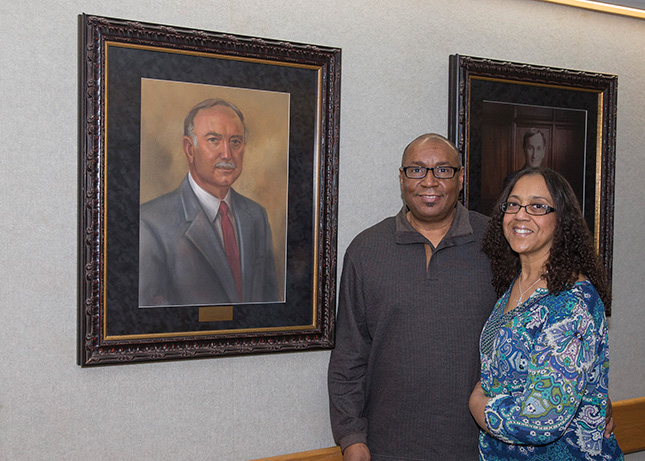
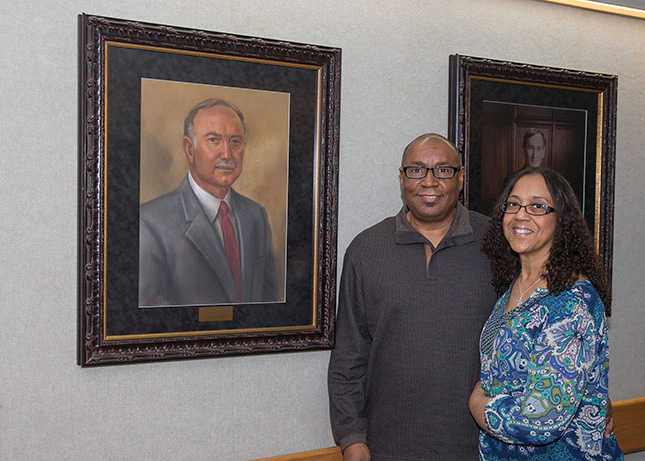
Dr. Cleveland Manley and Dr. Dana Johnson next to a painting of former dean Dr. George C. Shelton
Johnson’s grandmother wasn’t the only person who inspired her as a child. The local veterinarian, Dr. John Key, also encouraged her to pursue a career in veterinary medicine.
“The veterinarian in Lubbock who took care of our animals was very influential too,” Johnson said. “He was a very good person, and whenever we would take our pets in, he knew that I was interested and he would take the time to show me X-rays and ask me what I thought. I remember that vividly, and that piqued my interest even more to want to do this.”
Meanwhile, across the country in Sudbury, Massachusetts, Dr. Cleveland Manley grew up in a rural neighborhood raising animals, including rabbits, chickens, and dogs.
“Being around animals was a natural thing for me,” Manley said. “I had really passionate advanced biology teachers. I was lucky enough to have a teacher to inspire me and really fascinate me with science and anatomy and physiology.”
Manley grew up in a working class family, and he wanted to do well in his undergraduate program so that his transition to professional school would be smooth. Texas A&M; University had a well-respected undergraduate animal science program and offered him a scholarship, so he came to Texas.
Headed to College Station
Manley’s transition to College Station was not easy. “It was a pretty big culture shock to go from the northeast to a university that culturally and ethnically was very different in 1978,” he said. “I adapted by finding people that were receptive of my differences. I made friends here that were like my family.”
In the 1980s, Johnson’s and Manley’s paths converged at the Texas A&M; College of Veterinary Medicine & Biomedical Sciences (CVM). As the only African-Americans in the college, they supported each other while navigating the rigorous academic challenges and the unique social challenges due to their ethnicity.
“We spent a lot of time together. That’s how our courtship kind of grew,” Johnson recalls. “Wherever he was, I was. Wherever I was, he was.”
One of their biggest influencers at the CVM was the college dean, Dr. George C. Shelton. “The dean had an open-door policy, and any time we needed to talk, if we were having a hard time or feeling stressed out for various reasons, we could go and talk to him,” Manley said. “He was there to listen to us.”
“I think he played matchmaker too,” Johnson said. “I remember after my interview a lady came to me and said, ‘Dean Shelton would like to see you.’ I was wondering why, and I soon realized that he was wanting me to meet Cleveland Manley.”
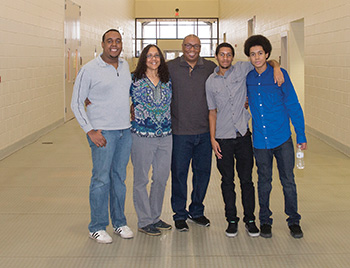
The relationship blossomed into marriage for the two young veterinarians in 1990, three years after they both received their veterinary medicine degrees. Johnson was the first African-American woman to graduate with a DVM from Texas A&M.; Now living in Wiley, Texas, a northern suburb of Dallas, both doctors are respected veterans in their field and are raising three sons, Isaiah, Elias, and Xavier, ages 16 to 23.
“We feed off each other, and we come home and talk about cases and new ideas,” Johnson said. “I realize now that the dean had a plan. He was a good man, the dean.”
Lasting Influence
Drs. Johnson and Manley with their sons, Xavier (left), Elias, and Isaiah (right)
Johnson works at a full-service clinic, East Plano Murphy Pet Hospital, in the Dallas suburb of Murphy, Texas, seeing primarily dogs and cats. Manley is medical director for the VCA Pet Doctor Animal Hospital in Richardson, Texas, a position that involves not only staying abreast of the latest veterinary medicine practices but mentoring associate doctors.
Manley remembers the support he received from Dr. Alice Wolf, now retired from the CVM, who encouraged him to continue learning and not become complacent. “She made me feel like, okay, she wants me to succeed, so I’m going to do my best to succeed,” he said.
Dr. Mike Herron, who is now a veterinarian at the Wellborn Road Veterinary Medical Center, and Dr. Gregory Troy were other important influences who left a positive, lasting impression on the two. “There are people like them who stand out,” Johnson said, “professors who made you feel welcome, like a real person.”
“I have always thought that students deserve respect, and I have always attempted to treat them as future colleagues,” said Troy, now a professor in the Department of Small Animal Clinical Sciences at the Virginia–Maryland College of Veterinary Medicine. “I hope I had a small part in providing an inclusive environment for Dana and Cleveland during their time at Texas A&M.;”
“Even though we had some bad experiences, the good far outweighed the bad,” Johnson said. “It’s just that sometimes those things stick with you a little bit longer, but when you think about the whole realm of things, it was a good place to come to school. We enjoyed it here; we met here. There are lots of good people in that class. There were lots of good professors here that did make us feel welcome.”
Growing up in a house with two veterinarians, the Manley boys have learned a lot about veterinary medicine from spending time at clinics, listening to their parents discussions, and even helping care for the occasional pet patient that their parents have brought home for short stays. “They talk about work all the time, think about work all the time,” Xavier said. “They have a passion for what they do, and it’s apparent.”
Manley and Johnson are happy for their children to follow their own interests. “Where their passion takes them is the most important thing to us,” Manley said. “You’ve got to do what you love and hope everything works out.” Xavier studied journalism at Texas Tech University, Elias is enrolled in the college of architecture at Texas A&M;, while Isaiah is still in high school.
Both Johnson and Manley are happy that Elias gave Texas A&M; a chance. “I have a lot of clients that come in and ask me, ‘What school did you go to?'” Johnson said. “A lot of times they went to A&M; and they’re like, ‘Whoop!’ They’ve still got that atmosphere and pride of being here.”
Vaccinations can prevent many illnesses in puppies, but viruses such as canine parvovirus are still a threat to dogs with developing immune systems. Young puppies often have immunity against the virus because they get antibodies from the colostrum in their mother’s milk, but these antibodies are not always as effective as a vaccine.
Dr. Johanna Heseltine, clinical assistant professor at the Texas A&M College of Veterinary Medicine & Biomedical Sciences, explained the characteristics of parvovirus. “Canine parvovirus, or ‘parvo,’ is a highly contagious virus that affects dogs and often causes severe diarrhea and vomiting in puppies,” she said. “Parvovirus lives for months in the environment, so many puppies can be exposed while their immune system is still vulnerable. Once dogs are fully vaccinated, they seldom become infected. Even if a puppy has received some vaccines, they are still at risk for infection because the antibodies they receive from their mother’s milk can interfere with the puppy’s immune response to the vaccine. In addition to this, the puppy’s body has not made its own protective antibodies.”
Parvovirus attacks areas of the body where cells are rapidly dividing, such as the intestinal tract and bone marrow tissue. As a result, victims of the virus experience a loss of appetite, vomiting, diarrhea, weakness, and lethargy. “Since the virus attacks white blood cells in the bone marrow, infected dogs develop low white blood cell counts, which puts them at risk for a bacterial infection called sepsis,” said Heseltine. “The severity of illness varies between patients, but most of the dogs we see in the hospital develop severe bloody diarrhea and vomiting.”
Parvovirus spreads through fecal-oral contact, meaning the virus can be transmitted through any animal, person, or object that comes in contact with an infected dog’s feces. A dog can shed parvovirus in its stool without showing any signs of illness and can continue spreading the virus for several weeks after recovering. Parvovirus is so common that it may be present anywhere that dogs frequently visit. Inanimate objects, such as food bowls, shoes, clothes, and carpet also serve as carriers for the virus for up to several months.
Treatments for parvovirus are available, but prevention through vaccination is essential to protect puppies’ health. If infected, puppies should be hospitalized and isolated from other dogs to avoid spreading the disease. Large amounts of bodily fluids are lost through vomiting and diarrhea, so patients are replenished with electrolytes through intravenous fluid therapy. Antibiotics are also needed to help prevent secondary infections. Other treatments include antiemetic medication, plasma transfusions, or related therapies.
You can protect your puppy from this deadly virus by making sure they stay up-to-date on vaccinations. Limiting your puppy’s exposure to other dogs, as well as keeping a secure backyard that prevents strays or other potentially infected animals from entering will also decrease the puppy’s risk of contracting the disease. Until your veterinarian declares it is safe, try keeping your puppy away from dog parks or other areas where there is a high concentration of dogs.
If you think your puppy may be infected with parvovirus or has come in contact with another infected animal, contact your veterinarian for assistance. To prevent further spread of the disease, it may be necessary to remove your puppy’s toys, blankets, and other belongings from the environment.
Pet Talk is a service of the College of Veterinary Medicine & Biomedical Sciences, Texas A&M University. Stories can be viewed on the Web at vetmed.tamu.edu/pet-talk. Suggestions for future topics may be directed to editor@cvm.tamu.edu.