BIMS Majors Give Back Through Service, Research

It is evident from their level of involvement on the Texas A&M campus that junior biomedical sciences (BIMS) majors Ryan Bindel and Elizabeth Nevins have “servant hearts.”
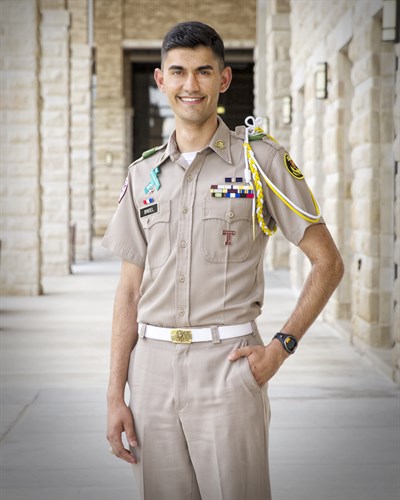
Ryan BindelBindel is a member of the Texas A&M Corps of Cadets who will join the U.S. Navy after he graduates; he plans to become a physician in the military. An avid runner on marathon and triathlon teams, he’s active in the Ross Volunteer Company and tutors his fellow cadets. Nevins, who plans to become a pediatric hematologist or oncologist, is involved in Fish Camp, her sorority Delta Gamma, and Big Event.

Both are active undergraduate research assistants in the College of Veterinary Medicine & Biomedical Sciences (CVM). Both also are scholarship recipients-Bindel, through the military, and Nevins, through the Terry Foundation.

“I actually had two scholarships that allowed me to come to A&M,” Nevins said. “If I didn’t have these scholarships, I probably wouldn’t be here.”

Because of the significant role that benefactors have played in their collegiate careers, Bindel and Nevins decided to give back by applying to the Texas A&M Foundation’s Maroon Coats ambassador program, which aims to increase the culture of philanthropy at Texas A&M by educating students on the importance of outside support and thanking donors.

More than 300 students applied for the prestigious position, and the selection process was rigorous, including multiple rounds of interviews, according to the students. Only 20 were selected for the 10th class this year, and both Nevins and Bindel were among them.

“I’m humbled and excited for the opportunity; I am really glad to bring the College of Veterinary Medicine & Biomedical Sciences to Maroon Coats and the foundation because I want to support this college in any way that I can,” Bindel said. “I know in previous years, there have not been many Maroon Coats from this college, and so I really was looking forward to the opportunity to say, ‘Hey, we’re doing incredible things, and we can grow in these ways. Please help us get there.’ It’s really just exciting.”

Bindel, from Mansfield, Texas, never intended to choose Texas A&M he was accepted into the United States Naval Academy and planned to move to Annapolis, Maryland. And then his father was diagnosed with colon cancer.

“We recognized late into my senior year that he was getting much worse, and he ended up passing away in June,” Bindel said. “So we made the decision that going away to the Naval Academy just wasn’t a very good option for my family, for my two younger brothers and my mom, and I needed to stay in Texas; and that was something that was totally OK with me.”

To Bindel, the next best military school was Texas A&M, so he applied and was accepted.

“Initially, I did not enjoy it at all,” he said of his freshman year.

But one day, bussing to West Campus, he took the only empty seat and noticed a copy of The Battalion lying there. In that edition was a story featuring the work of Dr. Nancy Turner, a research professor in the Department of Veterinary Pathobiology; that ultimately led to his involvement in undergraduate research.

“Dr. Turner does colon cancer research, and my dad passed away of colon cancer, so that was just a really easy decision for me to get involved,” Bindel said. “I said, ‘Yeah. I want to contribute to this field and learn more about the disease.’ I don’t know how I would’ve gotten involved in Dr. Turner’s lab if I hadn’t read The Battalion that day.”

Through Turner’s laboratory, Bindel works on a NASA-funded project studying colon cancer and how the cancer manifests in the “astronaut environment.” His work is part of the undergraduate research scholars’ program, and he wrote his thesis on the project.

“The experimental design that we use includes a no gravity, high-iron diet, which astronauts receive, and then the radiation,” Bindel said. “All three of those combine to cause injury to the colon, which has the potential to cause cancer.”

The indirect connection to his father through his research and the new family he found through the Corps of Cadets have changed Bindel’s initial views of Texas A&M.

“Over time, I realized how important each of the traditions is and the family-like environment of being an Aggie,” he said. “Understanding what that means and getting all wrapped up in it, I realized this is exactly where I need to be.”

It was also his connections in the Corps that led him to the Maroon Coats program.

“My commanding officer last year, Marisa Howat, was a Maroon Coat, and I got a little bit of a closer interaction with her and seeing what she did,” Bindel said. “She got to wear the coat to a football game and sit in the President’s Suite, and I was like, ‘That’s kind of cool. How do I do that?’ That sparked the initial conversation.”

Now, though only an active Maroon Coat for a few months, Bindel has found that the program has deepened his connection to the university, its donors, and the entire community.

“An Aggie’s always an Aggie, and I think it’s more than just the students; it’s the community, as well,” he said. “The Bryan-College Station area and the former students who just care so much about what is happening at the school, and, more importantly, the people who are in it, all of the Aggies are incredible. That family aspect has really hooked me.”

Unlike Bindel, the Aggie traditions and people were a big part of Nevins’ attraction to Texas A&M. Like with Bindel, the research component became a major draw to the BIMS program.
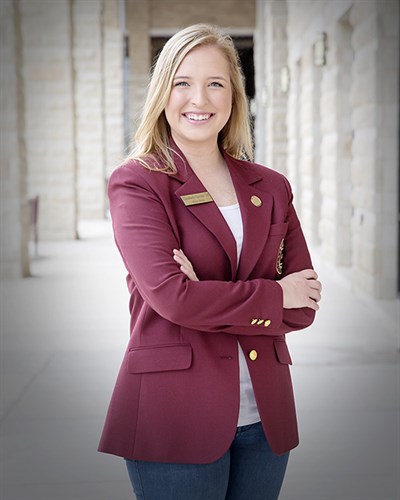
Elizabeth NevinsA Plano, Texas, native, Nevins said she always knew she wanted to be a doctor, so selecting the BIMS program was the obvious choice.

“I grew up the youngest of three, and so I’ve always been taken care of. But I’ve always wanted to be able to take care of other people, and science has always intrigued me,” she said. “I’ve always wanted to work with children, as well, because I was a swim teacher growing up. I just love how resilient they are and how they have such a positive outlook on life.

“Biomedical sciences is very tailored toward research and becoming more of a well-rounded student. I especially like the electives I’m taking, and it’s so interesting to actually be involved not just in the sciences, but in the application of the sciences,” she said. “I think that’s what’s so special about BIMS; it helps you see real-world problems and how you can solve those problems innovatively, using the sciences, and then apply that to real-world problems today.”

Knowing that she could make a long-term impact on the lives of others through research and the role research will play in her future career, Nevins got involved in the lab of Dr. Kevin Cummings, assistant professor in the Department of Veterinary Integrative Biosciences, studying the transmission of Salmonella by examining fecal samples from animals in feed lots.

“We’re looking at birds mainly around H-E-B and Kroger, and you can see the transmission from animal to humans and how that relates,” she said. “The reason I was drawn to this research is because there’s a bridge between animal and human transmission with diseases, and I feel like sometimes it gets overlooked when you’re going into human medicine.”

Her lab work is facilitated by the fact that she doesn’t have to worry about tuition as a Terry Scholar, which provides her a full-ride scholarship, ultimately easing the burden on her family of the expense of medical school.

Through the Terry Scholars program, Nevins learned about the Maroon Coats, and the idea of giving back through service to prospective students and donors appealed to Nevins greatly. Over the past decade, the group has devoted more than 7,300 service hours in the community, provided more than 200 campus tours to prospective students and other guests, and written thousands of thank-you letters and made hundreds of phone calls to donors and friends.

“Unfortunately, I’ll never get to meet my Terry Scholarship donors because they passed away years ago, but I know there are so many donors here who go unnoticed and unrecognized,” she said. “It’s funny; my freshman year, Maroon Coats opened the door (at the A&M Foundation) for me, and I remembered that during my Terry interview, they asked me how I would give back in the future.

“Through Maroon Coats, I’m able to give back a little bit of my time,” Nevins said. “In the future, I want to give back monetarily like these donors have, but for right now, giving my time and my Aggie spirit and wanting to make something of myself is, I feel, giving thanks to them.”

Pets can have allergies too

cat with dim eyes

With spring right around the corner, many of us are bracing ourselves for pesky allergies. Just like people, pets can suffer from allergies, too. While humans tear, cough, and sneeze their way through allergy season, pets usually deal with allergies differently.

Dr. Adam Patterson, a clinical associate professor and chief of dermatology at the Texas A&M College of Veterinary Medicine & Biomedical Sciences, said every animal has a different reaction to allergies, just as people respond to allergies differently. However, most animals display itch as a hallmark sign of allergic skin disease.

“An itch may be manifested as licking, chewing, biting, rubbing, scratching, head shaking, and/or scooting,” Patterson said. “Common itchy body areas include the face, ears, paws, armpits, groin, rump, and anal region. Horses may present with an itchy skin disease and/or hives.”

Allergens that most commonly irritate pets include fleas, pollen, molds, mites, insects, danders, and food.

“Every pet has its own itch tolerance, which means the intensity and reason(s) for your pet’s itch may not be the same as another animal,” Patterson said. “Regardless of the animal, allergic patients are prone to bacterial and yeast infections that can cause skin discoloration, hair loss, pimples, scabs, and/or ear disease.”

If your pet shows any sign of an allergy, it is best to contact your veterinarian so they can properly diagnose the cause of itch. Your veterinarian can also perform tests to determine the most effective treatment plan to alleviate your pet’s discomfort.

We all know how annoying allergies can be, so be sure to keep an eye on your pet this allergy season. If your pet shows any sign of an allergic skin disease, visit your veterinarian to help alleviate your pet’s discomfort.

Pet Talk is a service of the Texas A&M College of Veterinary Medicine & Biomedical Sciences. Stories can be viewed on the Web at vetmed.tamu.edu/pettalk . Suggestions for future topics may be directed to editor@cvm.tamu.edu .

CVM Students Put ‘One Health’ Into Practice During Disaster Day

The gymnasium of the Central Baptist Church Family Life Center in Bryan is filled with more cots than the eye can absorb in a single glance. People wander aimlessly through the room, past emergency stations set up for triage or to dispense medicine, as students meet and attend to the needs of the injured or ill.

Screams randomly echo off the walls as a young man lies on one of those cots while Texas A&M students hover over him, assessing the dog bites on his leg and face. Another young man walks past, searching for his dog. Has anyone seen his dog?

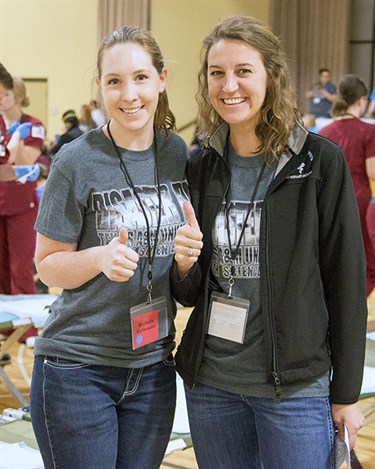
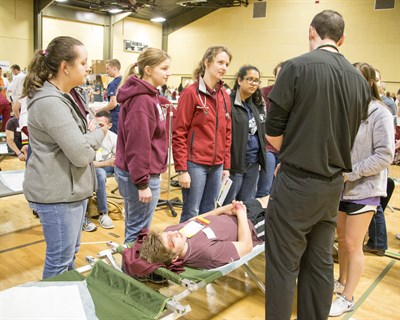
It sounds like the scene from a pandemic genre movie, but it’s actually all a part of the ninth annual Disaster Day training hosted in March by the Texas A&M College of Nursing. The largest student-run mass casualty simulation event in the country brought together more than 300 students from nursing, pharmacy, medical, and, for the first time, from the College of Veterinary Medicine & Biomedical Sciences (CVM), all of whom were employed to act as care providers for more than 400 volunteers portraying victims of a hurricane.


Disaster Day 2017
Students participate in Disaster Day simulations; 2017 was the first year CVM students participated in the activity.

Students were able to gain experience by putting into practice the knowledge and skills they are acquiring within all of Texas A&M’s medical disciplines. While nursing and medical students assisted actors with “broken bones” or “flesh wounds,” 30 veterinary students reacted to three vet-med scenarios written by Michelle Kurkowski and Laura Hurst, third-year veterinary students and co-presidents of the Student One Health Association.

Kurkowski and Hurst, who were instrumental in the CVM’s involvement in Disaster Day and served as the vet-med liaisons during the event, specifically created the cases with input from students from the other colleges in an effort to incorporate both human and animal medicine.

The scenarios were designed to create a realistic experience that students might encounter in a similar situation as professionals; they included a man and his dogs showing signs of a bacterial disease and a girl suffering from head trauma who was brought in with her dog; it was ultimately discovered that the girl was epileptic and the animal was her service dog.

“The vet students and the medical/nursing students had to realize that the dog and the girl needed to be kept together at all costs,” Kurkowski said. “Failure to recognize this would result in the girl seizing without warning.”

In another incident, a child was bitten by a husky amidst a dog fight.

“The owner took the dog to the tent for veterinary care and informed the students that the dog wasn’t current on its rabies vaccination. The bitten child was in the medical tent and it was the veterinary students’ job to find the attending physician and inform him that the dog wasn’t current on its vaccine,” Kurkowski said. “The mother of the child demanded the dog be euthanized, and the medical and veterinary students had to diffuse the situation.”

The best part of practicing in this simulated environment, according to Kurkowski, was the collaboration that emerged between the veterinary, medical, and nursing students.

“The veterinary students greatly enjoyed the chance to interact with the other colleges and get in on the main action. They also remarked that they learned a lot clinically,” she said. “The senior students were vital in helping to teach the younger students how to approach each clinical case and make decisions.

“The medical and nursing students began to seek out the veterinary teams for assistance when needed; they even began to consult with the veterinary teams on cases that were not originally written as med-vet interface cases,” Kurkowski said. “The students seemed to enjoy the additional layer of complexity to the scenario once it was clear what was expected of them and how to respond to veterinary situations. The veterinary students were able to teach new things to the human medical providers and vice versa.”


Kurkowski and Hurst
Michelle Kurkowski and Laura Hurst, the vet-med liaisons for Disaster Day 2017

Likewise, students learned a lot from what went wrong during the day; because this was the first year that veterinary cases were incorporated into Disaster Day, awareness and communication were two hurdles that had to be overcome early.

“These experiential training opportunities in which our Texas A&M students participate help them think outside the box; work with interdisciplinary teams of medical, nursing, pharmacy, and veterinary professionals; and successfully address disasters,” said Rosina (Tammi) Krecek, research professor for Texas A&M’s Global One Health initiative. “Such training builds confidence and readiness in our students to face inevitable challenges such as natural disasters, pandemics, and other catastrophes.”

In addition, members of Texas A&M’s Veterinary Emergency Team (VET)-the largest and most sophisticated veterinary medical disaster response team in the country- set up tents outside to support the cause, helping students understand what it’s like to deploy for a disaster on the veterinary side by working through animal cases.

“It’s not just taking care of animals when you’re in a disaster environment; there’s noise and chaos around you, people constantly coming in with this or that problem or needing you to talk to the media or offering to volunteer,” said Deb Zoran, professor in the Department of Small Animal Clinical Sciences and VET member. “The chaos of a disaster environment is similar to all of the other things that are going on while you’re just trying to be a veterinarian; that’s a really good skill set to learn for life.”

While these devastating events are hard to mimic through simulation-in Brazoria County, for example, the VET saw more than 350 companion animals over a 10-day period, accounting for about 30–35 animals a day coming in suddenly and sporadically-Zoran said there’s no question that the activity was valuable for students.

“It is a great experience that allows the fourth-year veterinary students opportunities to practice being team leaders. Perhaps most importantly for the first-, second-, and third-year veterinary students, it is the first time they’re introduced to disaster response and the concept of triage and stabilization,” Zoran said. “This training will help them as they continue in school because it’s just another way of developing the skills of thinking things through and problem solving.”

Kurkowski and Hurst also tied in an educational component following the simulation by providing handouts and bringing in CPR dummies to teach participants about canine CPR; they hope to establish an even greater presence at Disaster Day next year to increase the learning opportunities for everyone.

“There is never a large-scale disaster, natural or man-made, that doesn’t involve animals in some way; people are very attached to their animals and often consider them members of the family, and anyone who works in disaster management needs to understand this and have a plan for how to handle it,” Kurkowski said.

“That’s why it was so important for us to participate in Disaster Day; we wanted to add another layer of reality to the incredible learning experience that the School of Nursing has created,” she said. “We also wanted to show students from all of the schools the communication and collaboration that is necessary when animals are inevitably involved, so that they are better prepared for the real deal.”

February is Pet Dental Health Month

dog being treated by a vet doctor

Dental health in dogs and cats may sometimes be overlooked by pet owners. However, just like humans, pets need regular dental cleanings to keep their gums and teeth healthy.

As part of pet dental health month, Dr. J.R. “Bert” Dodd, a clinical professor at the Texas A&M College of Veterinary Medicine & Biomedical Sciences, explained some common dental hygiene issues in dogs and cats.

“Poor oral hygiene in dogs and cats can lead to excess tartar, swellings in the mouth, and severe wear of the teeth (or broken teeth) from chewing on inappropriate objects,” he said.

In addition, neglected oral health can also lead to gum disease, which left untreated, can make your pet more susceptible to other health complications. For example, bacteria in the mouth can spread to other parts of the body and cause infections.

Keeping your pet’s mouth healthy is easier than you think. While your veterinarian can help through routine dental check-ups and treatments, most dental health issues in pets can be prevented at home.

“It is best to begin home care when your puppy or kitten is between 8 and 12 weeks old; however, it is never too late to start,” Dodd said. “The first step is to train your pet to accept the brushing of their teeth. The best approach is to establish a routine of brushing your pet’s teeth with gauze that is wrapped around your finger. It may be helpful to use beef or chicken broth with dogs or tuna water with cats to get them accustomed to the routine instead of using cleaning agents.

“Once your pet is familiar with the daily routine, you can switch out the gauze for a finger brush or a soft toothbrush,” he said. “Then you can incorporate using veterinarian-approved pet toothpaste.”

Even if you do regularly care for your pet’s teeth, you should visit the veterinarian if your pet has persistent bad breath or experiences bleeding from the mouth or tooth, a change in eating behavior, and sensitivity to touch around the mouth; this may be a sign of a more serious dental health condition, Dodd said.

Keeping your pet’s mouth healthy can help them live a longer, healthier life, so as part of pet dental health month, consider making a veterinary appointment to have your pet’s teeth examined. Your pet will thank you with a smile.

Pet Talk is a service of the Texas A&M College of Veterinary Medicine & Biomedical Sciences. Stories can be viewed on the Web at vetmed.tamu.edu/pet-talk. Suggestions for future topics may be directed to editor@cvm.tamu.edu .

Pets celebrate Valentine’s Day every day

little girl with a dog

With Valentine’s Day just around the corner, many of us can’t help but look at our pets and remember the day we fell in love with them. We are fortunate to share our lives with such caring (and cute) animals, which is why we do everything we can to keep our pets happy and healthy.

However, pets do a lot for us, too. They teach us how to love unconditionally and be a good friend. They are also there to lend a comforting paw in times of need.

In the spirit of Valentine’s Day, Dr. Sarah Griffin, a lecturer at the Texas A&M College of Veterinary Medicine & Biomedical Sciences, described some of the ways our pets show us love and affection.

“Cats show affection by purring, sitting in your lap, rubbing against your leg, and following you around,” Griffin said. “Sometimes, they may even gently nip or bite you.”

Cat owners may also find that their pet brings them toys; random, found objects (such as hair ties); or even a small bird or mouse. This is considered a present and is a sign that your kitty loves and cares for you.

Dogs show affection through tail wagging, licking, and playing with their owners, Griffin said. Dogs may also curl up next to you for a nap, especially after a relaxing walk. When this happens, it is common courtesy to go ahead and take a nap, too.

With all the love our pets show us, it’s no surprise that they have plenty of love for other animals.

Both dogs and cats will play, cuddle, groom each other, and nap together. Though dogs and cats are sometimes portrayed as enemies, it is actually common for dogs and cats to become cuddle-buddies and friends.

There is no doubt that pets are a special part of the family. This Valentine’s Day (and every day), appreciate the gift of unconditional love from your pet. Reciprocate love not only to your pet, but also to the family and friends in your life.

Pet Talk is a service of the Texas A&M College of Veterinary Medicine & Biomedical Sciences. Stories can be viewed on the web at vetmed.tamu.edu/pet-talk. Suggestions for future topics may be directed to editor@cvm.tamu.edu

Andersson Receives Uppsala University’s Most Prestigious Award

Leif Andersson

Texas A&M University and Uppsala University professor Leif Andersson has been honored with the most prestigious award given at Uppsala University, The Björkén Prize.

Anderson, a visiting professor in the Texas A&M College of Veterinary Medicine & Biomedical Sciences’ (CVM) Department of Veterinary Integrative Biosciences (VIBS), was awarded the prize during Uppsala University’s Winter Conferment Ceremony on Jan. 26.

Selected by the Uppsala University Board, The Björkén Prize is granted “as a reward for outstanding scientific research or other work based on science—either discoveries, inventions, or fruitful enhancements—that brings honor to Swedish research or contributes to the material improvement of the country.’

It is alternately awarded in four different fields: botany, zoology, and landscape planning; chemistry, mineralogy, metallurgy, and geology; physics, mechanics, and engineering science; and theoretical disciplines of medical sciences.

“It is a true honor to receive this prize since so many outstanding scientists, including several Nobel prize laureates, have received the prize before me,” Andersson said.

The Björkén Prize was first awarded in 1902 on the day of John Björkén’s death, Dec. 16.

Andersson also recently was awarded an honorary doctorate from Texas A&M University during its commencement ceremonies Dec. 15-16.

###

For more information about the Texas A&M College of Veterinary Medicine & Biomedical Sciences, please visit our website at vetmed.tamu.edu or join us on FacebookInstagram, and Twitter.

Contact Information: Jennifer Gauntt, Director of CVMBS Communications, Texas A&M College of Veterinary Medicine & Biomedical Sciences; jgauntt@cvm.tamu.edu; 979-862-4216

Texas A&M’s Teaching Hospital Receives Emergency, Critical Care Certification

The Texas A&M Veterinary Medical Teaching Hospital (VMTH) has received certification from the Veterinary Emergency and Critical Care Society (VECCS) recognizing the VMTH as one of the most advanced emergency and critical care facilities in the country.

veccs level ii

VECCS certification identifies hospitals that meet and exceed the minimum standards and guidelines. The goal is to raise the standard of care while also increasing public and professional awareness in the field of veterinary emergency and critical patient care.

“VECCS certification is becoming more and more important in the evaluation of emergency critical care hospitals, not only as a reflection of resources available for patient care, but also in regards to house officer training,” said Dr. Christine R. Rutter, clinical assistant professor in the Texas A&M College of Veterinary Medicine & Biomedical Sciences (CVM). “It is a reflection of our staff, our continuing education standards, our records, our emergency capabilities, and our facility.”

Th VECCS certification program identifies three levels (I through III) based on facility operating hours, equipment, and personnel. The VMTH received a Level II facility certification.

“The distinction as a Level II certified facility reflects the commitment to high-quality patient care that our hospital can provide,” said Bo Connell, CVM assistant dean for hospital operations. “It is an indication of our comprehensive capabilities, cutting-edge technologies, and world-renowned veterinary specialists; it ensures that the most up-to-date and advanced treatments are available to all of our patients.”

Dana Heath, assistant director of the Small Animal Hospital, said that as the hospital works to achieve Level I certification, they can do so knowing that they already meet or exceed the vast majority of the VECCS requirements.

“When we go through this process, it makes us look critically at our standards, and by doing that, it helps us raise the standard of care at the hospital, where appropriate,” she said. “I welcome these processes because it ultimately improves all that we are already doing well and makes us better patient advocates, which is our goal.

“I would like to personally thank Kim Koehler, the ICU supervisor; Jennifer Sheldon, the ER supervisor; and Melissa Thomas, my administrative assistant, among many others who were instrumental in this process,” she said. “Everyone pitched in; it was a huge team effort. The faculty, staff, and students step up to make sure we are providing excellent care at every level, and even when there are so many things going on in the clinics, they give their time to participate in this review. It’s incredible.”

The facility’s clinicians, staff, and veterinary students are committed to providing state-of-the-art care and making VMTH a model for excellence in the state of Texas and beyond.

The VMTH is shaping tomorrow’s veterinarians while providing an unmatched patient and client experience.

CVM Welcomes New Center for Educational Technologies Director

Nicola L. Ritter
Nicola Ritter

Nicola L Ritter, an instructional assistant professor in the Texas A&M College of Veterinary Medicine & Biomedical Sciences’ (CVM) Department of Veterinary Integrative Biosciences (VIBS), has been named the director of the Center for Educational Technologies (CET).

Ritter, who assumed her new role Jan. 1, brings a wealth of expertise, with more than 17 years of varied experience in teaching, educational publishing, and educational technology scholarship.

“I know CET to be a unique entity that lies between academia and industry,” Ritter said. “The CET is an essential part in making the CVM a leader in veterinary medicine education.

“I am excited about the opportunity to lead such an exceptional team,” she said. “It is an honor to give back to my alma mater in this way.”

In her previous role at Texas A&M, Ritter collaboratively worked with interdisciplinary and transdisciplinary teams to create transformative learning experiences for online and blended-learning programs.

“The CET’s international and national education programs attracted me because these programs were addressing real issues and aligned with my philosophies and values,” she said of her first impression of the center. “I recognize that these high-impact programs have an immediate influence on society.”

As a key addition to the CVM, Ritter is tasked with creating an annual strategic plan for the CET, ensuring the financial wellness of the CET, securing extra-mural funding, and championing the college’s Initiative for Educational Excellence.

In close partnership with other college leaders, Ritter will provide vision and leadership to ensure excellence in the CVM’s educational programs and empower the CVM’s faculty to create educational solutions that address today’s learning challenges.

“I am humbled by the opportunity to work with talented and accomplished faculty and staff,” she said.

Dr. Karen Cornell, CVM associate dean for professional programs, emphasized Ritter’s suitability for the role in relation to PPO’s strategic direction.

“The CET serves a vital role in keeping with the tradition of educational excellence at Texas A&M University,” Cornell said. “We are pleased to welcome Dr. Ritter, who has a proven record of accomplishment working collaboratively and across disciplines to find solutions to education challenges.”

Ritter is a three-time graduate of Texas A&M University, holding a doctorate in educational psychology, a certificate in advanced research methods, a Master of Education degree in curriculum and instruction, and Bachelor of Science degree in interdisciplinary studies, with an emphasis on mathematics and science.

Annual Gala Raises Funds for Heifer International

Members of the CVM Heifer International

Bryan’s Brownstone Reserve roared with jazz music, as couples dined, danced, and donated to a worthy cause for the 5th Annual Heifer International Charity Gala, hosted by veterinary students in the Texas A&M’s College of Veterinary Medicine & Biomedical Sciences (CVM).

An annual fundraiser for the CVM’s Heifer International Club, the Jan. 27 gala raised $14,616.29 for the global, non-profit organization.

Approximately 150 CVM students, faculty, staff, and administrators, as well as friends and family, attended the event, which also included a silent auction of items donated by community businesses; a plated dinner sponsored by Abuelo’s Mexican Restaurant; and a keynote talk by Ardyth Neill, president of the Heifer Foundation. Heifer International local representative Kendra Penry was also in attendance.

Among the silent auction items were a handmade quilt; Vera Wang jewelry; hockey tickets; works of artwork; and wine and cheese, craft beer, and local honey baskets.

heifer gala cake

“This event has grown bigger and more sophisticated every year. The theme was the 1920s and people got really into it; everyone brought out their pearls and flapper dresses and the men wore their fedoras,” said Karly Brightwell, a second-year veterinary student and food chair for the gala. “It’s nice to see people embrace the theme by dressing up and dancing to the jazz music; it was really fun.

“We put a lot of work and a lot of hours into making it perfect, and I think it was successful,” she said. “We received so much positive feedback both during and after the event from faculty members and administrators, who just raved about it, and we’re really appreciative of all the support we received, both financially from our sponsors and from those who attended.”

Heifer International is dedicated to working to eradicate poverty and hunger through sustainable, values-based holistic community development.

“Heifer International is a huge organization that has some locations in the United States, as well. Their mission is to end world hunger and poverty through education by embracing the concept of ‘Give a man a fish; teach a man to fish,’” Brightwell said.

president of the Heifer Foundation gives a talk
Ardyth Neill, president of the Heifer Foundation, gives the keynote talk at the CVM Heifer International Charity Gala.

“They give a heifer, or a goose, or a duck, or it can even be an alpaca—it depends on the region—to a family and they spend a year educating these people how to care for that specific animal,” she said. “The animal’s first female-born is gifted to someone else to the community to help build up the economy in the entire community.”

Sponsors for the evening included: Merck; KBTX; Brien Water Wells; Quality Bioresources, Inc.; and Dr. Fuller Bazer, in honor of his grandchildren Elise Hudson, Wes Hudson, and Zach Anderson.

A full list of the committee members include: Elizabeth Martin, president; Andrea Mercer, venue/entertainment; Karly Brightwell, food; Sarah Brien, multimedia; Valerie Briell, sponsorships; Laine Freeman, advertising; and Carling Urben, silent auction.

The sixth annual Heifer International Charity Gala will be held next January.

To see more pictures of the event, taken by Eva Trevino, historian for the CVM Class of 2020, visit the event’s Flickr album.

CVM Welcomes Prospective DVMs During MMI Interviews

Linda Fillip and the CVM Ambassadors
Linda Fillip and the CVM Ambassadors, including Taylor Owens and Ali Carriker (pictured), welcomed prospective students and offered tours of the facilities Jan. 5-6.

Prospective veterinary students from all over the country visited the Texas A&M College of Veterinary Medicine & Biomedical Sciences (CVM) on Jan. 5-6 to interview for coveted spots in the Doctor of Veterinary Medicine Class of 2022.

The multiple mini interviews (MMI) are one component among the selection criteria for admission to the CVM’s veterinary medicine program. They comprise an hour-long circuit that applicants complete in the Communications Suites in the Veterinary & Biomedical Education Complex’s (VBEC) VICI Building, during which, the prospective student interviews in six- to 10-minute increments with a series of CVM professors and veterinary practitioners, many of whom are Texas A&M alumni, over the course of an hour.

“The multiple mini interviews allow us to learn more about our applicants’ abilities to communicate, problem solve, and think critically about situations or scenarios that are real to life,” said Karen Cornell, CVM associate dean for professional programs. “Having all of the candidates visit our facility also gives us the opportunity to showcase our program and the fantastic people—the students, staff, and faculty who make the Texas A&M College of Veterinary Medicine & Biomedical Sciences a great place to pursue a DVM degree.”

During the two-day activity, the approximately 250 eager candidates also toured the facilities with the CVM Ambassadors, attended a one-hour orientation before the interviews begin, and attended an evening barbeque hosted by the Texas Veterinary Medical Association (TVMA), during which they could talk with current students.

Following the MMIs, the candidates are evaluated by the CVM selections committee members on the applicant’s extracurricular activities, leadership experience, personal statement, and letters of evaluation. Approximately 150 will be admitted into the DVM Class of 2022.

For more information, visit the CVM admissions page at https://vetmed.tamu.edu/dvm/admissions/selection/.